


On Tuesday, Americans went to the polls and did something they’ve done several times before in our history.
They threw the party in charge of Congress out of power.
And this time, they did it almost everywhere.
Democrats won control of both houses of Congress, picked up at least seven Senate seats, and captured governorships in states where Republicans have dominated for decades.
Texas elected a Democratic governor for the first time since 1990. It also elected a Democratic U.S. senator for the first time since 1988. Kansas elected its first Democratic senator since 1932. Georgia elected its first Democratic governor since 1998.
Some races were still being counted Wednesday, but the overall outcome was unmistakable.
President Trump’s Republican Party suffered a historic defeat.
So, has anything like this happened before?
Several times, actually. And the history is fascinating because it shows how quickly Americans can change their political loyalties.
When America Fired Herbert Hoover
In 1932, the country was in the middle of the Great Depression. Millions were unemployed. Banks were failing. Families were losing their homes.
President Herbert Hoover, a Republican, had become the face of the disaster.
Franklin Roosevelt promised a New Deal, although voters couldn’t have known exactly what that would mean. They knew they wanted something different.
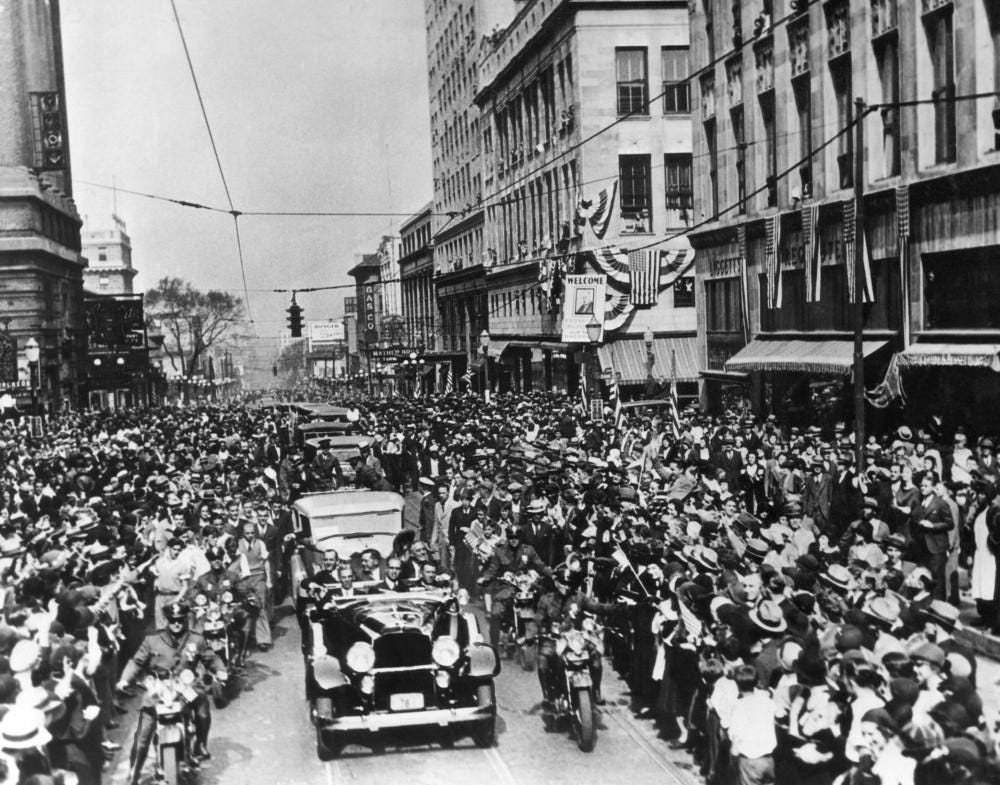
Roosevelt crushed Hoover in the presidential election. Democrats gained 97 seats in the House and 12 in the Senate.
The Republican Party, which had dominated national politics through most of the 1920s, was suddenly on the outside looking in.
But this election had consequences that lasted well beyond Roosevelt’s presidency.
The New Deal permanently expanded the federal government’s role in American life. Social Security, federal banking protections, and other programs emerged from the political transformation.
Democrats would control the House almost continuously for the next 62 years.
That’s what historians call a political realignment. People don’t simply vote against the party in power. Large groups of voters change their loyalties, sometimes for generations.
1932 was one of those elections.
Eisenhower Gets a Message
In 1958, Dwight Eisenhower was president, and the economy was in a recession.
The Soviet Union had launched Sputnik the previous year, raising fears that America was falling behind technologically. There were also concerns about influence-peddling inside the administration.
Republicans paid for it at the polls.
Democrats picked up 13 Senate seats, the largest one-election transfer from one party to another in Senate history.
Those gains eventually helped create the conditions for the civil rights and Great Society legislation of the 1960s.
Eisenhower remained popular personally in many respects, but voters weren’t giving his party a free pass.
It’s a useful reminder that an election can be a rejection of the governing party without necessarily being a rejection of every politician associated with it.
The Watergate Babies
Then came 1974.
Richard Nixon had resigned three months before the midterm elections, following the Watergate scandal.
Gerald Ford was president, but the Republican Party was carrying the baggage of Nixon’s administration. Inflation wasn’t helping.
Democrats gained 48 House seats and four Senate seats.
The newly elected Democrats became known as the Watergate Babies, a generation of lawmakers who arrived in Washington determined to change how Congress operated.
They challenged the seniority system, pushed for greater openness, and helped weaken the power of longtime committee chairmen.
The election also reflected something that would shape American politics for decades: growing public distrust of Washington.
The Revolution Goes Republican
Twenty years later, the political earthquake struck the other party.
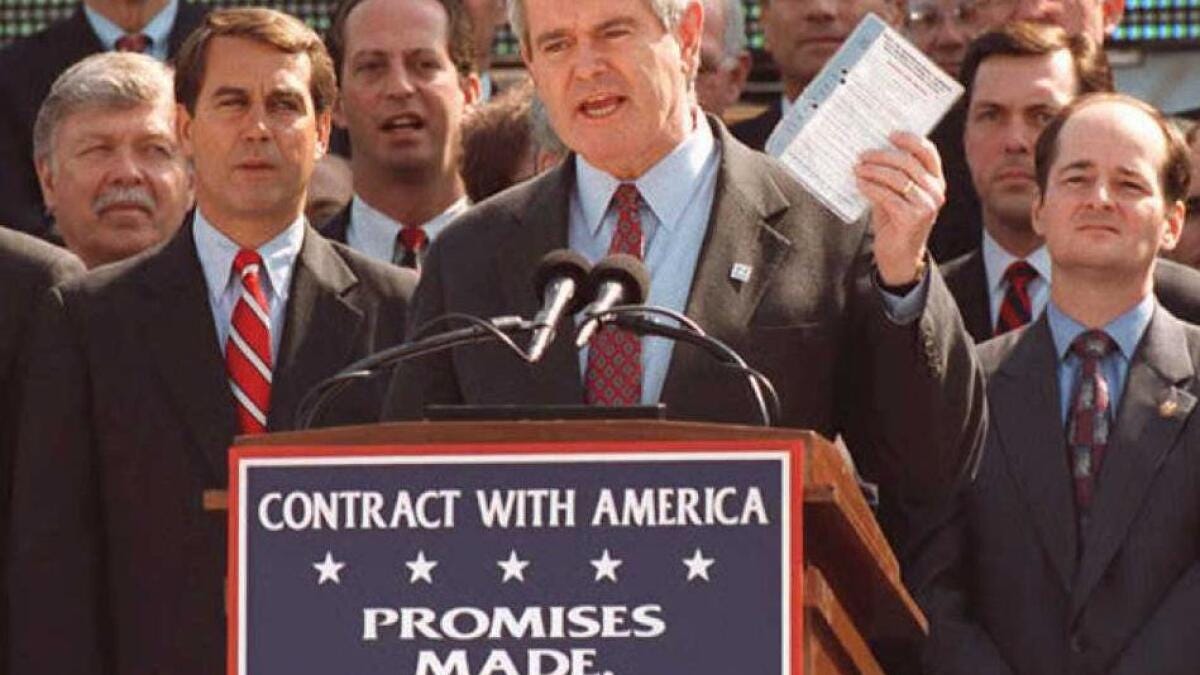
In 1994, Republicans led by Newt Gingrich won control of the House for the first time in 40 years.
They picked up 54 House seats and eight Senate seats.
Bill Clinton had been president for less than two years. His administration had struggled over healthcare reform, taxes, and other issues, and Republicans capitalized on public dissatisfaction.
The election changed Washington almost overnight.
Gingrich became speaker. Republicans pursued their Contract with America. Clinton found himself dealing with a Congress controlled entirely by the opposition.
And then something inconvenient happened to the Republican revolution.
Clinton won reelection in 1996.
The Republicans kept Congress, but the sweeping victory of 1994 hadn’t permanently converted the country to their way of thinking.
In fact, the two parties spent much of the following decades fighting over the same closely divided electorate.
What Happened Tuesday?
That brings us back to 2026.
The Democratic victory certainly qualifies as a wave election. According to Ballotpedia’s historical analysis, the Senate losses alone place this election among the largest swings against a president’s party.
High prices, the war in Iran, and concerns about government corruption helped drive the backlash. Many also wanted Congress to put some limits on Trump’s power.
But the geographic reach of the results is especially striking.
Texas. Kansas. South Carolina. Georgia. States that have been reliable Republican territory for years, and in some cases decades.
Those victories raise a question that can’t be answered just yet.
Did Americans change their minds about the Republican Party, or did they change their minds about the Republicans currently running things?
The first could signal the beginning of a political realignment like 1932. The second might look more like 1974 or 1994, when public frustration produced an enormous electoral swing without permanently settling the country’s political arguments.
And Trump is still president. Democrats will control Congress, but they won’t control the White House.
That means investigations, legislative battles, vetoes, and probably a good deal of political theater over the next two years.
The voters have changed who’s in charge of Congress. They haven’t eliminated the country’s political divisions.
How Long Does a Landslide Last?
Political parties have a remarkable ability to recover from elections that appear to have destroyed them.
Republicans survived 1932. Democrats survived 1994. Republicans survived Watergate. Democrats survived the Republican landslide of 2010, when they lost 63 House seats.
Each time, political commentators wondered whether the defeated party had lost touch with America.
And each time, the country eventually changed its mind again.
That doesn’t mean Tuesday’s election was insignificant.
The voters have delivered a message that will reshape the final two years of Trump’s presidency and influence the political arguments leading into 2028.
What we don’t know is whether we’re witnessing the beginning of another long-term transformation or one more swing of America’s unpredictable political pendulum.
We won’t know that this morning. We may not know it for years.
But I suspect the politicians who went to bed Tuesday expecting business as usual have already learned something about American history.
Voters can be remarkably patient.
Until they aren’t.
What do you think? Was Tuesday’s election a fundamental change in American politics, or a temporary backlash against the party in power? I’d like to hear your thoughts in the comments.
If you enjoyed this piece, please share it. And if you’d like to support independent writing about history, politics, science, and the occasional absurdity of American life, consider becoming a paid subscriber to Archer’s Line.