

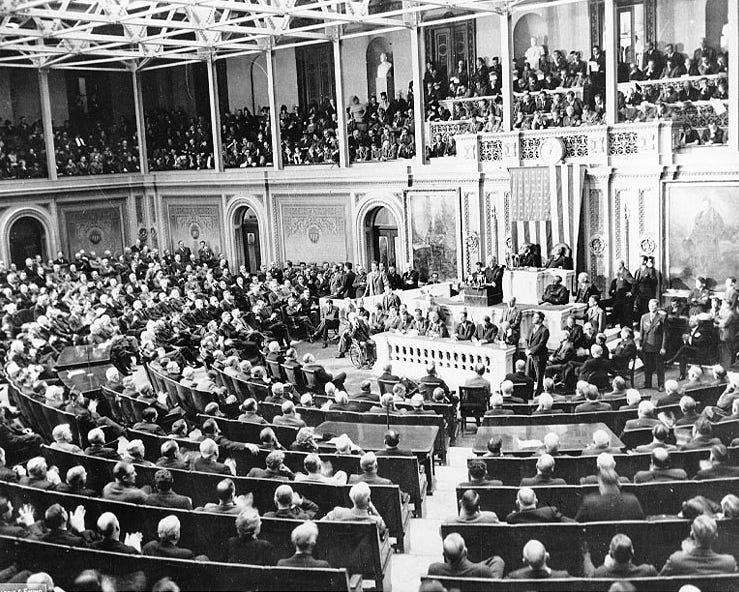
News networks, journalists, and assorted politics junkies will gather to watch the State of the Union address tonight. Though I think there may be fewer politics junkies because, well, they’re quite burned out.
Given President Trump’s recent behavior, I think just about everyone knows what to expect from him. He says it’ll be a long one, because “we have a lot to talk about.” It’s safe to assume that it’ll contain everything he’s been harping on recently. The 2020 election. The Supreme Court. His complaints that he’s not allowed to do whatever he wants without answering to anyone. Greenland. Immigrants. And a collection of conspiracy theories popular on MAGA social media.
But rather than delve into all that — believe me, plenty of other independent journalists will — I thought I’d stick to my second favorite topic, history.
And a brief history of the State of the Union.
The Constitutional Requirement
The State of the Union is a constitutional invention.
Article II, Section 3 of the U.S. Constitution says the president “shall from time to time give to the Congress Information of the State of the Union, and recommend to their Consideration such Measures as he shall judge necessary and expedient.”
That’s it. No requirement that it be annual. No requirement that it be a speech. No requirement that it be televised in prime time with a designated survivor hiding somewhere undisclosed.
The first president to comply was George Washington. In 1790, he delivered the first State of the Union address in person to Congress in New York City. It was formal, brief, and read aloud — more report than rhetoric.
His successor, John Adams, did the same.
Then came Thomas Jefferson, who decided the whole thing felt a little too monarch-like. He thought delivering a speech before Congress resembled the British king addressing Parliament. So in 1801, Jefferson sent a written message instead.
And that became the norm.
For more than a century — from 1801 until 1913 — presidents submitted their State of the Union messages in writing. Clerks read them aloud to Congress.
Wilson Brings Back the Speech
The modern State of the Union begins with Woodrow Wilson.
In 1913, Wilson revived the in-person address. He believed the presidency should be more active and more central in shaping legislation. Speaking directly to Congress — and through them, to the public — was a way to assert that leadership.
From then on, most presidents delivered the message in person.
But it still wasn’t the spectacle we know today. That transformation came with technology.
The Radio Era: FDR and the Fireside Presidency
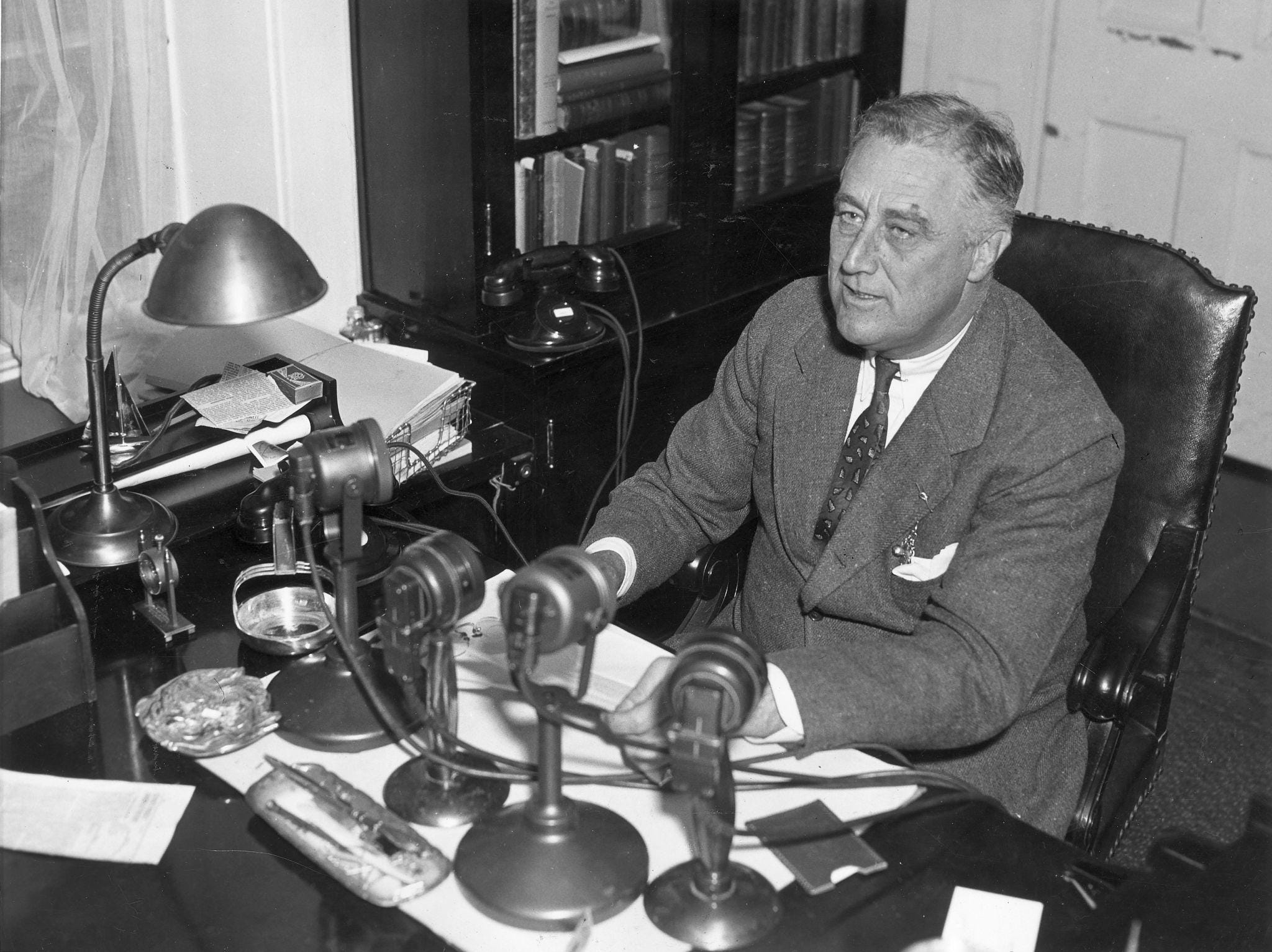
When Franklin D. Roosevelt took office in 1933, radio had become a mass medium. Americans could hear their president in their living rooms.
FDR understood this better than anyone.
His annual messages weren’t just reports to Congress. They were direct conversations with the country. Calm. Measured. Reassuring. At a time of economic collapse and global war, tone mattered.
On January 6, 1941, FDR delivered one of the most consequential State of the Union addresses in history. In it, he outlined the “Four Freedoms”: freedom of speech, freedom of worship, freedom from want, and freedom from fear.
That speech helped frame America’s moral argument as it moved closer to entering World War II.
Television Turns It Into an Event
The first televised State of the Union was delivered by Harry S. Truman in 1947. But there weren’t that many television sets, so not a lot of people saw it.
By the time John F. Kennedy stood before Congress in 1961, the address had become a national broadcast event. Kennedy’s speeches were crisp and forward-looking, reflecting Cold War urgency and a generational shift in leadership.
Then came the Reagan era.
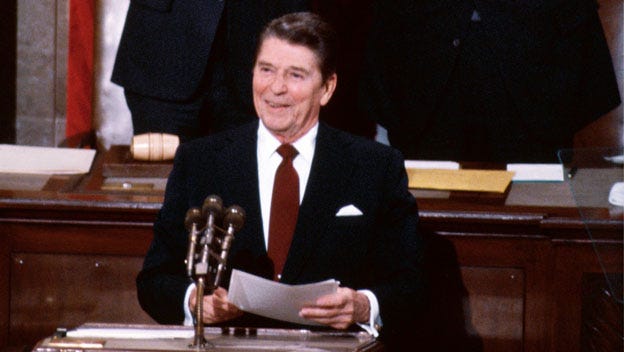
In 1982, Ronald Reagan invited Lenny Skutnik, a government employee who had jumped into the Potomac River to save a woman after an Air Florida crash, to sit in the gallery. Reagan pointed him out during the speech.
Since then, presidents from both parties have filled the gallery with symbolic guests — everyday Americans whose stories reinforce policy themes. It’s effective television. It’s also calculated.
The speech became less of a report and more of a prime-time production.
The Most-Watched Addresses
Viewership has fluctuated over the decades, but some addresses stand out.
Bill Clinton drew massive audiences in the 1990s, particularly during moments of political drama. His 1998 address — delivered amid the Monica Lewinsky scandal — drew roughly 53 million viewers.
George W. Bush delivered the most-watched State of the Union in modern history in 2003, just weeks before the invasion of Iraq. About 62 million Americans tuned in. (There are some conflicting numbers about whether Bush or Clinton achieved “most-watched” status.)
In 2009, Barack Obama addressed Congress early in his presidency during the financial crisis, drawing more than 52 million viewers.
In recent years, audiences have declined — another sign of political fatigue and media fragmentation.
The State of the Union still matters. But it competes with streaming services, social media, and short attention spans.
Length has varied wildly over the years. The shortest State of the Union address was George Washington’s first, in 1790 — just 833 words. The longest was delivered by Bill Clinton in 2000, for an hour and 28 minutes. That record stood until 2025, when Trump gave a speech that went on for an hour and 39 minutes. So when Trump promises another “long one,” we could be looking at a new record.
Memorable Moments
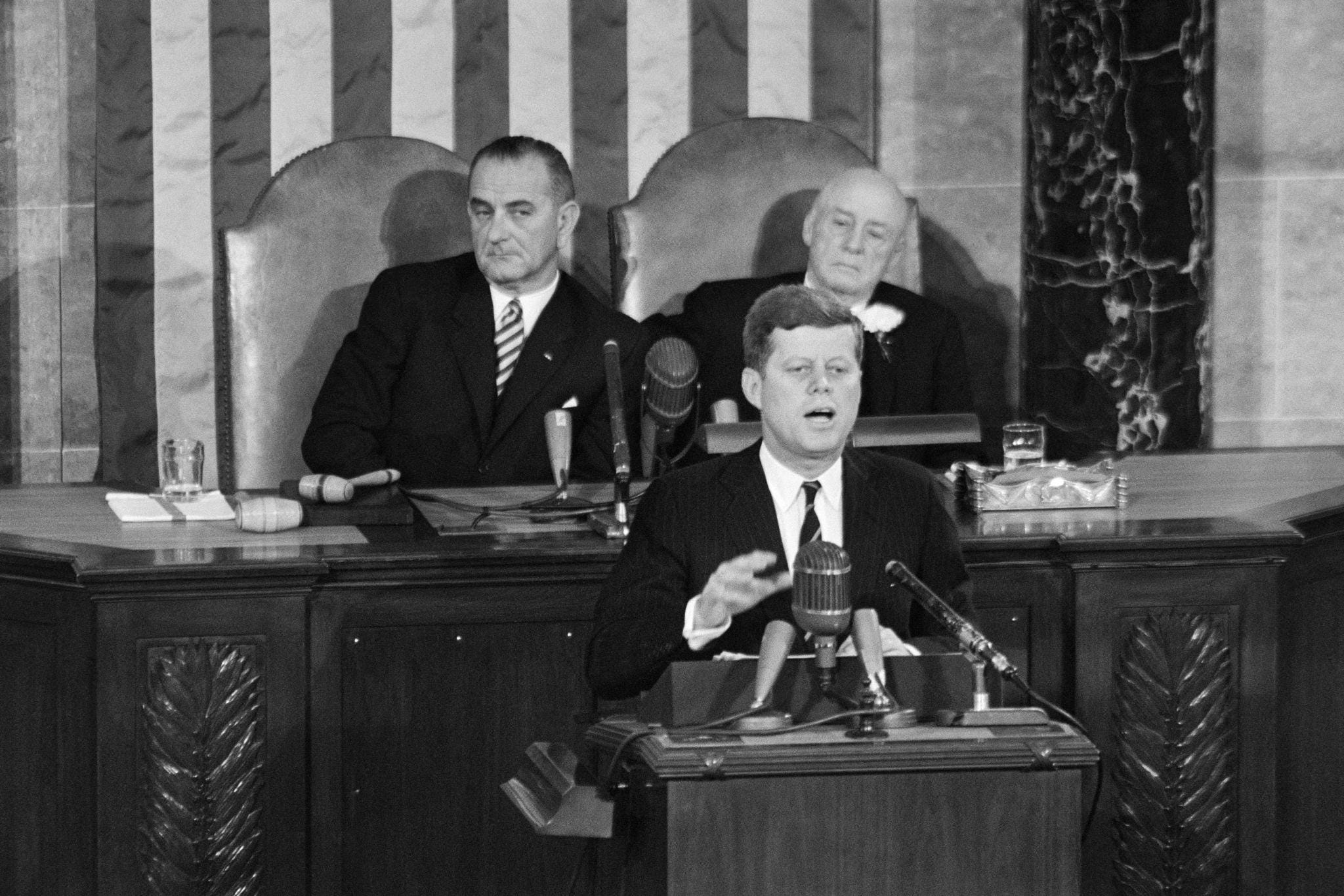
In 1962, Kennedy used his State of the Union to signal an accelerated space program — part of the broader push that would culminate in the Apollo moon landing.
In 2002, George W. Bush labeled Iran, Iraq, and North Korea the “Axis of Evil,” setting the rhetorical tone for the War on Terror.
In 2010, Barack Obama directly criticized the Supreme Court’s Citizens United decision during his speech — with several justices sitting feet away. It was a rare and pointed moment of confrontation.
These speeches are snapshots of the country’s anxieties and ambitions at a given moment. They tell you what presidents want you to fear. And what they want you to believe.
What It Is — and What It Isn’t
At its core, the State of the Union is a report. That’s what the Constitution intended.
But in practice, it has become something closer to a political ritual. A televised assertion of executive power. A messaging strategy aimed not only at Congress but at voters, donors, foreign governments, and history itself.
The founders required “information.” We got spectacle.
Still, there’s something uniquely American about it. A president — even a controversial one — stands before a coequal branch of government and outlines his vision. Lawmakers applaud or sit stone-faced. Sometimes, as has become more common, they shout insults. Cameras capture every eye roll and every standing ovation.
Tonight’s address will likely generate headlines, outrage, applause, and fact-checks.
But two hundred thirty-plus years ago, it was just ink on paper. From time to time. That’s all it’s required to be.
What do you think? Let me know in the comments below. And check out the Disciples of Democracy podcast.
I'm unconvinced this State of the Union address will matter. I'd also very much like to travel back about 100 years and live out my life in that world. Any news on time travel recently?
Thank you Rob.