

What’s holy?
Man on the Moon?
Hell yes.
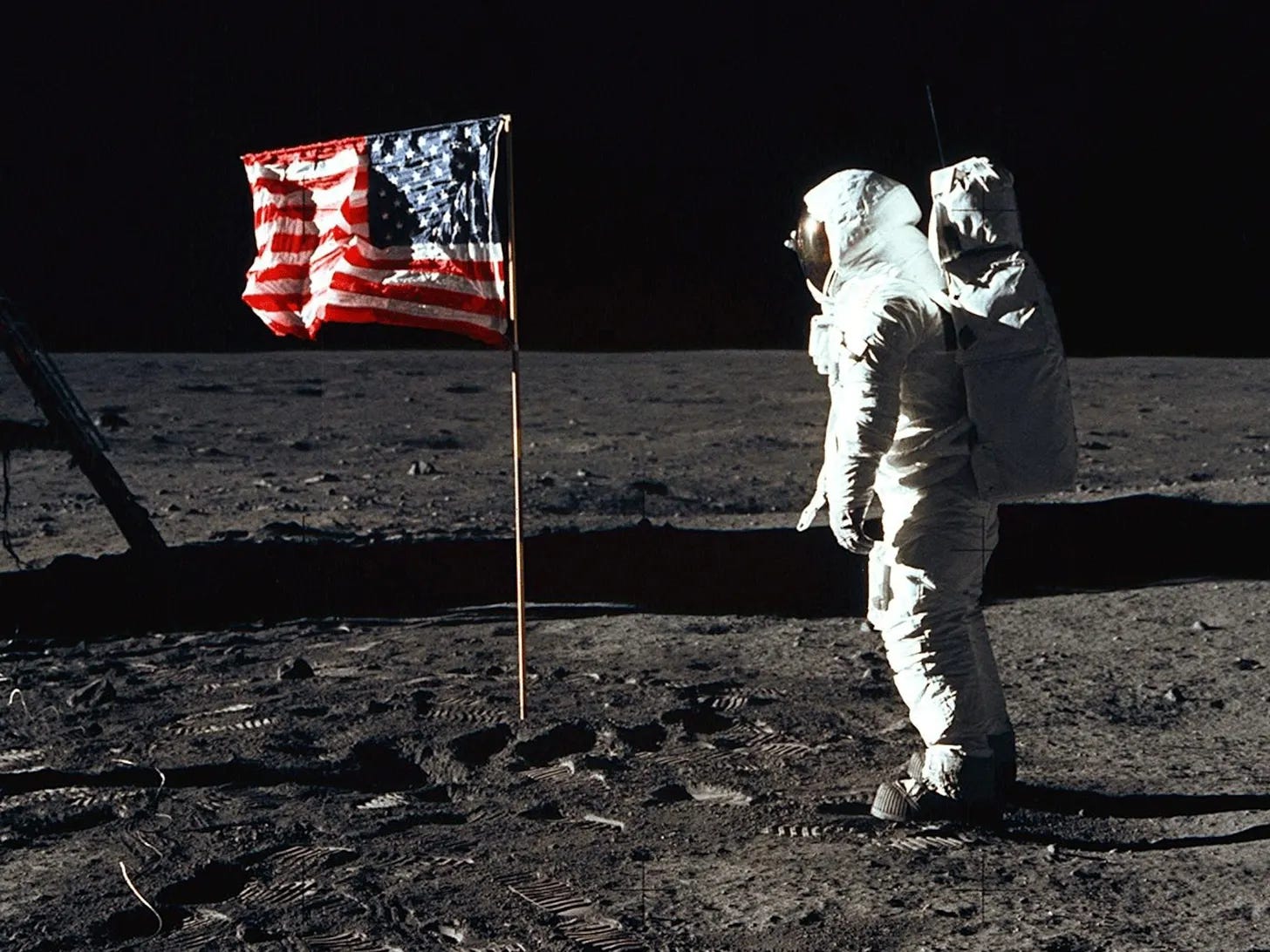
America landed a man on the Moon and returned him safely to Earth. I think that’s holy.
And we did it within the decade some crazy president said we should. In answer to his challenge, we produced the scientists, engineers, mathematicians, mechanics, technicians, trainers, designers, and astronauts who somehow pulled it off.
We were something.
That crazy president with his crazy ideas? Some guy blew half his head off. That guy had been trained by the U.S. military, the same institution that gave us most of our first astronauts.
Landing a man on the Moon and getting him home was a good thing. A sacred thing. But it wasn’t entirely an American achievement.
We had help from some Nazi war criminals we “captured” and brought to America because we had to grab as many of them as we could before the Soviets got theirs. Both sides understood what the next game was going to be after World War II.
Those German rocket scientists who found new lives in America and the Soviet Union had built weapons for Adolf Hitler. Their V-2 program depended on slave labor under hellish conditions. Thousands died making the rockets. Others died when the rockets fell on England and continental Europe.
Then those same men helped the United States and the Soviet Union develop rockets capable of carrying nuclear warheads and spy satellites.
And eventually, they helped get us into space. That gives the whole thing some uncomfortable nuance.
But back to the Moon.
Man, that’s something I love America for. For all our faults and all our troubles, I love America for Apollo. I love that we pushed out into the great unknown and actually pulled it off.
The fact that some of the road there ran through Nazi Germany darkens it for me.
When I was a wide-eyed, pale kid with breathing problems, I wrote a letter to astronaut Alan B. Shepard, the first American to travel into space. Well, if you define “into space” as a tiny suborbital hop off the coast of Florida before splashing into the ocean.
Then Shepard was grounded because of problems with his inner ear.
Being a famous astronaut apparently had its advantages. He eventually got the medical treatment he needed, returned to flight status, and years later walked on the Moon.
And somewhere along the way, he took the time to write back to a kid. He sent me a letter and a signed photograph. I loved them. I have no idea what happened to them. They’re lost somewhere back there.
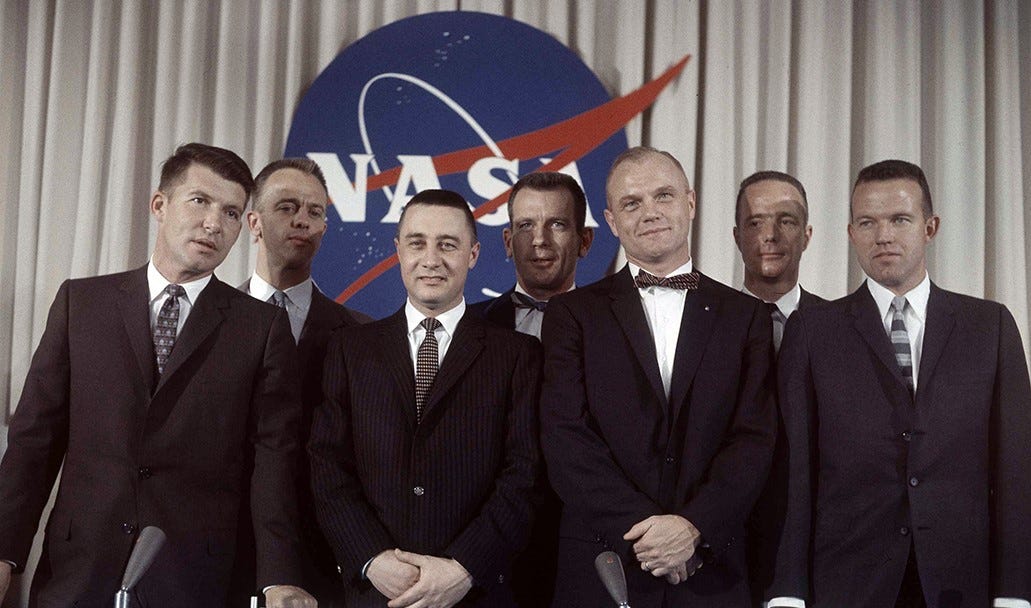
But look at the Americans who got to go into space in those first years. Look at the men who went to the Moon. You’ll notice something. They were white. They were men. Non-Caucasians and non-males need not apply.
The Soviets, on the other hand, sent Valentina Tereshkova into orbit in 1963, the first woman in space.
The Soviet program was hardly a model of openness or safety. The secrecy surrounding its failures helped create legends that persist today, including the suspicion that Yuri Gagarin may not have been the first human launched into space, merely the first one who came home alive.
The Moon landings were described as an accomplishment “for all mankind,” back when “man” was the default term for the entire human race.
But still, an accomplishment. Human beings walked on the Moon.
They did it with computers that would be humiliated by the cheapest smartphone in your pocket. They landed in a lunar module with skin so thin you could kick a hole in it with your boot.
We did a holy thing. But the holy was mixed with the profane.
After World War II, we brought Wernher von Braun and other German rocket specialists to America and did something America has always been remarkably good at doing when necessary: we cleaned up the story.
Von Braun emerged as a celebrity scientist, a genial prophet of the Space Age explaining rockets on television next to Walt Disney.
The mythology suggested that men like him had simply been forced to work for Hitler. But that’s not really the way it happened.
Von Braun and his colleagues built weapons for Hitler. They improved those weapons. They benefited from a system in which slave laborers were worked to death producing them.
There’s an old joke about von Braun: “I aim for the stars, but sometimes I hit London.”
And make no mistake about why the United States wanted those German rocket experts. It wasn’t aiming for the stars.
We wanted missiles. We wanted rockets that could carry nuclear warheads across continents so American pilots wouldn’t have to fly bombers through Soviet air defenses.
The Soviets wanted exactly the same thing. Both sides believed the other represented a mortal threat. They felt forced to play that game. The Space Program was just a by-product.
We used the promise of spaceflight to sell the nuclear missile program. Why do you think they spent so much time showing us retro-futuristic homes on the Moon, space stations, sultry maidens awaiting us when we landed on Titan? They wanted us to be excited.
American taxpayers would pony up the dough because getting out into space and beating the Commies to the Moon was sexy. We pretended that’s all the rockets were for.
So, how do I reconcile my awe at the Moon landing — my memory of being a boy allowed to stay up late to watch it happen on television — with the knowledge that part of the road to Apollo passed through men tied to one of the most murderous governments in human history?
I can’t. I don’t know what to tell you.
I’ve been to Auschwitz. I’ve stood in the gas chamber, a dark, evil, oppressive place, where, if you’re quiet and still for a minute, you can still hear the screams and smell the smell of death.
That’s history. Ugly history.
So okay. Parts of the space program are holy. I take nothing away from the pioneers who went to the Moon, the ones who were first in orbit, willing to fly in dangerous machines that killed some of them. I take nothing away from the people in the back rooms who did the math, designed the machines, and laid out the programs, although some of them got their due too late because they were the wrong color or gender.
What else is holy to me? America in World War II. We were on the right side.
I think of the men who went ashore at Normandy, climbing out of landing craft into gunfire because somebody had to do it. They knew exactly what might happen to them. They went anyway. Because it was their job.
Dwight Eisenhower belongs on my list, too.
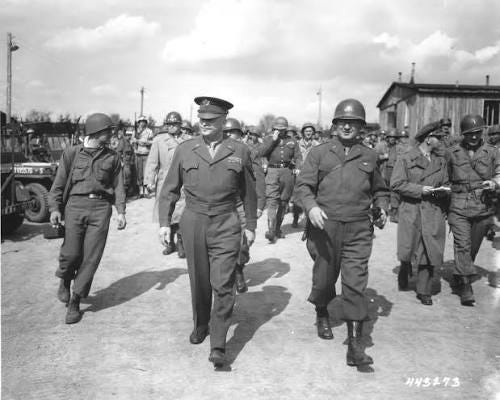
When Allied troops liberated the concentration camps, Eisenhower understood immediately that people would someday try to deny what had happened. So he made people look. He ordered photographs. He brought journalists through. He made local Germans confront the bodies and, in some places, help bury them.
I love Eisenhower for making them look.
What else? Abraham Lincoln. Maybe the closest thing America has produced to a secular saint. There’s an aura around him that even history’s endless appetite for tearing down heroes has never managed to destroy. If anybody deserves hagiography, Lincoln probably comes close.
What else is sacred? Aaron Copland’s music.
Especially that great open American sound he developed — music that somehow feels like enormous skies and impossible distances. His “Fanfare for the Common Man” was written during World War II, inspired by the struggle against fascism and by the idea that ordinary people mattered.
And much of Copland’s music evokes the mythology of the American West: open land, possibility, people moving toward a new life.
Uh oh. Trouble there. The settlers were taking the land from people who lived there before we arrived. But that’s not Copland’s fault. Is it?
Is there anything unsullied? Anything completely holy? Anything human beings have touched that doesn’t have blood somewhere in its family tree?
I don’t know. We’re a country made out of human beings, after all.
Humanity produced Bach and Mozart. Humanity also produced death camps and biological weapons.
Maybe all a country can hope for — maybe all any individual human being can hope for — is to try, with all our frail might, to do more good than evil.
Good night. Good night to the sacred, with its inevitable trace of the profane. Good night, Abraham. Good night, Dwight. Good night, Aaron.
Good night, country that landed a man on the Moon. Wherever you are.
If you value pieces like this — history, memory, culture, and the uncomfortable places where they overlap — please consider becoming a paid subscriber to Archer’s Line.
Paid subscriptions help support the time it takes to research and write this work, especially while I’m getting settled after the move to Atlanta.
If you’re already a paid subscriber, thank you. You’re helping make this possible.
Highly recommend “For All Mankind” on Apple TV, if you’re not already watching it.