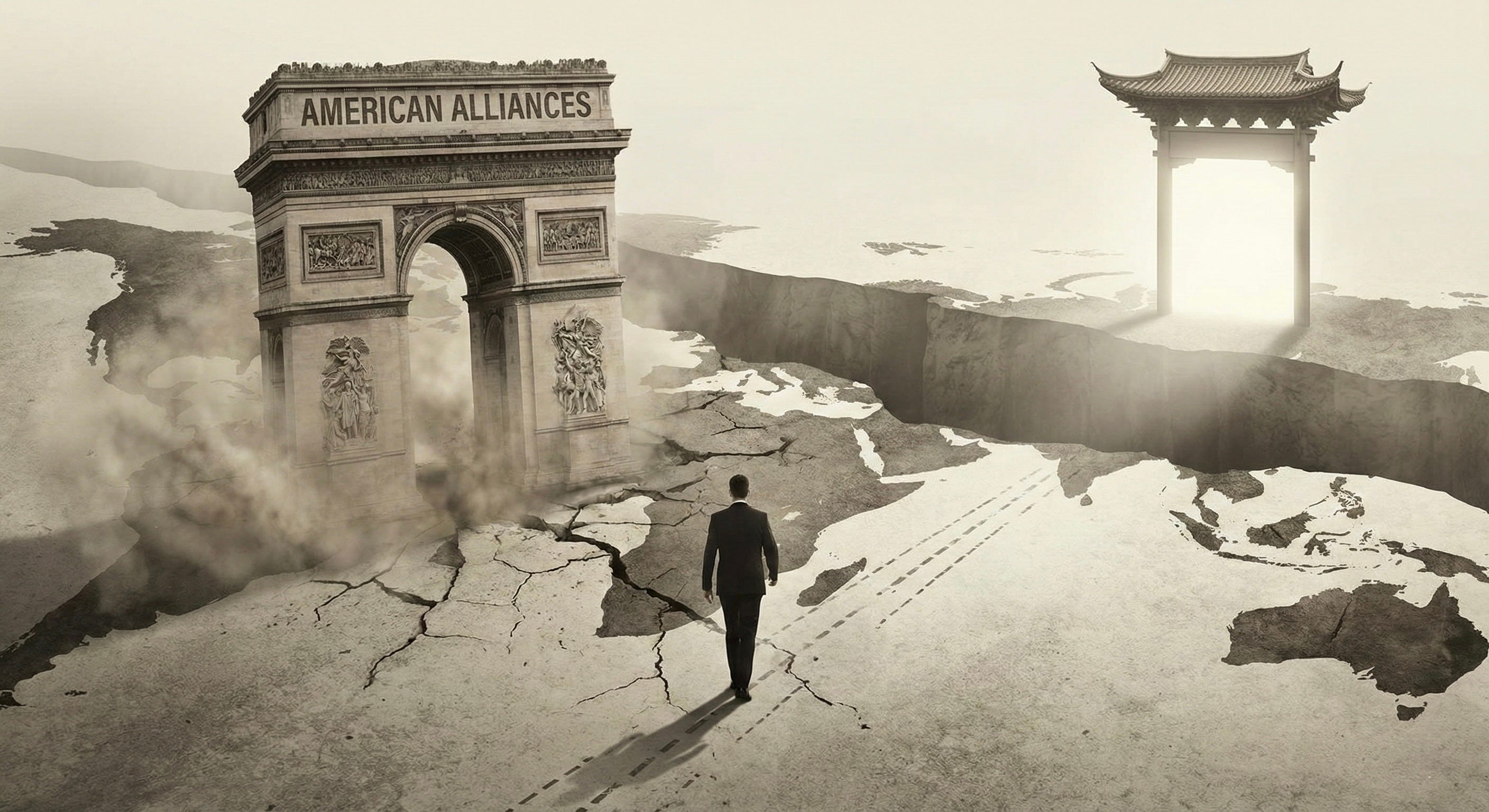
The Global Realignment Is Already Underway
Trump has pushed America’s allies away — and the world is reorganizing without us
President Trump is making history. He has done what no rival power managed to do — push America’s allies away. The result is the largest global realignment in a generation, with partners turning toward China, forming new alliances without us, and treating the US as unreliable.
Canada is the clearest signal. Ottawa has begun openly rebalancing its economic future away from Washington and toward Beijing. Prime Minister Mark Carney’s recent visit to China wasn’t symbolic. It produced concrete changes: reduced tariffs on Chinese electric vehicles, renewed access for Canadian agricultural exports, and a broader partnership designed to limit Canada’s exposure to U.S. instability.
That is not how allies behave when they trust American leadership. It’s how they hedge against it.
Europe is doing the same — more quietly, but no less deliberately. Trump’s threats over Greenland and tariffs against NATO countries crossed a line that even recent transatlantic tensions hadn’t touched. European leaders didn’t respond with deference or diplomacy-by-delay. They responded with coordination. NATO countries sent personnel to Greenland not to deter Russia, but to signal something far more alarming: Europe will defend allied territory even when the pressure comes from Washington.
That should stop you cold.
For decades, the foundation of NATO wasn’t just Article Five on paper. It was the assumption that the United States would never use economic coercion or territorial threats against its own allies. That assumption is now gone. Once it disappears, the alliance doesn’t collapse overnight — it adapts. And adaptation means Europe planning for a future where American guarantees are conditional, transactional, and reversible.
China is watching this unfold and adjusting accordingly. Its rapid transition to electric vehicles is already reshaping global energy markets. As China buys less oil — including from Venezuela — the leverage Washington thought it had through sanctions and supply control weakens. Beijing is building an economy less dependent on American pressure points, while America burns through the trust that once made those pressure points effective.
Meanwhile, the administration’s strategic focus has drifted in ways allies can’t ignore. The U.S. dithers on Ukraine while Vladimir Putin continues to dismantle the country piece by piece. Security assistance slows. Commitments are questioned. Treaty obligations are treated as bargaining chips. At the same time, Washington launches aggressive actions elsewhere — including Venezuela — that look less like a coherent strategy and more like impulse.
From Europe’s perspective, the message is simple: the United States is unpredictable, distracted, and willing to trade long-term stability for short-term spectacle.
Even America’s own hemisphere isn’t immune. Threats against Mexico, Canada, Colombia, and Cuba — delivered publicly and often casually — have pushed regional leaders to seek alternatives. China, the Gulf states, and regional blocs are stepping into the space the U.S. once occupied almost by default.
This is how influence erodes. Not with a bang, but with a whisper — with allies quietly planning around you.
Trump didn’t need to lose a war or suffer an economic collapse to make this happen. He did it with words, tariffs, threats, doubt, and impulse. He turned American power from something stabilizing into something risky — something to insure against.
That is the real historical achievement here.
America didn’t retreat from the world. It was edged out by its own behavior.
This is what decline actually looks like.


