

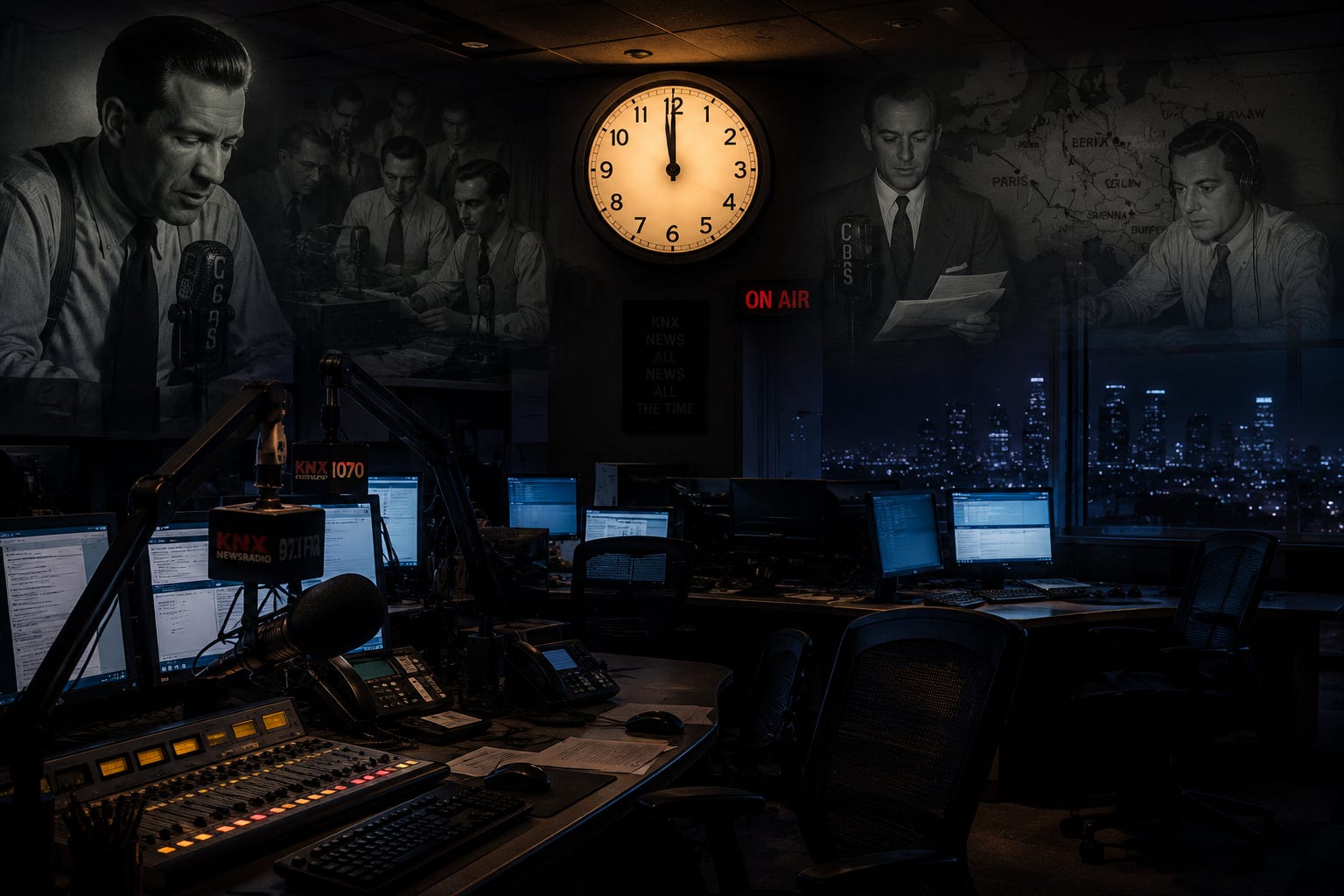
CBS Radio News is dying in less than two weeks.
For most people, that won’t mean much. Another media brand disappears. Another corporate restructuring. Another quiet ending in an industry that has spent the past 20 years dismantling itself piece by piece, pushing experienced professionals out along the way.
But for me, and for a lot of radio journalists, this one feels different. It feels more like we’re drawing closer to a dimming campfire as the night settles all around, and we can see that the fire is dying, and soon we’ll all be in the dark.
For 10 years at KNX in Los Angeles, the sound of CBS Radio News was part of the rhythm of my life. Every hour, the familiar chime and news sting rolled through the newsroom.
That chime was a reset. A turn of the clock. A new beginning. Another chance to tell people what was happening in the world.
Long before podcasts, long before cable panels, long before social media turned everyone into a broadcaster, CBS Radio News was helping invent modern electronic journalism in one of the darkest moments of the twentieth century.
Its defining broadcast — World News Roundup — was born in 1938 after Nazi Germany annexed Austria. As Europe slid into barbarism and chaos, CBS stitched together reporters across multiple countries in real time. That was revolutionary then. Radio networks usually centralized everything in New York. But this was different — eyewitness journalism crossing borders as authoritarianism spread across Europe.
Fascism was rising in real time. And CBS understood the stakes.
Then came Edward R. Murrow.
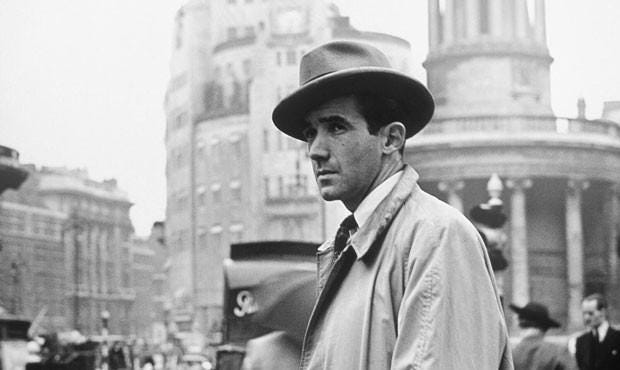
Murrow wasn’t loud. He wasn’t theatrical. He didn’t turn journalism into performance art. What made him powerful was his moral clarity.
From London rooftops during the Blitz, Murrow described bombs falling on civilians while much of America, climbing out of the Great Depression, hoped the horror in Europe could somehow be ignored. His reports made authoritarianism feel real and immediate to American listeners sitting safely thousands of miles away.
And later, when Senator Joseph McCarthy used fear, intimidation, and accusation to poison American politics, Murrow confronted him directly. And he did it because it was necessary.
That was the original DNA of CBS News.
The mission was simple: tell the public the truth, especially when powerful people don’t want you to.
Which brings us to now.
The modern media environment feels very different. Some news organizations still do fearless reporting. Great journalists still exist. But many corporate outlets feel cautious, fragile, and nervous. Billionaire ownership. Political pressure. Fear of lawsuits. Fear of losing access. Fear of government retaliation. Fear of audience backlash.
Mountains of corporate money are at stake now. Mergers. Licenses. Regulatory approvals. Billion-dollar valuations tied to political goodwill. In that environment, moral clarity and First Amendment principles start looking like liabilities.
And too often, the result is paralysis disguised as balance. But the reality is — and may all the gods forgive me for saying it — isn’t so much concern about balance as it is covering corporate asses.
You can feel it in the language. The hesitation. The refusal to plainly describe anti-democratic behavior for what it is.
That’s part of what makes the death of CBS Radio News feel strangely symbolic.
This network was born warning Americans about fascism. And it’s ending in an era when much of the press seems terrified of doing exactly that.
I keep thinking about those hourly chimes and the 60-minute reset.
Some hours brought earthquakes. Wildfires. Shootings. Elections. Presidential speeches. Wars.
Some hours brought nothing at all.
But the sound remained constant, steady, and reliable. Like the breathing of some great organism, coiled and poised and ready to warn us of danger.
Connected to generations of broadcasters stretching all the way back to Murrow and those first frightened reports from Europe.
Soon, that sound disappears.
And maybe that’s what bothers me most. The feeling that something larger is fading with it.
A belief that journalism is supposed to confront power instead of orbiting around it. A belief that telling uncomfortable truths is part of the job. A belief that democracy requires a press willing to say plainly what it sees.
The chime was never just a sound effect. It was a reminder of what broadcast journalism once believed was its purpose.
What do you think? Is the death of CBS Radio News just the beginning? Leave a comment below.
BY THE WAY, if you were a fan of KNX In Depth, good news: I’m reuniting with my cohost Charles Feldman for a new podcast, Archer & Feldman. The first episode drops Tuesday morning at 9 Eastern / 6 Pacific on YouTube. And yes, we’ll be talking about the death of CBS Radio News. Please join us!
I used to think CBS was truly the Black rock, the perfect foundation of true news and journalism – objectivity, objectivity, objectivity, and doing what you have to do to get the story – that is ethical. Attribution attribution attribution. Those things are dead. Not putting down all journalists or reporters —
they really try, but because they have to go live five times a day and they have to keep up with ratings they often don’t have more than one attribution.
It’s sad to see the cookie crumble or the black rock disintegrate.
And not just CBS, ABC, and CNN.
I am afraid it may be just the beginning, but journalists like you--and others who are willing to confront power--are my hope. I did my protesting starting back in the 70's so reading your stories and those of others similar to you is the way I can continue to confront power. Not as much fun as I sometimes had but it's what I can do.
Thank you Rob.