

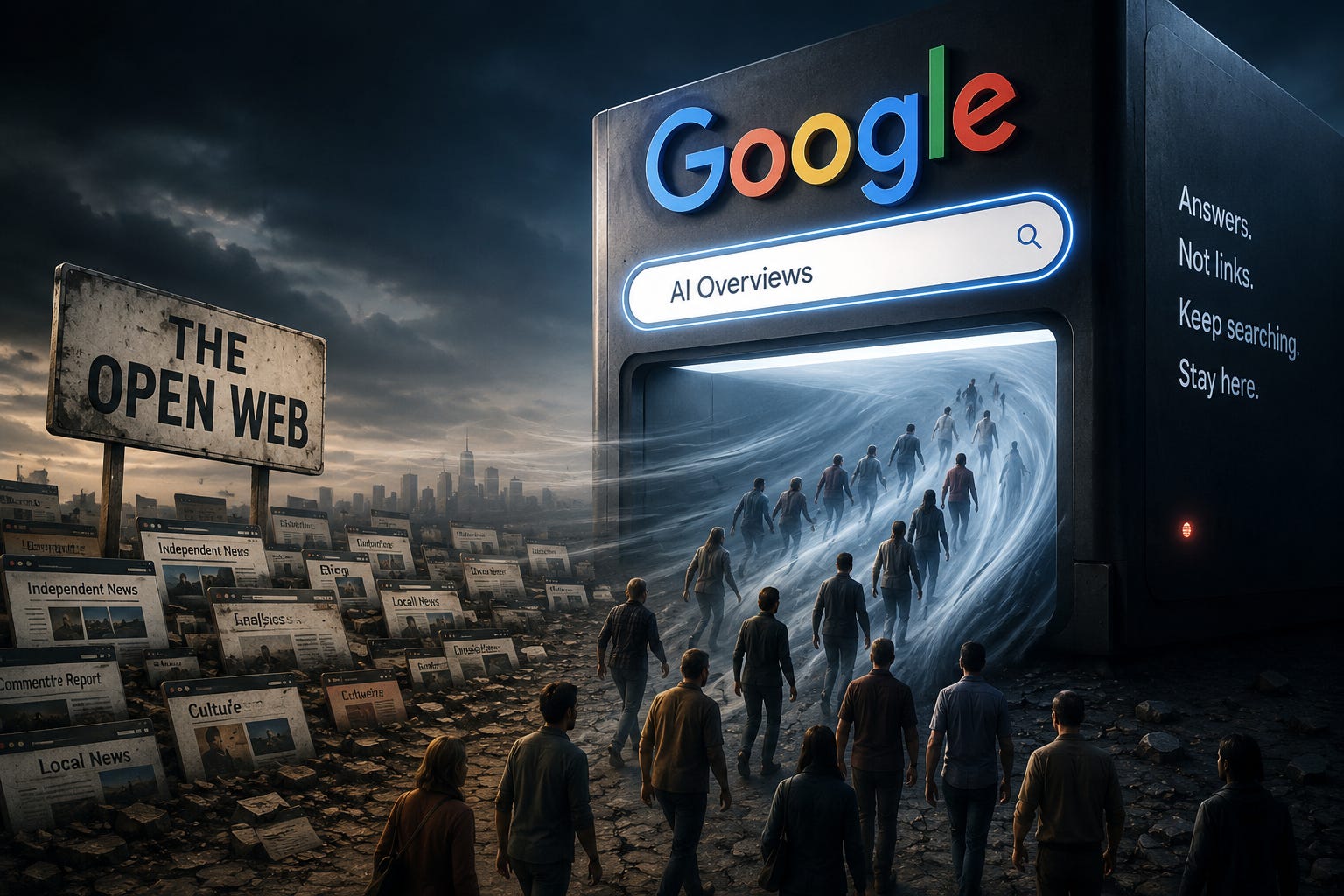
There’s a phrase quietly spreading through the media business right now that would have sounded insane just a few years ago:
“Google Zero.”
As in: prepare for a future where Google sends you no traffic at all.
At Google I/O this week, Google made it clear where search is headed. And if you publish online for a living — whether you’re The New York Times, a local newspaper, a Substack writer like me, or some guy yelling into the void from a home office in Burbank — you should pay attention.
Because Google is changing what “search” even means.
For most of the modern internet, Google acted like a giant traffic cop. You searched for something, Google pointed you toward websites, and the websites got the audience.
That arrangement built huge parts of the modern web.
Journalism, blogs, and independent media depended on it. Entire businesses were built around those famous “ten blue links.”
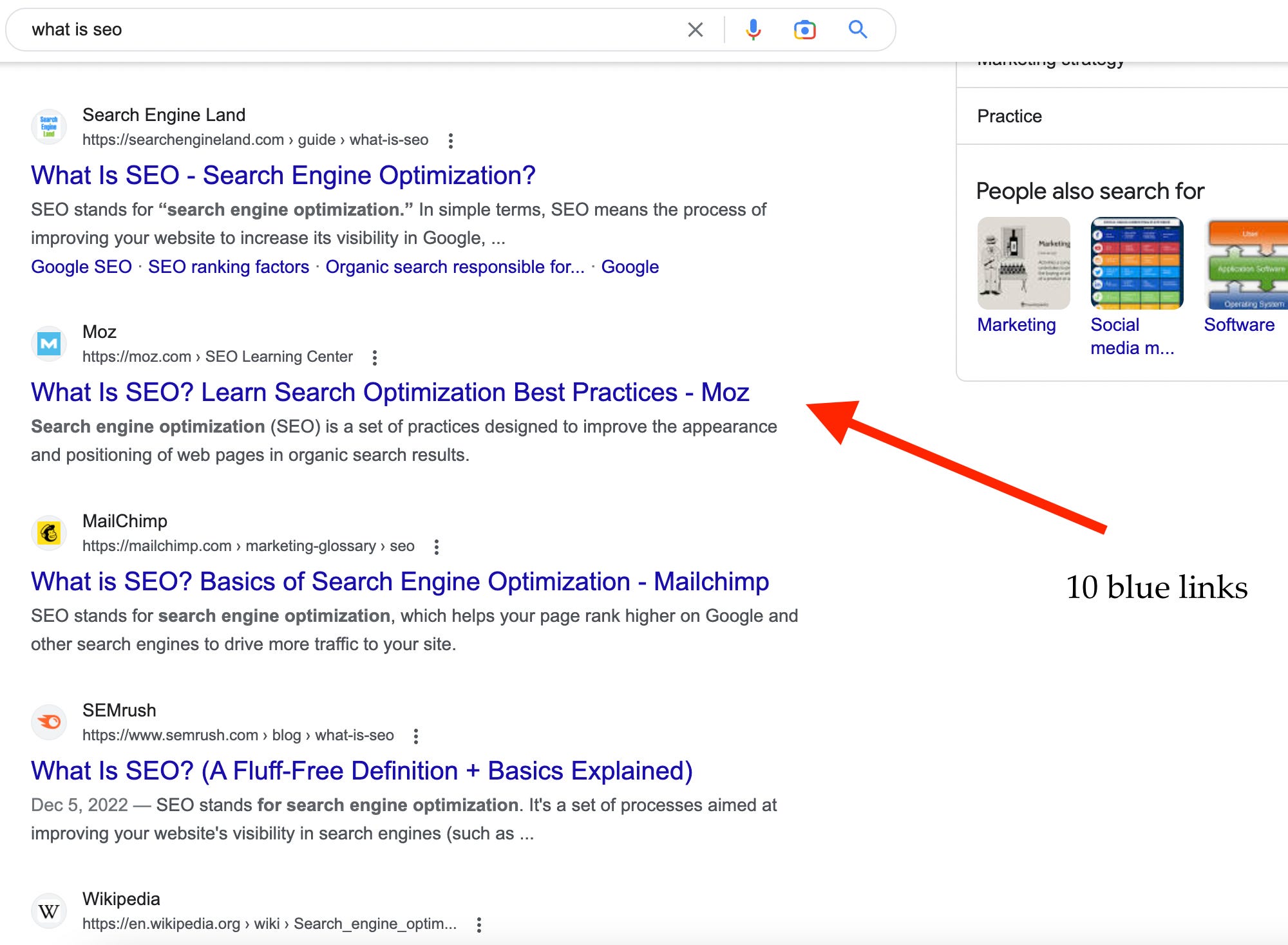
Now Google wants to skip that middle step entirely. They’re calling the era of the ten blue links over.
Instead of helping you find answers, Google wants to own the answer.
The company’s new AI-driven search tools move everything closer to a chatbot experience. You ask a question. Google summarizes the internet for you. Maybe you get a couple of tiny source links somewhere underneath. Maybe you don’t bother clicking them.
And that’s the problem.
The old version of search sent people outward. The new version keeps them inside Google.
If you run a publication, that should terrify you.
Publishers have already been watching search traffic decline since Google rolled out AI Overviews. Some sites have reportedly seen catastrophic drops in referrals. Whole categories of publishing are getting hollowed out.
A lot of those businesses were built on a simple equation:
Search traffic equals advertising revenue.
Take away the traffic, and the whole thing starts collapsing.
What’s happening now feels like watching the ecosystem of the open web slowly being enclosed inside a machine that no longer needs the people who created the information in the first place.
AI systems don’t create knowledge out of thin air. They absorb, summarize, remix, and repackage human work. Everybody feeds the machine.
But more and more, the machine may not send the audience back.
That changes the economics of everything.
And honestly? Google may not even see this as malicious. From their perspective, this is just the next evolution of search. But there’s collateral damage here.
A huge amount of the modern internet was built on discoverability. You could start a blog, write something smart, and eventually Google might surface it to readers all over the world.
That possibility created independent media.
Without discovery, power consolidates.
The biggest brands become even bigger because AI systems tend to favor sources they already consider authoritative and “safe.” Smaller publishers risk becoming invisible unless readers intentionally seek them out.
Which may explain why so many smart publishers are suddenly obsessed with subscriptions, newsletters, podcasts, memberships, and direct audience relationships.
(You know. Like when I ask you to become a paid subscriber.)
Last week, Condé Nast CEO Roger Lynch said he told his teams to operate as if search traffic could eventually disappear entirely. One of the world’s biggest publishing companies is preparing for a future where Google effectively stops mattering as a traffic source.
That would have sounded absurd 10 years ago.
Oddly enough, there may also be an opportunity hidden inside all this. Because while AI may commoditize information, it still struggles with identity.
People don’t just want information anymore. They want interpretation. Perspective. Trust. Voice.
That’s part of why Substack exploded in the first place. People subscribe to people. Not “content.” Not “verticals.” Not “brands.”
They subscribe to writers whose worldview they understand. People they feel they know. People whose judgment they trust to sort through chaos.
That’s much harder for AI to replicate.
You can summarize facts. You can mimic tone. You can remix patterns. But genuine perspective is harder.
And maybe that becomes the new scarcity.
Maybe the future of publishing belongs less to giant interchangeable content factories and more to recognizable human voices that people seek out.
Because the real shift happening right now may be this: For 20 years, people searched for topics. Increasingly, they may search for people.
This is revelatory, and I will intentionally seek out the individual links. The sad fact is that we tend to want someone (or something) to do our work for us, to make it easier. I had been distressed when the AI summary began topping my search, but I admit there were only some times when I wanted a deeper dive and scrolled down. I thought about the possible manipulation of information, but I honestly never thought about the economical and existential harm for publishers. And I do subscribe to meaningful sources like yourself, Rob.
If trying to search gets me AI I will just stop trying to search. I purposely look down the page I get from Google now because I won't even use AI to define a word or phrase I'm looking up. I avoid using it ALWAYS. I do that because I want to recognize the person or group behind the information I'm reading. I no longer work so it doesn't serve me in that capacity. If I want to talk through something I choose humans. I don't envision these things changing but I guess I will need to wait to see how all of this plays out.
Thank you Rob. You I will always be certain I know how to find.