


I have struggled with an anxiety disorder for most of my life.
But I didn’t know that until about ten years ago.
When the psychiatrist explained it to me, suddenly my whole childhood made sense.
Being “high-strung.” Frustration leading to angry outbursts. Difficulty being around new people. Constantly berating myself for small errors. Hypervigilant about what other people think of me. Catastrophizing anything that went wrong. Deathly afraid of “messing up.” Self-sabotage. You name it, it’s all in there.
So you’d think radio would have been the last thing I’d wind up doing.
But look at me now.
I can’t say performing on the air while having an anxiety disorder has been easy, but as I said up top, I didn’t know I had one for a long time.
But finally finding the right doctor, the right medication, and the right doses (after years of trial and error), and knowing just what the hell this thing was that’s been in my brain this whole time, has helped me cope.
I learned some other ways to cope, too. Using humor to hide my intimidation. Sometimes giving in to my anxiety on the air to make a “bit” out of it. It helped me perfect my persona as a music DJ.
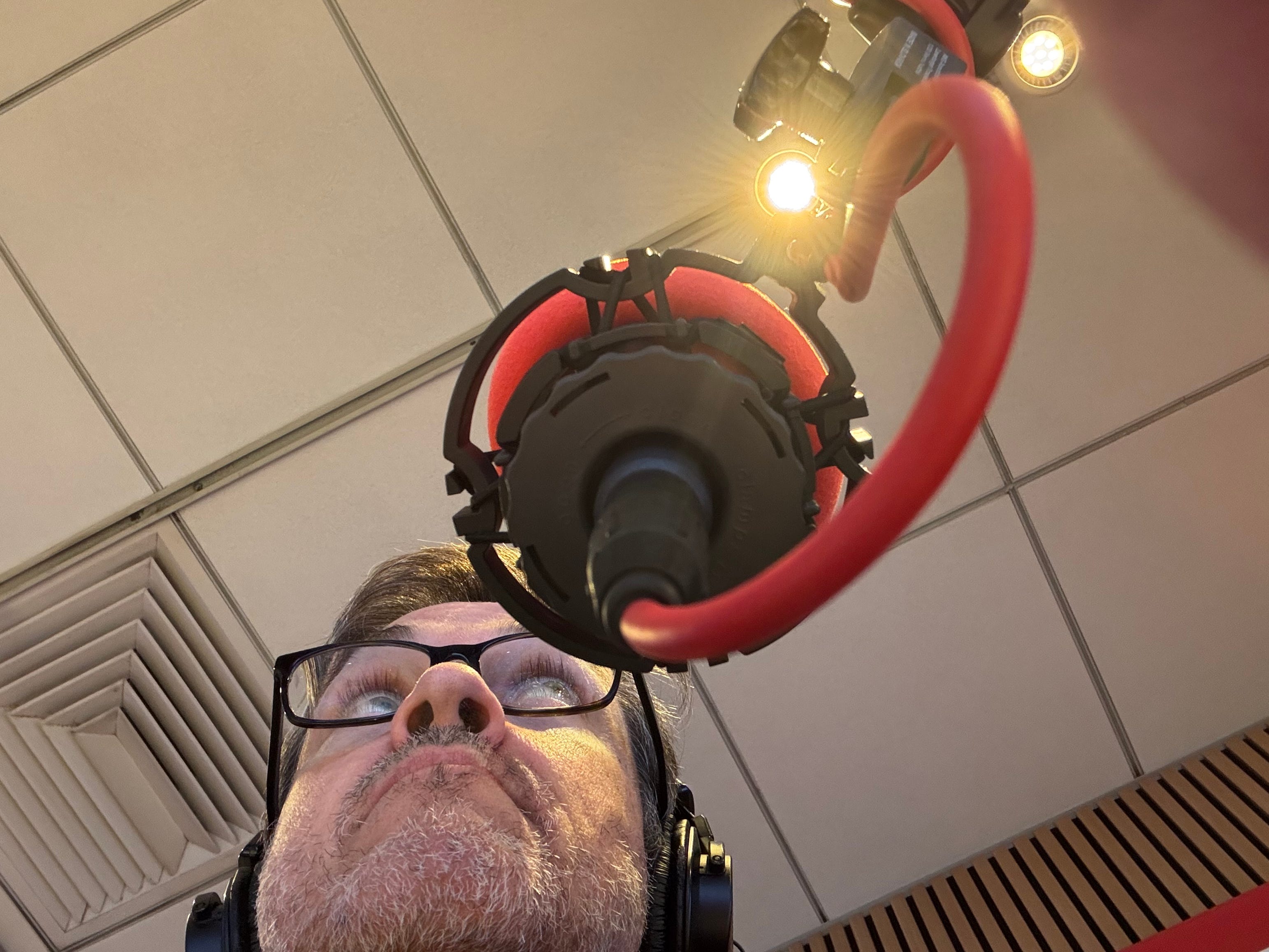
In a weird way, radio was actually a good place for me to be. I had greater control over how I presented myself — no one could see me. No one could see what an ugly dork I was. I learned to hide behind the microphone.
And strangely, I never had stage fright. In fact, I found it a lot easier to stand up on a stage and address hundreds of people than it would be to have a one-on-one conversation with someone.
I even did sketch comedy for a bit. And I’ve long suspected that anxiety has fueled an awful lot of successful comedians.
There may be something to that.
A 2024 study of stand-up comedians found elevated anxiety symptoms, although some of the differences disappeared after researchers adjusted for other factors. Other studies have found higher levels of psychological distress among professional musicians and actors.
That doesn’t prove anxiety makes people more creative or funny. Or that people with anxiety deliberately seek careers in entertainment.
But it raises the question.
Could the very traits that make ordinary social interactions difficult actually make certain professions appealing?
Consider radio.
I could talk to thousands of people without seeing a single face. I controlled the conversation. I decided when to speak, what to say, and how to present myself. I could hide my insecurities behind a carefully constructed personality.
(Other than having to read liner cards, that is.)
And if I said something stupid, I could usually pretend I meant to.
Try doing that at a dinner party.
The company I keep
According to the CDC, about 19% of American adults reported in 2024 that they’d been diagnosed with an anxiety disorder at some point in their lives.
The National Institute of Mental Health estimates that about 31% of adults experience an anxiety disorder during their lifetime, based on an older national survey.
There’s little doubt that many people spend years living with anxiety without understanding what they’re experiencing.
I was one of them.
And I wonder how many others have unknowingly built careers around their anxieties.
Comedians who transform their insecurities into jokes. Actors who feel more comfortable pretending to be somebody else. Writers who can express themselves beautifully on paper but struggle to make conversation at a party.
And broadcasters who are more comfortable talking into a microphone than talking to one person.
We don't really know whether people with anxiety are drawn to these professions. But studies suggest that anxiety and other mental health struggles are common among people who perform for a living.
Which makes me wonder how many of us found refuge in careers that, to outsiders, would seem like terrible choices for anxious people.
When everything goes wrong
Broadcasting is also a profession where your mistakes are public.
I’ve spent an unreasonable amount of my life replaying errors that nobody else remembers. A mispronounced name. A poorly worded sentence. A moment when my brain couldn’t quite catch up with my mouth.
Long after everybody else has moved on, I’m still conducting a disciplinary hearing inside my skull.
And for decades, I’ve had recurring nightmares about being on the air when everything goes wrong.
The equipment fails. The controls have been rearranged. I can’t find the right audio. There’s dead air, and I’m desperately trying to get something, anything, onto the radio.
I wrote about those dreams earlier this year.
And about a real-life broadcasting disaster at KNX, an all-news radio station, when our audio went down for about 40 minutes. Every recorded news report, every music bed, even the commercials stopped working. Somehow, we managed to improvise our way through it.
Maybe all those nightmares had been rehearsals.
Or maybe decades of experience had taught me something — that I'm actually pretty good at handling a crisis.
It’s the anticipation of a crisis that drives me crazy.
Behind the microphone
I don’t want to romanticize anxiety.
It hasn’t given me some magical creative superpower. It’s made parts of my life considerably harder than they needed to be. It’s damaged relationships, undermined my confidence, and consumed countless hours I could have spent doing something more productive than worrying about things that never happened.
And medication hasn’t transformed me into someone who floats through life without a care in the world.
But understanding what’s happening inside my head has changed how I deal with it.
I can recognize when my brain is inventing a catastrophe. Sometimes I can shut it down. Sometimes I can’t.
At least now I know what’s going on.
For most of my life, I thought the person behind the microphone was a character I’d created to conceal the insecure, anxious person underneath.
But maybe that person was also me. The part of me that could be confident, funny, articulate, and comfortable in my own skin, even if only for a few hours at a time.
I’ve come to realize that sometimes faking it really is the same thing as doing it. If you can convincingly act confident, personable, funny, articulate, and informed, then you’re actually being those things.
Maybe I’ve been more comfortable being myself than I ever realized.
The microphone didn’t cure my anxiety. But it did give me my voice.
And speaking of anxiety, you could help ease mine about my subscriber numbers. Share this with someone you know. Leave a comment. And if you enjoy Archer’s Line, consider becoming a paid subscriber.
My therapist would probably appreciate it, too.
Rob, your nightmare about being on the air when everything goes wrong - or variants of it - is a classic among broadcasters. My version usually had the news sounder going out over the air while I would open my mic and… suddenly I had no news copy. Different versions of that dream would repeat themselves over several decades in my case, although with decreasing frequency as the years passed. We’re in a special club.