

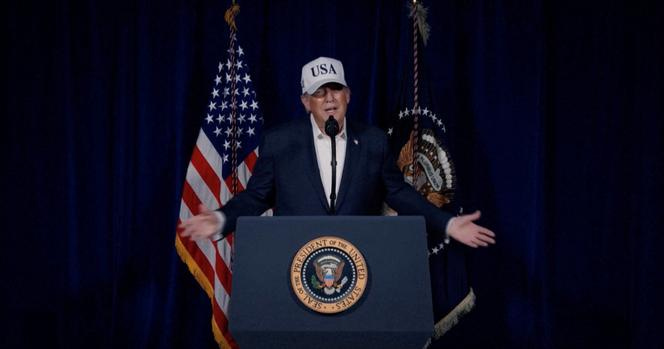
Usually, when the United States launches a major war — or even a significant military strike — the president addresses the nation live from the Oval Office.
We remember George W. Bush speaking to the country when military action began in Afghanistan, and again before the invasion of Iraq. Those were formal moments.
Instead, for this war with Iran — a conflict that remains unclear and open-ended — we got a pre-taped social media video in the middle of the night. Trump was wearing a cap, casually dressed, his eyes in shadow, speaking from Mar-a-Lago.
That’s been the pattern so far. Official statements have come through recorded videos or social media posts. There haven’t been extended live exchanges with reporters, aside from a few phone calls with anchors. When Trump returned to Washington, he rushed past the cameras without taking questions, which is unusual for him, a man who loves the spotlight and loves to ramble.
He did make brief remarks before a Medal of Honor ceremony on Monday, saying Iran’s missiles posed a “direct threat to the United States” and that action was necessary. But even then, the comments were short, and he moved on to talking about White House drapes before the ceremony began.
The larger explanation still hasn’t come.
For years, intelligence assessments have indicated that Iran does not possess an operational intercontinental ballistic missile capable of striking the continental United States. Its missile program is largely regional — aimed at Israel, U.S. bases, and neighboring countries. That doesn’t make it harmless. But it does complicate the claim that this was about an imminent homeland attack.
Trump says this war — and he has used that word — is about stopping Iran’s nuclear program. Yet last year, he insisted that he had “completely obliterated” that program. He strongly rejected suggestions that Iran’s capabilities were merely delayed.
So now we’re being told that the completely obliterated program must be obliterated again.
He has also argued that Iran forced our hand by refusing to make a nuclear deal. But we had a deal — the 2015 agreement that limited enrichment levels, installed monitoring equipment, and allowed international inspectors access to key facilities. You can debate if it was enough. But it imposed constraints.
Trump tore up that deal in 2018. Because President Obama did it.
And I won’t revisit all the times he accused Obama of potentially starting a war with Iran for political reasons. Or his warnings during the last campaign that Kamala Harris would drag the country into World War III while he would be the “peace president.”
He ran against foreign wars and regime change.
Now we are in a widening regional conflict.
Twelve nations are involved in some capacity as retaliation spreads. Americans have died. Iran’s Supreme Leader has reportedly been killed, but the regime structure remains intact. There is no clear plan for what follows.
Markets are reacting. Oil prices are rising. Roughly one-fifth of the world’s petroleum supply moves through the Strait of Hormuz, and that chokepoint is under threat. Iran’s Revolutionary Guard announced Monday that the strait is closed and any ship trying to get through will be fired on.
Three U.S. aircraft have been shot down, confirmed by friendly fire. The pilots are okay.
And still, the central question lingers.
Why?
Rachel Maddow recently outlined how several regional powers have long pushed for a direct strike on Iran, and she pointed to financial relationships between some of those governments and Trump-linked ventures. Whether that represents alignment of interests or something more, the optics are striking.
At the same time, the Epstein files remain unresolved, with continued accusations that key information is being shielded.
Military escalation. Political scandal. Economic volatility. All unfolding at the same time.
It overwhelms the public’s ability to process events. It strains the media’s capacity to keep priorities straight. Each new development pushes the last one aside before it can fully land.
And perhaps that’s part of the design.
Distraction is geared to distract from the last distraction, which was designed to distract from the last distraction. “It’s Epstein files all the way down!”
This is ongoing and fluid. In fact, between the time I write this and when it goes live on Archer’s Line, earth-shattering developments may have happened.
Stay tuned.
Let me know what you think in the comments. Share the article if you believe it’s worth sharing. And if you’d like to support independent journalism, consider becoming a paid subscriber.
And don’t forget to check out the Archer’s Line and Disciples of Democracy podcasts.
Just days before the U.S. launched a major military operation in Iran, FBI Director Kash Patel gutted a counterintelligence unit tracking Iran threats. Why? The agents had worked on the Mar-a-Lago classified documents investigation involving President Trump.
I haven't the vaguest of notions what to think. About this and/or anything else these days. Still seems as though he is just completely vacant mentally and the reason it escalates is the escalation of the vacancy. This is not a man who was once intellectually gifted!!
Thank you Rob, (I think).