Is History Still History?
The step-by-step logic that once led to war — and why it suddenly feels familiar again
“The Rhineland must be occupied! Austria belongs to Germany! The Sudetenland must be ceded to Germany! Poland must be wiped out for threatening Germany!”
Just a few chart-topping songs from a bygone era.
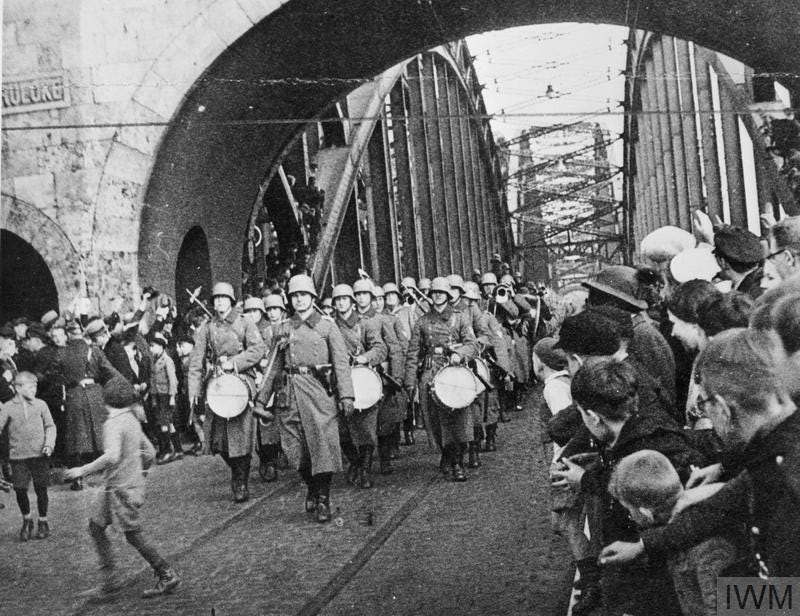
What made those demands sound acceptable wasn’t madness or menace. It was familiarity. They became normalized after the first outrage. Each successive outrage — even though bigger — somehow landed more softly.
Each claim was framed as overdue, defensive, even boring. Each was wrapped in history, grievance, and national pride. Each insisted it wanted stability — not expansion — and warned that refusal would leave no choice but action.
At the time, many believed the danger was being exaggerated. That cooler heads would prevail. That lines would be drawn somewhere before it went too far.
They always are. Just never where you think.
What follows is pattern recognition.
Between 1936 and 1939, Europe didn’t plunge into catastrophe overnight. It moved step by step — each move justified on its own terms, each framed as limited and final. Each one made the next easier to accept.
History doesn’t repeat, but it sure rhymes like dark poetry.
The Rhineland — “Restoring sovereignty”
The Rhineland had been demilitarized after World War I to serve as a buffer between Germany and its western neighbors. In 1936, Adolf Hitler ordered German troops into the region anyway.
The argument was straightforward: Germany was merely reclaiming its own territory and restoring national dignity. No borders were formally redrawn. No war was declared. The forces involved were small enough that German commanders feared disaster if France intervened.
France didn’t. Britain urged restraint. The violation was absorbed into the status quo. The outrage was normalized, setting the pattern for future ones.
The lesson was unmistakable. A move framed as defensive — even if illegal — would be tolerated if the response seemed riskier than acceptance.
What often gets overlooked is how modest the action was, and how loudly it was described as inevitable. Once sovereignty itself is treated as an insult that must be corrected, restraint can be painted as weakness. From there, the question stops being whether force will be used and becomes how much resistance is expected.
Austria — “One people, one nation”
Two years later, Germany annexed Austria in what became known as the Anschluss. The justification leaned on shared language, shared culture, and shared identity. Germans were joining Germans. History was being completed.
A plebiscite followed, conducted under occupation, delivering an unsurprising and overwhelming vote in favor. International objections were muted. Many outside observers argued that Austria wanted this — or at least that stopping it would be worse.
What vanished was Austrian sovereignty. What replaced it was precedent.
Normalization.
Unification arguments carry a particular appeal because they borrow the language of belonging. They suggest borders are artificial, resistance unnecessary, and history unfinished. But once identity becomes the justification, consent becomes optional — especially for those who live there but don’t fit the story being told.
The Sudetenland — “Protecting minorities”
Later in 1938, Germany turned to Czechoslovakia’s Sudetenland, claiming ethnic Germans there were under threat. Britain and France chose negotiation over confrontation. The Munich Agreement handed over the territory without Czechoslovakia even being present at the table.
The promise was explicit. This was the last demand. Peace had been secured.
Within months, the rest of the country was dismantled anyway.
This was the moment when outside powers convinced themselves that intervention was the real danger. Better to concede a piece than risk a fire. But once protection becomes the excuse, the protected group no longer needs to ask — and the protector never needs to leave.
It was a further normalization of outrage.
Poland — “Preemptive self-defense”
By 1939, the language shifted. The claim wasn’t correction or reunification, but survival. Germany argued that Poland posed a threat. Provocations were staged. Warnings were issued. Then came the invasion.
This was no longer incremental. It was open war.
By that point, the earlier steps could not be separated from the outcome. They had prepared the ground — politically, psychologically, rhetorically. What had been sold as defensive correction ended as conquest.
When self-defense is invoked against a neighbor’s mere existence, escalation has already been normalized. Threats no longer need proof. Warnings replace evidence. Violence becomes not a choice, but a necessity forced by others.
“Look what you made me do!”
When history stops being history
None of these moves, taken alone, looked like world war to many people at the time. Each could be explained away. Each had advocates who argued that resistance would be reckless, emotional, or dangerous.
What united them was not ideology alone, but method.
Grievance framed as destiny. Expansion framed as defense. Power framed as inevitability. Critics framed as hysterical or disloyal.
History rarely repeats line by line. It rhymes through logic, structure, and escalation.
Normalization.


