January 6 Still Hurts - And So Do the Others
Watching 9/11, Sandy Hook, and January 6 in real time — and what their aftermath reveals about America
I watched 9/11 as it unfolded.
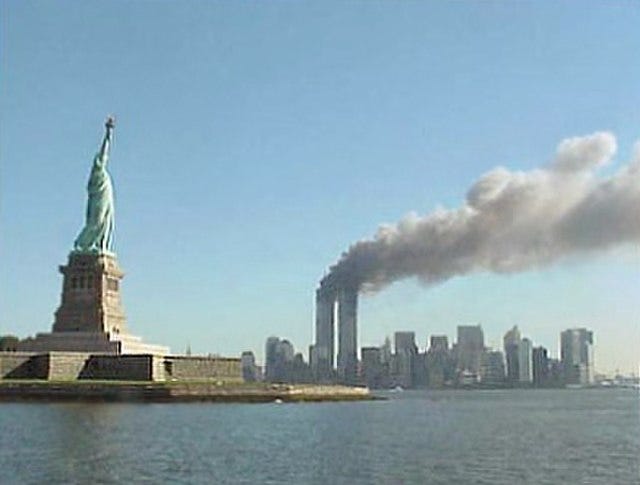
My girlfriend’s mom called early that morning and woke us up, screaming about a plane crashing into the World Trade Center. I told her she must be watching a movie. But she kept yelling for us to turn on the TV. We did—and there it was.
At first, I thought it was a catastrophic failure of air traffic control. A terrible accident.
Then we watched the second plane hit.
I was doing news on KFI in Los Angeles on the day of the Sandy Hook school shooting. I worked the whole day as the story kept getting worse—report after report about what had happened to those little kids. When I finally got home that night, my whole body started shaking. I couldn’t stop it. The anguish just poured out of me.
And I watched January 6, 2021, as it happened.
The same feelings from those other moments came rushing back—but this time, something worse was layered on top of the horror. I wasn’t watching foreign terrorists or a lone mass murderer. I was watching my fellow Americans screaming about killing people, hanging the vice president, dragging Democratic lawmakers out in zip ties.
I watched them batter windows. Attack police officers. Trash the People’s House. Ransack offices. Smile and laugh while they did it.
The violence. The hatred. The unreasoning rage driven by lies. The threats. To them, it was a celebration, a party.
For hours, we looked like one of those fragile countries we used to watch on the evening news—another coup attempt unfolding in real time.
I didn’t write this on Tuesday, on the fifth anniversary, because even now the feelings are still raw. Maybe they always will be. They’re still raw from 9/11. Still raw from Sandy Hook.
What followed those events has been its own kind of heartbreak.
After 9/11, we used a real terror attack to justify a long, costly, and deadly war in a country that had nothing to do with it—driven by lies about weapons of mass destruction.
After Sandy Hook, we told ourselves this time would be different. Surely the bodies of murdered children were finally enough to force action. Surely now the country would find a spine and do something real about gun violence.
But the resolve faded fast. And the truth settled in: if we didn’t act after Sandy Hook, we were never going to act.
After January 6, it looked—briefly—like we might finally draw a line. We investigated. We arrested. We convicted. We sentenced. We tried to send a message that what happened was not America, and that it would not be allowed to happen again.
Then Donald Trump pardoned them all. En masse.
Not just trespassers, but people accused of violent crimes. Some of whom went on to commit more violence after their release.
The message was unmistakable: yes, this is America. And any crime committed in Trump’s interest will be excused, condoned, pardoned, forgotten—and eventually rewritten as patriotism.
Those three events alone are enough to leave any attentive American with a deep sense of tragedy, followed by exhaustion so heavy it borders on fatalism.
But they aren’t the whole story.
There’s also been the slow march of quieter damage—self-inflicted, normalized, barely noticed at first. Like slicing off a limb so quickly you don’t feel it right away, only to look down later and realize how much blood you’ve lost.
Some part of our brain keeps insisting, We’ll get through this.
Maybe we will.
But we haven’t begun to reckon with the long-term damage already done—or whether all of it can even be repaired.
Because history is very clear about one thing: when democracies begin to crack, when they slide into autocracy, authoritarianism, empire-building, suppression of rights, and the dehumanization of groups of their own people, it is extraordinarily hard to bend that arc back toward freedom.
History is our guide here. And it is not comforting.


I overheard a tragic conversation, between an elderly man and another man, probably about 40 years old.
The elderly guy asked “What about the future? What about 40 or 50 years from now? What about the country we leave for our children?”
The younger guy’s response was “Why do you care? You won’t be here to see it?”