

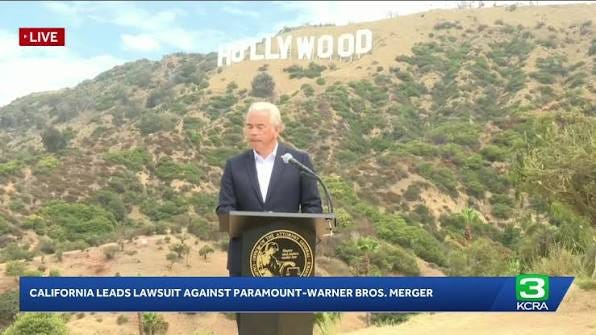
A coalition of 12 state attorneys general, led by California Attorney General Rob Bonta, filed an antitrust lawsuit Monday seeking to block the $110 billion merger, setting up what could become the biggest media antitrust case in decades.
The lawsuit doesn’t merely ask the court to review the merger. The states say they want to stop Paramount from closing the deal before the legal challenge is resolved. If the companies refuse to wait voluntarily, the coalition says it will ask for a temporary restraining order.
What Bonta says
At Monday’s announcement, Bonta argued the merger would combine two of Hollywood’s five major movie studios and two of the five largest basic cable programmers into a single company with outsized control over both industries.
His office says the combined company would control nearly one-third of theatrical film distribution and nearly one-third of basic cable programming in the U.S. The lawsuit argues that would reduce competition, raise prices, lower quality, and ultimately leave consumers with fewer choices.
What’s missing in the discussion? CNN. The attorneys general are mostly focused on Hollywood. That makes sense for Bonta, with Hollywood being a major economic driver for California.
But most of us following this story have been watching it through the lens of journalism.
It’s not that CNN isn’t an important part of this situation. But the attorneys general have to argue the case the courts are more likely to consider, and right now, that’s monopoly concerns
Politics is everywhere
Of course, politics is impossible to ignore. The coalition consists of Democratic attorneys general. The Trump administration cleared the merger.
Supporters of the deal say the lawsuit is election-year political theater designed to energize Democratic voters.
Opponents argue the merger itself has been shaped by politics, given David Ellison’s close ties to President Trump and the administration’s unusually swift approval of the transaction.
Then Trump said something revealing
Just one day before the lawsuit was filed, President Trump made his first televised appearance on CNN since returning to office. Near the end of his conversation with Jake Tapper, Trump said:
“We’re trying to have CNN go on a normal path.”
Tapper immediately replied:
“Well, I’m on a normal path right here, sir.”
Trump answered:
“Good. You are.”
That exchange lasted only a few seconds.
It may end up being remembered much longer.
When Trump says “we’re trying to have CNN go on a normal path,” the obvious question is:
Who exactly is “we”?
Presidents don’t normally speak about independent news organizations as if they’re participants in managing them. Even if Trump intended nothing more than political bravado, the remark reinforces concerns that have surrounded this merger from the beginning.
It echoes another comment he made months ago when he declared it was “imperative” that CNN be sold.
Sometimes politicians say the quiet part out loud. Trump has a habit of doing exactly that when he's speaking off the cuff.
The road ahead
This lawsuit doesn’t automatically stop the merger.
Paramount has already promised to fight aggressively, calling the transaction lawful and necessary to compete against much larger streaming and technology companies.
The company also faces a financial clock. If the merger isn’t completed by the end of September, additional payments to Warner Bros. Discovery shareholders begin kicking in, increasing pressure to resolve this quickly.
Now the questions become legal ones. Will a judge issue an injunction? Will Paramount, as it did in Europe, offer concessions? Or does this end up going to trial?
The popcorn is popping.
What does "normal" mean when it's uttered by Donald Trump???
Thank you, Rob.