

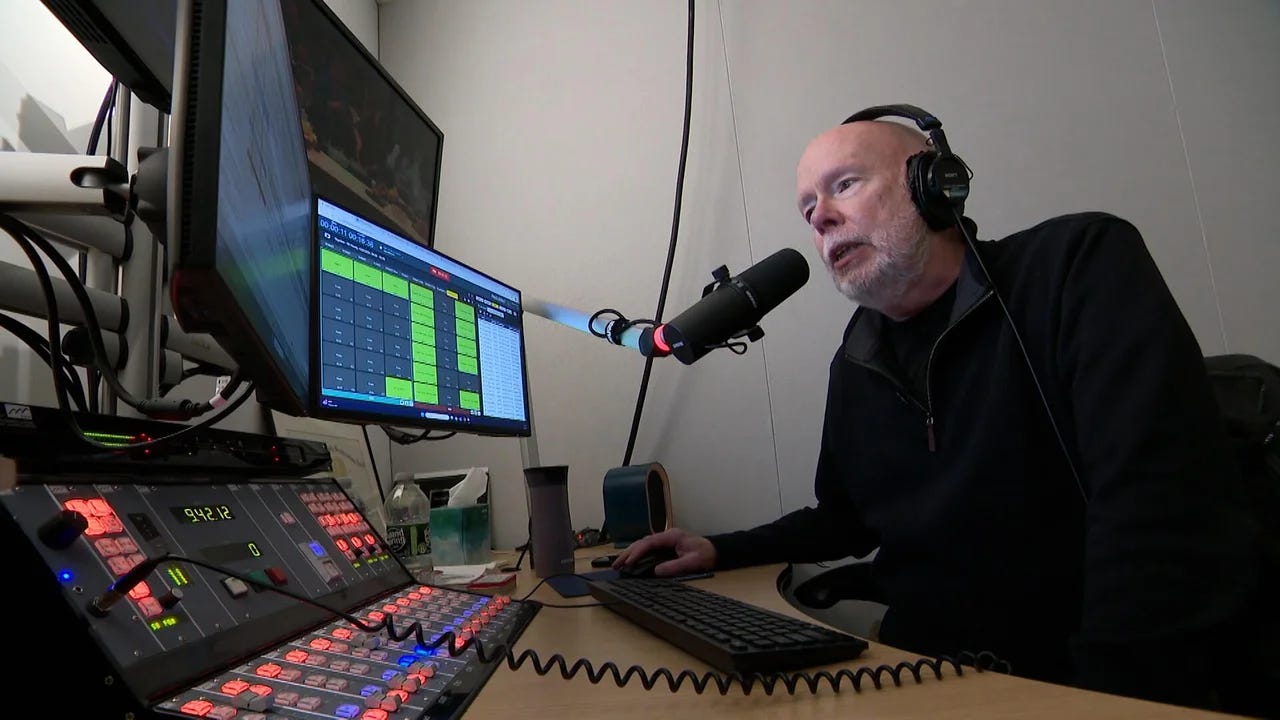
The shutting down of CBS News Radio was big news. But there is a bigger story here, and it’s about jobs and the people who are disappearing behind the scenes: The reporters no longer covering beats. The editors no longer catching mistakes. The producers no longer making one more phone call before air. The copy editors no longer asking, “Are we sure about this?”
According to Challenger, Gray & Christmas, the news industry announced 839 job cuts through the first four months of 2026 — up 46 percent over the same period last year. The broader media industry announced nearly 3,000 cuts overall. Artificial intelligence was cited as one of the fastest-growing reasons for layoffs across industries.
Those are only the cuts big enough to track publicly.
They don’t include the hiring freezes. The buyouts. The positions left vacant after somebody retires. The local reporter now expected to shoot video, edit video, post to TikTok, write web copy, anchor a livestream, and somehow still produce original journalism in the middle of all that.
And then there’s the emotional collapse happening inside the profession. Because there is a point where an industry stops feeling stressed and starts feeling hunted.
That’s where journalism is now.
I’ve watched newsrooms go from noisy, crowded places full of overlapping conversations and scanner traffic to half-lit rooms where one exhausted producer is trying to do the work of four people while feeds scream in the background. You can feel the institutional memory disappearing.
You can see it everywhere. The Washington Post is shrinking again. NPR is offering buyouts to hundreds of employees while trying to close budget gaps tied to collapsing funding and changing audience habits. Local television stations are slashing staff after ownership changes. Small newspapers are barely hanging on.
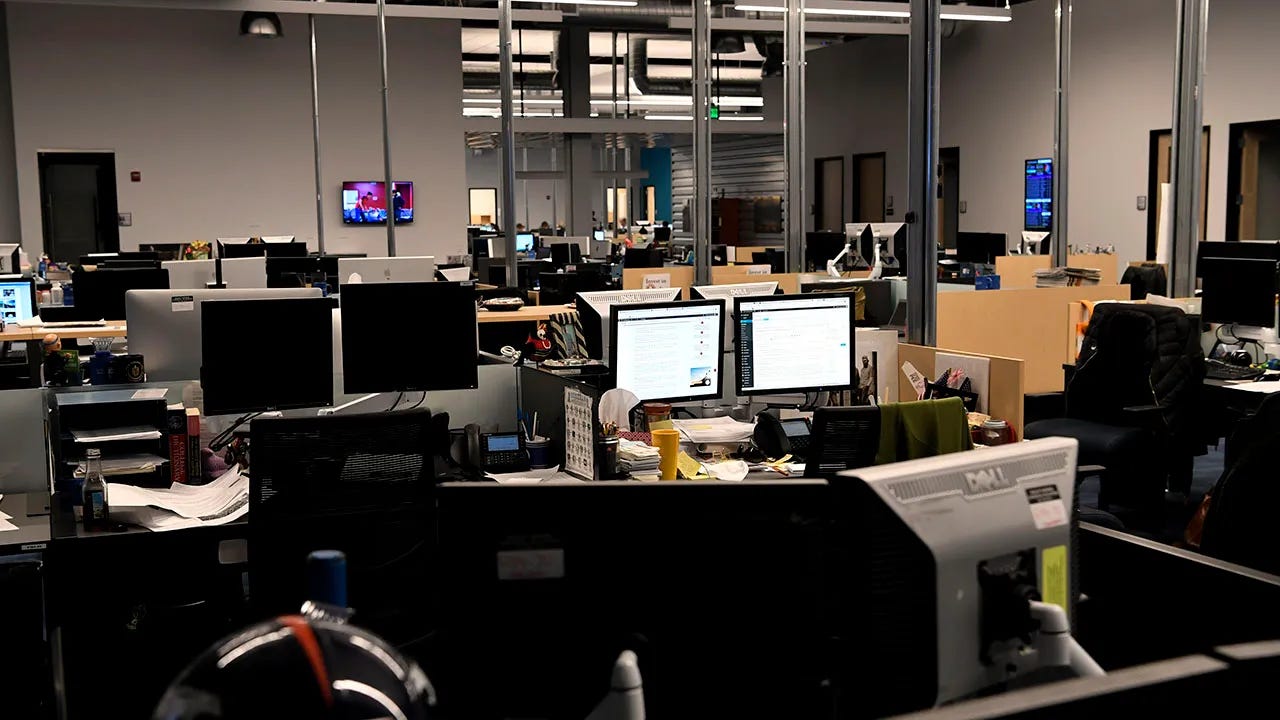
Meanwhile, the surviving companies keep consolidating.
CBS News Radio served roughly 700 affiliates before shutting down this month. Many are now moving to ABC News Audio, effectively concentrating even more national radio news distribution under one umbrella. Under the thumb of one billionaire.
The modern media business talks about journalists as interchangeable units. “Content creators.” “Talent.” “Assets.” As if a veteran courthouse reporter can simply be swapped out for a younger, cheaper employee with a smartphone and a Canva subscription.
But journalism is institutional memory.
A veteran reporter knows when a police department statement feels incomplete because they’ve seen the same wording used before. A good editor can hear when a source sounds evasive. A producer who has worked natural disasters understands immediately which rumors are likely to spread first and which official numbers are probably wrong.
That knowledge takes years to build.
And once it disappears, it doesn’t magically come back because somebody launches a podcast.
America has spent years convincing itself that journalism was just another form of content production. Something old. Something bloated. Something the internet would naturally replace with something faster and more democratic.
Instead, much of what replaced it was noise, and fewer people actually gathering verified facts.
Cities still need reporters covering corruption. States still need journalists covering legislatures. Communities still need somebody sitting through zoning meetings, school board fights, and environmental hearings. Somebody still has to verify the death toll during a wildfire. Somebody still has to call the sheriff back when the numbers don’t add up.
Most journalism is boring until the exact moment it becomes essential.
America has already lost nearly 3,500 newspapers over the past two decades. More than 270,000 newspaper jobs have vanished during that same period. Tens of millions of Americans now live in areas with little or no reliable local news coverage.
A newsroom stripped down to the bare minimum may look financially lean right up until the moment a real crisis hits. Then suddenly you discover whether there are enough experienced journalists left to cover a war, a riot, a hurricane, a cyberattack, an assassination attempt, or an election night that spins out of control at two in the morning.
That’s when journalism stops being abstract.
That’s when people suddenly want verified information again.
And that’s the danger in all this. The need for journalism hasn’t gone away. If anything, the modern world demands more of it than ever before. We are living through an era of political instability, algorithmic propaganda, AI-generated misinformation, climate disasters, collapsing public trust, and increasingly concentrated corporate power.
This should be a golden age for reporting.
Instead, it’s becoming a liquidation sale.
Couple all this with the generations-long attacks on education, especially higher education. For years, universities have increasingly been portrayed as hostile to patriotism, religion, and traditional values. In popular media, someone who is college-educated is seen as less smart, less caring, and less of a decent person than someone who graduated from the “school of hard knocks.”
So we’ve seen the chipping away of funding for schools, and pressure on universities to be more friendly to the government narratives… just like the pressure on news media.
A less informed, less educated populace is much easier to manipulate, to lie to, to sell BS to. A population trained to distrust expertise and institutions becomes easier to flood with conspiracy theories, pseudo-science, propaganda, and dangerous ideas like whole segments of a population being seen as the “other,” to be rounded up and disappeared.
For journalists to be called “enemies of the people.”
The erosion of journalism capable of criticizing and questioning authority is essential if that’s the goal.
For more on living and dealing with stress if you’re a journalist or broadcaster, check out Archer & Feldman tomorrow morning on YouTube, with special guest Ronnie Loaiza, Habit Coach and who’s married to some guy who writes Archer’s Line.
Rob, Christopher Cruise is not in the photo. It is Steve Kathan.
Thank you Rob. It occurred to me while reading this that I think you would very much like a series I watched on HBO/Max. "The Newsroom" is the best quality TV I have ever seen. If you haven't had the pleasure you might want to check it out.