



When the Outlook outage first began in the early afternoon, there was a round of joking. “Finally, some peace and quiet!”
And the funniest: “Hey, Microsoft, please take your time fixing this.”
They did.
But other Microsoft tools were affected, too — documents, spreadsheets, Teams, not just email. And as the blackout stretched on into the late afternoon and early evening, it became apparent just how many businesses depended on Microsoft’s systems for their daily operations.
By the time I left work that night, Outlook was still down.
Perhaps the most telling — and infuriating — update from Microsoft was this X post in the evening:
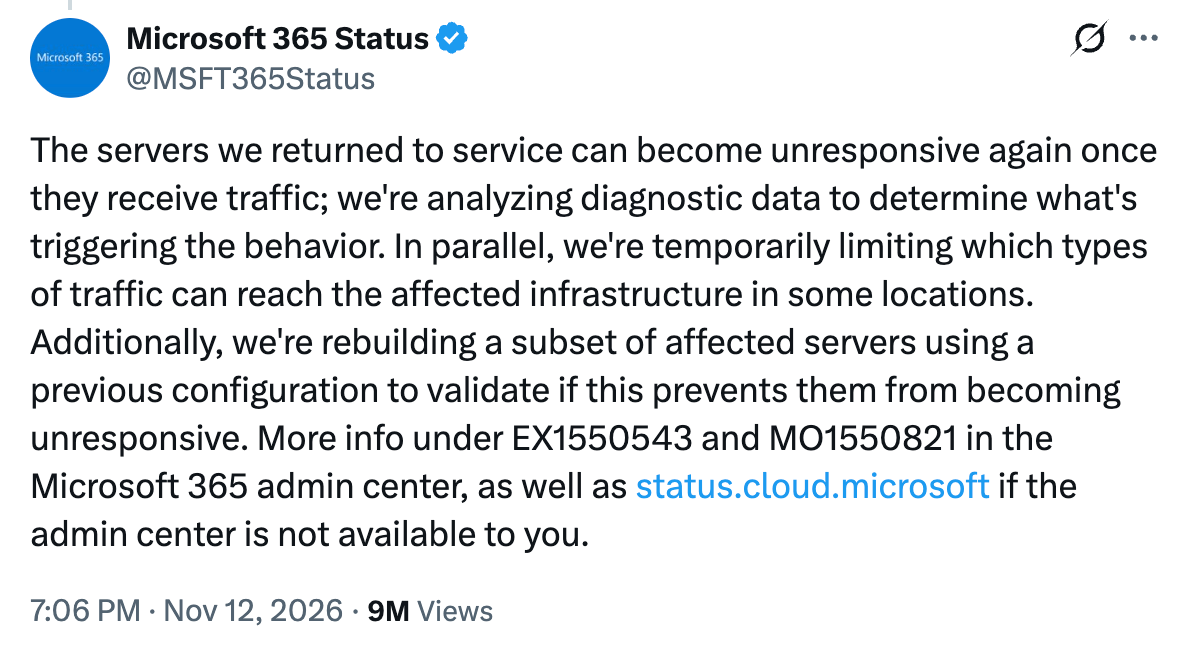
“The servers we returned to service can become unresponsive again once they receive traffic…”
In other words, “Hey, the servers are working, so long as they don’t have to do anything.”
As I write this Friday morning, everything seems to be getting back to normal. But who knows? These big failures can strike without warning. And right now, we don’t know the full cause. Bad update? Something to do with Nvidia? A rat chewed through a wire?
Whatever it was, it seems to have given some businesses an excuse to call it a day and go home. And it turned out that was the right call. Other than sending messages via carrier pigeon, how else could they send a detailed document or have a Teams meeting?
Which reminded me of some other Weird Wide Web fiascos.
In October 2021, Facebook, Instagram, and WhatsApp all disappeared from the internet for about six hours. The culprit was a configuration change that disconnected Facebook’s systems from the rest of the world.
Then came the great CrowdStrike disaster of July 2024. A faulty software update crashed about 8.5 million Windows computers around the world. Airlines grounded flights. Hospitals postponed procedures. Banks and businesses couldn’t operate normally.
And millions of people discovered something called the Blue Screen of Death. It’s a Windows feature that tells you your computer has decided to start being a paperweight.
In October 2025, Amazon Web Services suffered a massive failure that knocked out or disrupted everything from Snapchat to Slack. A problem with the system that helps computers find one another triggered a chain reaction that lasted for hours.
And just a month later, Cloudflare, a company that helps keep websites running smoothly, experienced its own massive outage. A bad configuration file caused failures across its network, taking numerous websites and online services down with it.
What did most of these disasters have in common?
Good old human beings.
Our collective hair is on fire over the fear that AI could take over every system and lock us out. Looks like we could do that just fine by ourselves.
Yes, there are many jokes to be made. “We survived the Great Outlook Outage of 2026.” “Microsoft 364.” Until you consider how dependent we’ve become on a relatively small number of companies and their enormous networks of computers.
We’ve moved our documents, our email, our communications, our finances, and much of our daily lives into something we call the cloud.
It’s a lovely name. It sounds soft and fluffy.
But the cloud is really just somebody else’s computers.
And sometimes, somebody else’s computers have a very bad day.
Which means we all have a very bad day.
There you go. An argument for the interconnectedness of all human beings. Including our mistakes and body odors.
Meanwhile, I’m thinking about going into the carrier pigeon business.
You know, for the next one.
So on point.
Definitely pick up some pigeons. Maybe don't even wait for the weekend. 🫢