

Twice a year, time-change weekend rolls around. So many of us hate it.
John Oliver’s Last Week Tonight once asked, “How is Daylight Saving Time still a thing?”
Congress may finally have an answer. The House has passed a bill that would make daylight saving time permanent, with the backing of Democrats, Republicans, and President Trump. A rare bipartisan issue in these divisive times.
But not everyone is on board. Senator Tom Cotton, usually a die-hard Trump backer, has threatened to filibuster the bill.
“I understand that Americans hate changing the clock. I hate changing the clock,” Cotton said. “But I think you have to think through the second-order implications of what permanent daylight saving time would mean.”
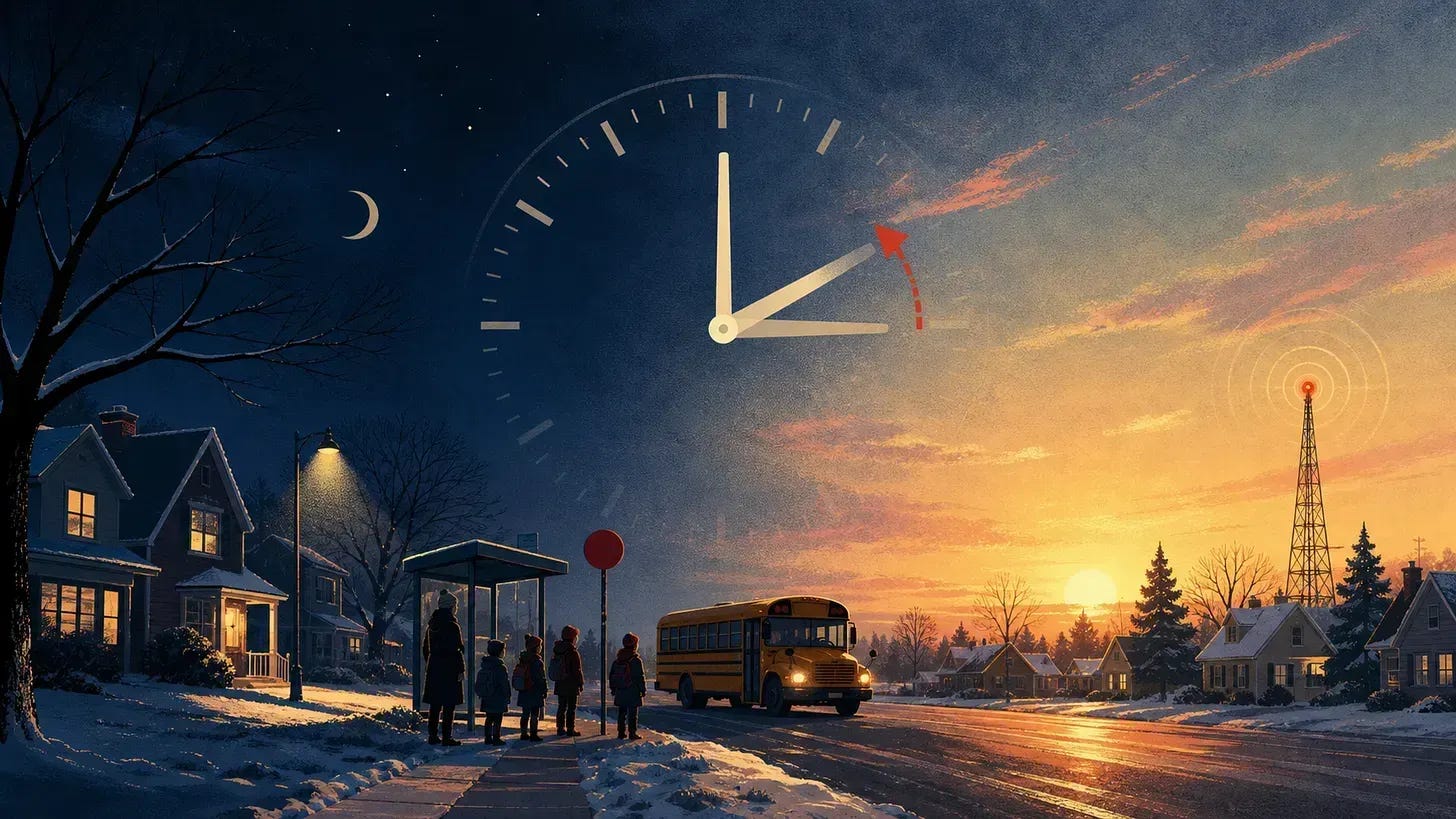
Cotton said the plan may “sound great” to somebody who lives in Florida. But in parts of the Midwest and Rocky Mountain states, the sun wouldn’t rise until after 9 a.m. during the winter.
“That would be very dangerous, especially for kids who are walking to school, biking to school, being left at bus stops,” Cotton said. “Many other senators are opposed as well from the states you would expect, frankly in both parties. This is one of those issues that is more of a regional issue than it is a partisan issue.”
Some radio station owners don’t like the idea either. Permanent DST could cost certain daytime-only AM stations part of morning drive because their operating hours are tied to local sunrise. Other AM stations could be stuck using reduced power or directional signals longer in the morning. The FCC has acknowledged that expanded daylight saving time can cost these stations valuable programming.
A better option might be making standard time permanent. That creates some annoyances of its own, but if it were up to me—and it won’t be until I become King of the World—that’s the way I’d go.
Sleep and medical groups, including the American Academy of Sleep Medicine, say permanent standard time is better for public health because it more closely aligns with human circadian rhythms.
Of course, some northern cities would have the minor annoyance of the sun rising around 4:30 a.m. for part of the year. But that’s how the ball bounces—or rotates, in this case.
The United States has already experimented with permanent daylight saving time. Congress tried it in January 1974 during the energy crisis, and the idea initially had broad public support. Then Americans experienced winter mornings in the dark. Support reportedly dropped from 79 percent to 42 percent, and Congress restored standard time that October.
The last time we tried this, it lasted less than a year.
I love the idea of doing away with time-change weekend. But making daylight saving time permanent is more trouble than it’s worth. Permanent standard time makes a lot more sense—scientifically, medically and historically. Daylight saving time wasn’t even introduced nationally until 1918.
It’s a separate issue, but once I complete the move to Atlanta, I’ve got to get used to the Eastern Time Zone again. I’ve been on laid-back California time for nearly 30 years.
But hey, that’s what we get for living on a great big ball.
I like the quarterly changes in time, always have, because it’s the only way that living either in Florida, as I used to, or now in California, I got some semblance of seasons. But now that I’m moving with the author of this piece to Atlanta, Georgia, perhaps I’ll get three or four seasons after all! I would prefer standard time.
I wholeheartedly agree with you. I’ve made this same argument for permanent standard time for many years. Yes, it’s nice to have daylight hours longer during summer evenings. Negatively though, trying to get school children to bed when it’s still light out is challenging, at best. The winter mornings are a real issue. We need that earlier morning sunrise, to start the day at a reasonable time.
Doing away with DST also doesn’t require congressional approval. That’s how Arizona and Hawaii stay on standard time.
It could chaotic if each state chose independently whether or not to drop DST.