

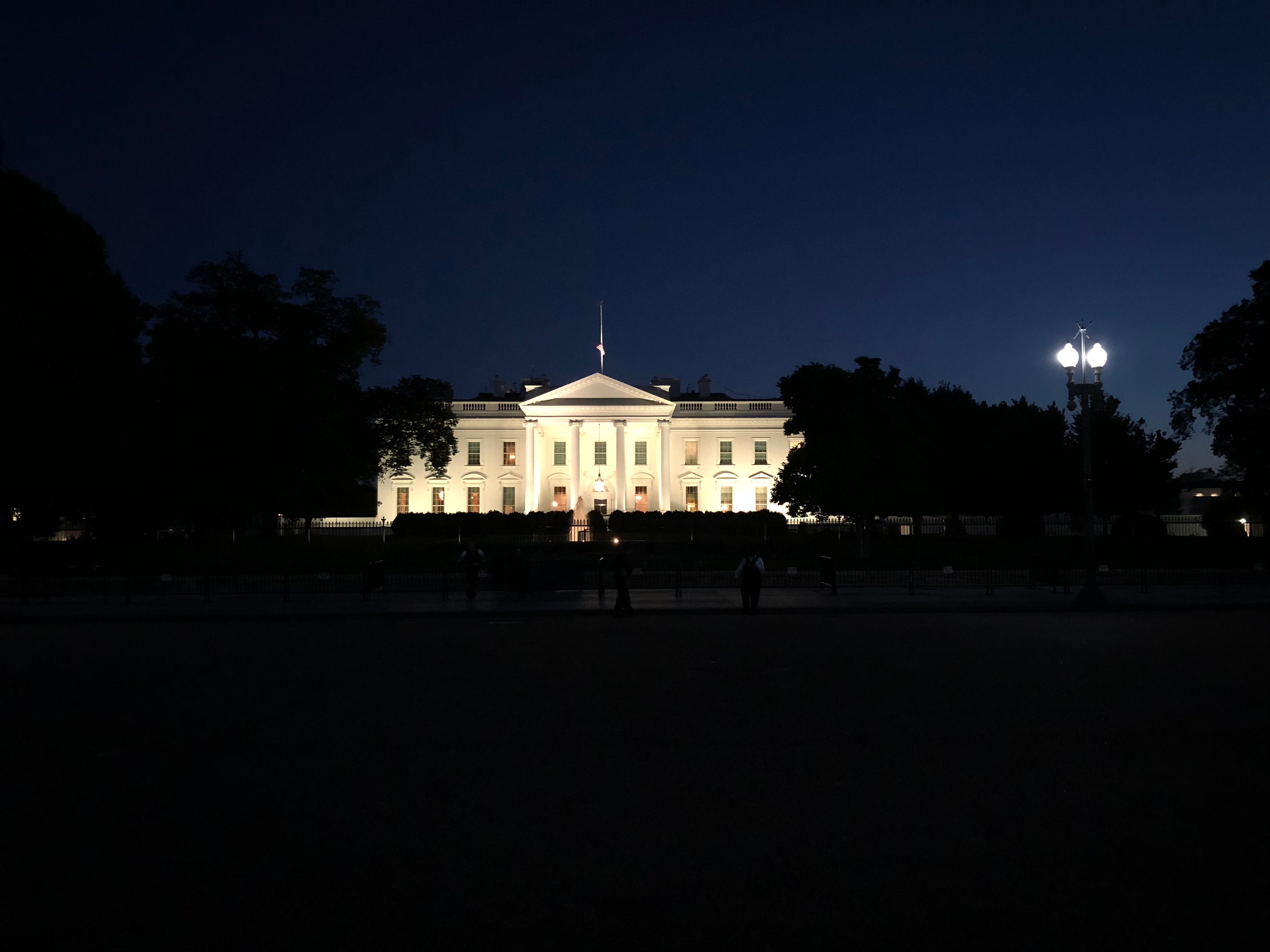
Taking a break today from covering media, journalism, and radio… and instead offering you a political horror story. The following is a fictional “what if” scenario.
Day One — 9:00 a.m. | The House Floor
The vote to impeach Donald Trump has been building for six weeks — slowly at first, then all at once, the way these things always go. What breaks the dam is not a single scandal or a single crime but something more corrosive: exhaustion. Senior Republicans, men and women who have spent years bending their spines into shapes they no longer recognize, have simply stopped bending. A former MAGA congressman from Ohio — a man who once called Trump “the greatest president of my lifetime” on national television — casts the vote that puts the tally over the threshold and then sits very still at his desk while the chamber erupts around him.
The final House count: 241 to 194. Thirty-one Republicans cross the aisle. Trump is now the first and only president to have been impeached three times. The third time, many cable news commentators note, is the charm.
The articles travel to the Senate by courier, as tradition requires, carried by a small procession of House members who look like they are walking to something they cannot take back. Which they are.
Days One Through Four | The Senate Trial
The trial is not a surprise by the end, though it would have been, once.
What has changed is simpler than ideology and more durable than loyalty: several senior Republican senators, including three who once faced primary challenges for insufficient fealty, have concluded that the man in the White House is no longer an asset. He is a liability with a nuclear clearance. There are doubts about his mental acuity. The witnesses are damaging. The evidence is methodical. The defense is loud and legally thin.
On the fourth day of testimony, a former MAGA senator from a state Trump carried by nineteen points announces he will vote to convict. His statement is one paragraph. He reads it at a press conference without taking questions and then walks directly to his car.
The room understands that it is over.
Day Five — 11:14 a.m. | The Senate Chamber
The final tally: 67 to 33. The constitutional threshold, met exactly.
The gavel falls.
In the chamber, no one cheers. A few members bow their heads. One senator from a deep-red state stares at the ceiling for a long moment before gathering her things. She knows what is waiting for her when she lands at home.
Under the Constitution, removal is immediate. There is no appeal, no grace period, no transition window.
The vice president is notified.
Day Five — 11:30 a.m. | Emergency Session
JD Vance receives the news in a secure room and makes his call — not to the Chief Justice, not to the Secretary of Defense. He calls the man who is no longer president.
He tells Trump he will not serve. He will not take the oath. Within the hour, he releases a statement calling the conviction “a constitutional atrocity, a legislative coup dressed in procedural clothing.” He does not use the word illegitimate once. He uses it four times.
Congressional leadership convenes in emergency session less than an hour later. The legal question is uncomfortable but not ambiguous: a vice president who refuses to discharge the duties of the presidency following a constitutionally valid succession has effectively abandoned the office. Another impeachment resolution is drafted. It is brutal in its efficiency — three articles, fourteen pages, introduced and voted on before sundown.
Day Six — 10:00 a.m. | Vance Convicted
The Senate, still in emergency session, reconvenes at dawn.
The Vance conviction moves faster than anyone expected, because senators on both sides understand that the vacuum is the danger. Final tally: 69 to 31. Vance issues no further statement. He will spend the next several weeks on television, describing what happened to him as martyrdom. But that is later. Right now there is only the count, and the gavel, and what comes next.
The Presidential Succession Act of 1947 is not a document anyone expected to need in their lifetime. It does not care about expectations.
Mike Johnson, Speaker of the House, is administered the oath of office in a side room off the House chamber at 11:22 a.m. There are no cameras by design. The man holding the Bible looks like he is trying to remember how to breathe.
Some were surprised. They expected Johnson to follow Trump’s and Vance’s lead. He took the oath quietly, then spent the next hour telling reporters he still “supported Trump” — without explaining what that meant or how both things could be true.
Hardly anyone is buying it, but there are sighs of relief that Johnson might hold the line.
Day Six — Noon | The Oval Office
The removed president does not pack a bag.
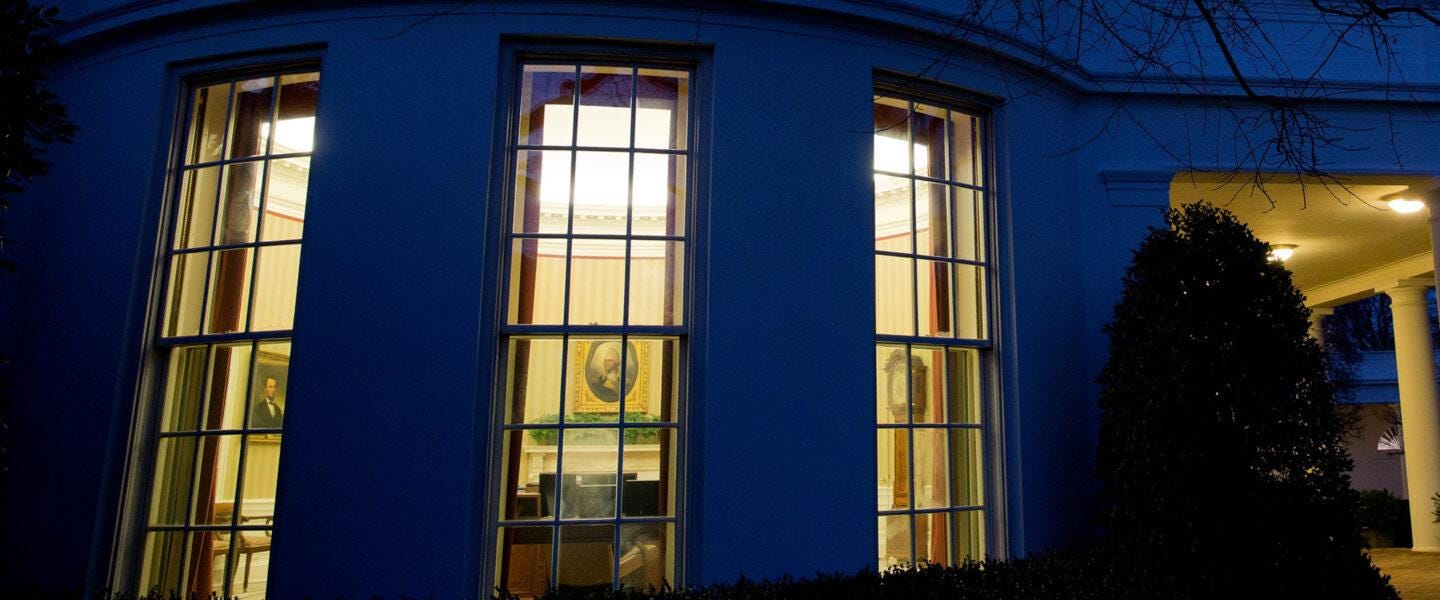
Trump sits behind the Resolute Desk — his desk, he will say this for months, his desk — and watches the coverage on three screens simultaneously. His remaining senior staff, the ones who haven’t left yet, stand in a loose, anxious cluster near the door to the outer office. No one sits down. No one wants to be comfortable in a room that may stop being accessible tomorrow.
“This is a coup,” he says. Not to anyone in particular. “A coup against a duly elected president of the United States.”
He picks up his phone. He has 87 million followers and he is not finished talking to them.
Day Seven — Nationwide
The posts come in waves.
They STOLE the Election. Now they STOLE the Presidency. This is what the end of America looks like.
Patriots — do not comply. Do not accept. Do not stand down.
I am still your President. I will always be your President. They can impeach me but they cannot remove the Greatest President Ever from your hearts and they cannot remove Me from history. What they have done is illegal. It will not stand. I will not let it stand. And neither should you.
By midnight the posts have been shared 40 million times. By morning, they have been translated into action: rallies forming in Phoenix, in Nashville, in a dozen mid-sized cities where the grievance runs deep and the organizational infrastructure has been quietly maintained for years. Men in body armor photograph themselves outside state capitols. Militia group chats — dormant for months — flicker back to life.
The temperature does not rise gradually. It spikes.
Some Democrats call for Trump to be arrested because of the danger he presents to the country. Some point out that his posts constitute calls for violence against the government. But absolutely no one is willing to arrest him. Even the ones who want to see Trump behind bars know it’s impossible. It would only cause an explosion.
They’re caught between an impossible rock and an immovable hard place.
Day Seven — Moscow
The statement from the Kremlin comes through official channels at 6 a.m. Moscow time, attributed to a spokesperson but worded with unmistakable deliberateness.
Russia has always believed in the sovereignty of democratic processes and the will of the people. We observe with concern the removal of a leader who received the overwhelming support of the American electorate, and we note that what has occurred in Washington has the appearance of an institutional coup rather than a constitutional process. President Putin has expressed his deep personal solidarity with his friend, Donald Trump, and wishes to convey that Russia does not recognize the legitimacy of a government installed through legislative maneuver rather than the ballot box. We are monitoring events closely and reserve the right to respond to developments that affect global stability.
The phrase reserve the right to respond lands in the State Department like a stone through a window.
Within hours, China issues a statement of its own — more measured, more cautious, but noting “irregularities in the American succession process” and calling for “international observation.” North Korea says something. Iran says something. The NATO secretary-general issues an emergency communiqué urging calm. Three allied heads of state who privately recognize Johnson as the lawful president decline to say so publicly until they understand which way the American military is going to move.
The crisis, which was American, is no longer only American.
Day Eight — The Country Splits
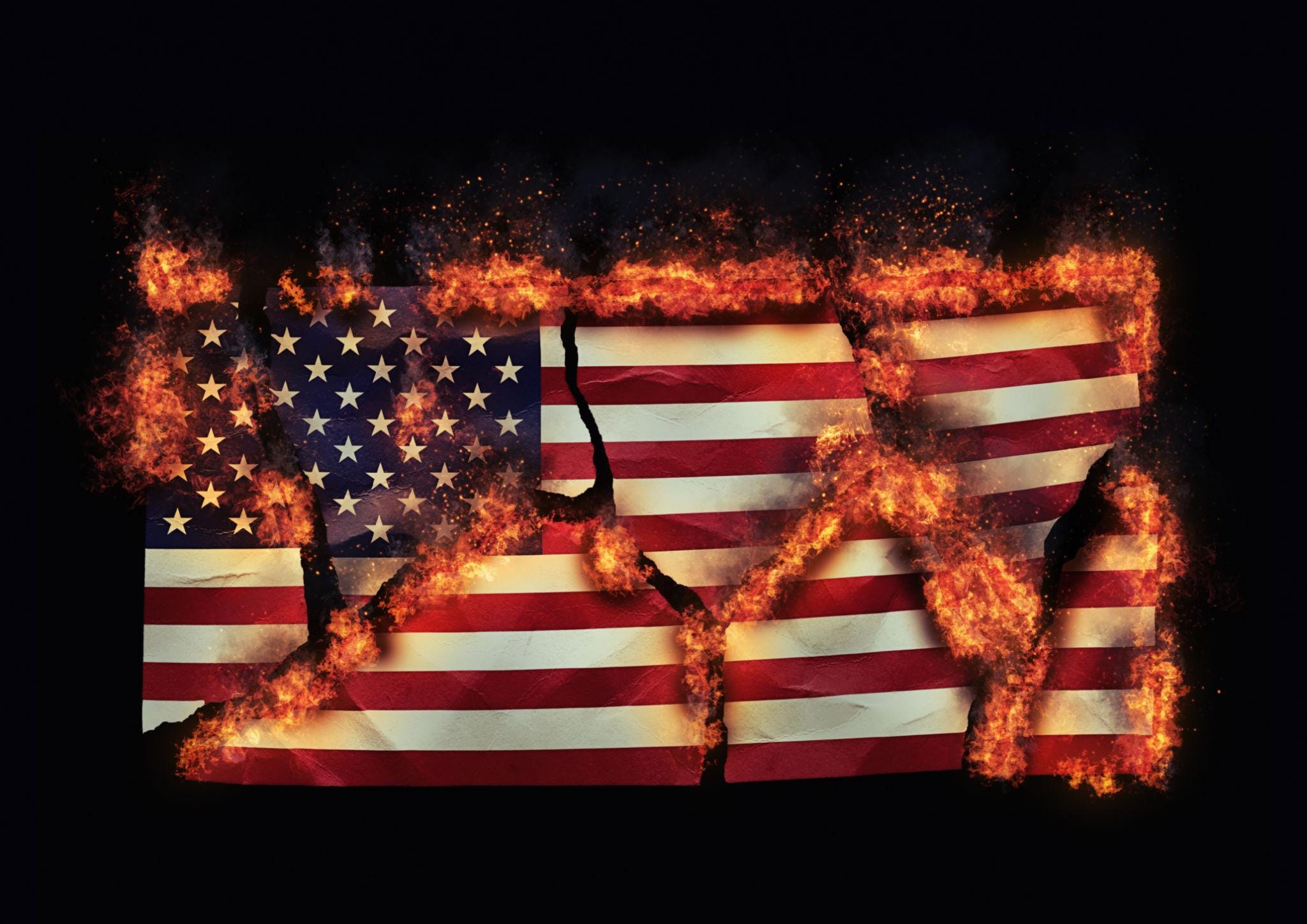
States do not secede. That is not how modern America fractures. They do something subtler and in some ways more dangerous: they simply disagree about who is in charge, and then they act on that disagreement with the full weight of state authority behind them.
California, New York, Illinois, Michigan, Washington — their governors convene a joint call and emerge with a coordinated statement. They recognize Johnson as the legitimate president. They direct their National Guard units to operate under the constitutional command authority. They freeze cooperation with any federal directive originating from the holdouts.
Texas, Florida, Alabama, Tennessee — their governors do the opposite. They recognize the removed president, or failing that, Vance. They instruct state agencies to ignore Johnson’s orders. Florida’s statement refers to Johnson as a “traitor.” Several begin using state-level law enforcement to “protect federal facilities” in ways that put armed men in direct proximity to other armed men following different chains of command.
The Guard units do not shoot at each other. Not yet. But in three states — Georgia, Arizona, Michigan — National Guard formations are now within visual range of one another, operating under different authority structures, with no shared communications protocol and no agreed-upon rules of engagement.
A military police sergeant at a federal depot outside Tucson receives simultaneous orders from the Johnson Pentagon and from the Arizona governor’s office. He puts both orders in a folder and calls his JAG officer.
“Which one do I follow?” he asks.
There is a long pause on the line. “I’m working on it,” the JAG officer says.
Day Nine — Johnson’s Problem
Johnson is not built for this. He knows it. His staff knows it.
His statements have been careful to the point of paralysis — calibrated to avoid confrontation, gesturing toward law and order without demanding it, never quite saying aloud what everyone in his situation must eventually say: I am the president. My authority is not conditional. The law is not negotiable.
He can feel his base fracturing beneath him. The MAGA constituency, even the remnant that has tired of Trump personally, is not tired of Trumpism. They do not want to see the apparatus turned against their movement. Johnson is trying to lead a country that includes people who believe his leadership is illegitimate, and he is doing it with the rhetorical tools of a man who has spent his career avoiding exactly this kind of binary.
His chief of staff puts it plainly in a conversation Johnson wishes he could forget: “Mr. President, you cannot be the reasonable man in a situation that has stopped being reasonable. At some point you have to pick a side. And the only side available to you is the law.”
Johnson nods. He does not issue a stronger statement.
The removed president posts three more times before midnight. Each one is angrier than the last. Each one lands like fuel on a fire that is no longer small.
Day Ten — The Core That Remains

They are not many, but they are not nothing.
The hardcore — the ones who were there on January 6th, the ones who have spent years in the militia forums and the encrypted group chats and the county Republican committees where the fever never broke — they are watching all of this with a particular, terrible clarity. They have seen what they believe is a pattern: the institutions are corrupt, the courts are captured, the military has been turned, the Republicans who broke with Trump are traitors and cowards who were never real conservatives to begin with. Every legal avenue has been taken from them. Every procedural option has been exhausted or co-opted.
They are not wrong that options are closing. They are catastrophically wrong about what that means.
But the logic of the desperate is not the logic of the rational. The logic of the desperate is: if they take everything, what is left?
In forums that the FBI is monitoring — and in some that it isn’t — the language is shifting. It is no longer the language of protest or of electoral politics or even of legal challenge. It is the language of men who have decided that the last door has been closed and are now looking at the wall.
This is what it comes to. This is what they forced us to.
If the tree of liberty needs watering — well. You know the rest.
A weapons cache in rural Georgia is photographed by a neighbor who doesn’t say anything for two days because he knows the men involved and doesn’t want trouble. Then he calls the FBI because he can’t sleep.
A militia unit in northern Michigan — forty men, disciplined, organized, not amateurs — begins a convoy toward Lansing.
A man in Phoenix, not affiliated with any group, just a man with guns and a television and a certainty that the country he loves is being murdered in front of him, loads his truck and pulls onto the highway.
He is not the only one.
Day Ten — 11:47 p.m.
The removed president hasn’t been seen in public for days, but then, suddenly, posts from Mar-a-Lago.
Tomorrow is the day Real Americans make themselves heard. This is our country. Not theirs. Do not let them take it. HOLD THE LINE!!! Thank you for your attention to this matter. President DONALD J TRUMP.
The post is live for eleven minutes before it is removed from every platform.
Eleven minutes is enough.
In the Michigan convoy, someone reads it aloud over the radio. There is a sound from the men in the trucks — not quite a cheer, not quite a prayer. Something between the two. The convoy keeps moving north toward the capital.
In Washington, Johnson is awake. The Chairman of the Joint Chiefs is awake. The director of the FBI is on a call with the attorney general. The Supreme Court’s ruling — issued two days prior, 7 to 2, clear and complete — sits on every desk in every relevant office, valid and unambiguous and entirely dependent on what happens in the next few hours.
In Moscow, someone is watching.
Somewhere on the Georgia-Tennessee border, a state police cruiser pulls up behind a truck it has been following for forty miles. The trooper sits in his car for a moment before getting out. He doesn’t know exactly what is in the truck. He has a feeling.
Somewhere in Lansing, the convoy is almost there.
Somewhere on I-10 outside Phoenix, a man who has decided he has nothing left to lose is driving east into the dark. Toward Washington DC.
The Constitution is a shared agreement. It endures as long as enough people choose to honor it — and as long as enough people with authority choose to enforce it. In the coming hours, both of those things will be tested in ways they have not been tested since 1861.
The question is not whether the breaking point has arrived.
The question — the only question now — is which way it breaks.
History does not telegraph its endings. It simply moves. And now, it is moving fast. Perhaps too fast for reason.
Whether the institutions held — whether the weight of law and collective belief proved sufficient against the weight of grievance and organized fury — is a question that nations answer not in courtrooms or on cable news, but in the specific, irreversible moments when someone either pulls a trigger or lowers a gun.
In the morning, there will be an answer.
Tonight, there is only the dark, and the waiting, and forty men on a highway in Michigan who have decided that history has left them no other choice.
They are wrong about that.
But they are moving anyway.
Oh My - This is actually frightening. To think this could actually happen. I certainly hope not and that the rule of law will hold. Excellently written and narrated my friend. Let's hope it stays fictional.