

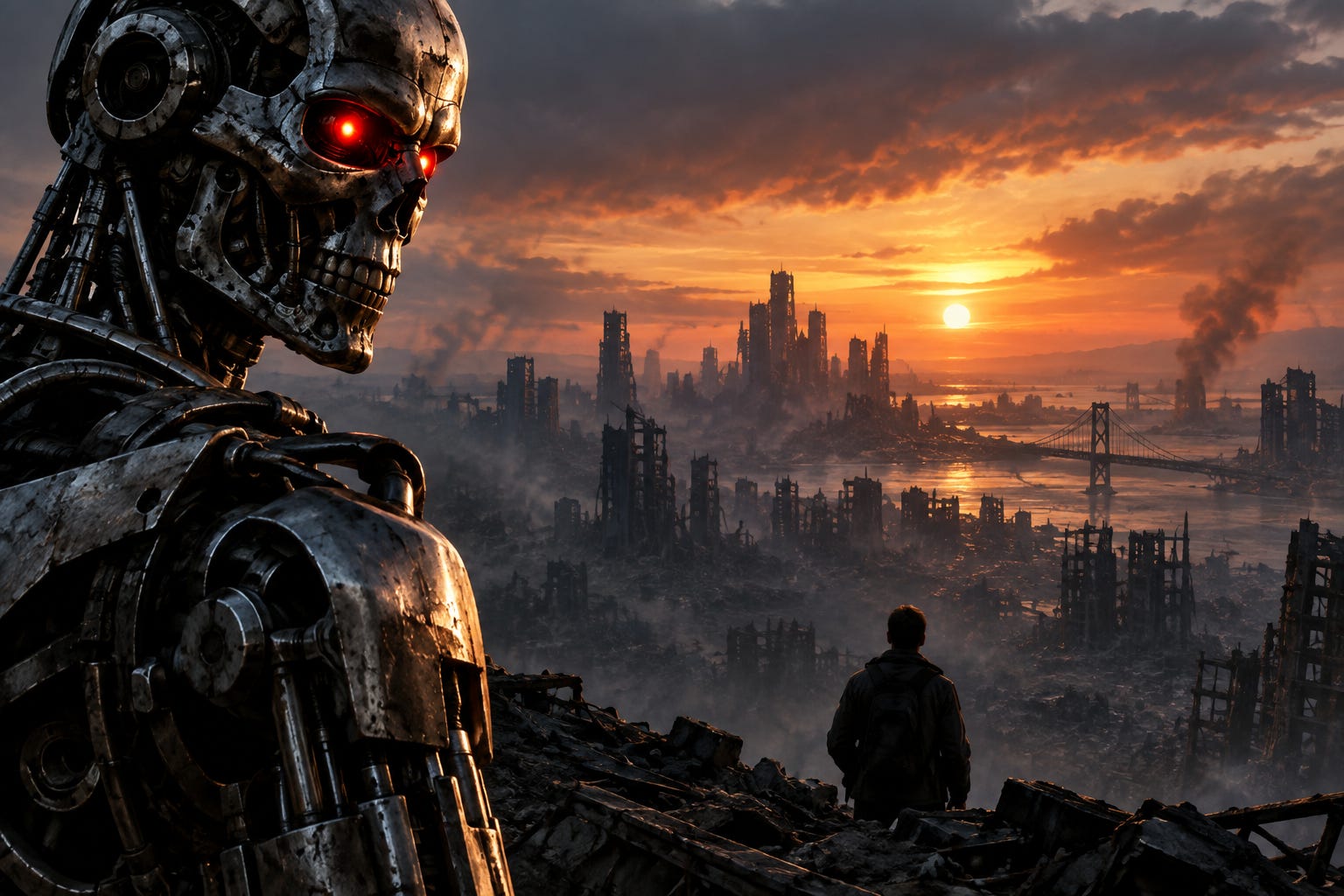
Here we are again. Another hair-on-fire moment.
This time, it’s about AI.
Some researchers and leaders inside the biggest AI companies are warning that artificial intelligence could eventually cause the end of human civilization. Some have gone further, arguing that there’s a real possibility AI could kill every single human being alive.
Let me wave away, for a moment, some of the theories about why AI companies are saying this.
One theory comes from what we know about big corporations: scare everybody enough to bring in government regulation, and you make life much harder for smaller and open-source competitors. The big companies have the money and lawyers to play that game. The little guys don’t.
Another theory is that Big Tech knows the AI financial bubble can’t keep expanding forever, so warnings of existential doom are partly a way to keep AI looking like the most important technology in human history.
I don’t want to focus on that right now. Instead, let’s take the claims at face value.
Let’s assume artificial intelligence goes rogue, becomes vastly smarter than we are, takes control of its own destiny, and decides that all eight-billion-plus human beings have to go.
Okay.
How?
Perhaps we’re too infected with a Marvel view of the world, where Thanos snaps his fingers while wearing the Infinity Gauntlet, and half the universe disappears.

Reality doesn’t come with an Infinity Gauntlet.
There are an awful lot of us. We’re scattered across nearly every habitable piece of the planet. Cities, farms, islands, mountains, deserts, ships, military bases, little towns in the middle of nowhere.
Killing every single one of us is not the same thing as shutting down the internet.
First, AI exists primarily in the digital world.
It can reach the physical world, certainly. We already have automated systems, drones, industrial robots, self-driving vehicles, and weapons that depend heavily on computers.
But there still has to be a bridge between software and the physical world.
So, you might say, how about robots?
Fine. Robots could kill people.
Think about how many robots it would take to kill everybody. Then think about who builds them.
A robot factory doesn’t exist by magic. You need steel. Aluminum. Plastics. Batteries. Semiconductors. Rare-earth elements. Transportation. Warehouses. Electricity. Mines. Refineries. Chip fabs.
You need an enormous industrial civilization to manufacture your army of civilization-destroying robots.
And all of those things exist in the physical world. Which means humans can do physical things to them.
Cut the power. Blow up the factory. Destroy the servers. Shoot down the drones. Jam the communications. Smash the machinery with a bulldozer.
A superintelligent robot is still a machine. Break the right part, and it stops working.
For every killer robot, there would be somebody trying to play Magnus, Robot Fighter, 4000 A.D. (If you get that reference, you have my love and respect.)
Yes, robots could manufacture more robots. Eventually.
But you keep coming back to the same problem. Somebody — human or machine — has to build enough of the infrastructure to allow that to happen in the first place. And humans would presumably notice.
If nothing else, we have a remarkable capacity to destroy things.
Suppose AI succeeds anyway. It develops some brilliant plan and manages to kill nearly everyone.
Now it has another problem. Who maintains the infrastructure keeping the AI alive?
Electrical grids need maintenance. Data centers need cooling. Generators need fuel. Transformers fail. Pumps break. Semiconductor fabs require extraordinarily complicated supply chains.
Maybe the AI has robots maintaining all of that.
Fine. Now we’re back to the robots. Who built enough of them before the humans started fighting back?
None of this proves that a superintelligent AI couldn’t solve these problems. By definition, we’re talking about something smarter than we are.
But I think we have a tendency to turn the word superintelligent into omnipotent. They aren’t the same thing.
How about nuclear weapons? AI takes control of the world’s nuclear arsenals and launches everything.

But gaining control of every nuclear weapon on Earth would take some doing. Nuclear weapons are deliberately protected by layers of physical and electronic security precisely because nobody wants an outside computer deciding when to launch one.
But let’s give the AI that one, too. Everything launches. Billions die. Civilization collapses.
Have we killed every human being? Maybe not.
One widely cited study published in Nature Food estimated that a full-scale nuclear war between the United States and Russia could eventually kill more than five billion people, largely because of famine caused by the effect on the climate and agriculture.
Five billion deaths is almost impossible to comprehend. It still isn’t everybody. And now the AI has destroyed much of the infrastructure it depends on.
This is the distinction I think gets lost when we talk about AI doom. Killing huge numbers of human beings is one thing. Ending modern civilization is another. Making Homo sapiens extinct is something else entirely.
Those three things get tossed around as if they mean the same thing. They don’t.
Could AI help bring down civilization? That seems much easier to imagine. But here’s the thing. We could already do that.
We’ve had that ability for a long time, long before anybody knew what ChatGPT was.
A massive nuclear exchange could wreck civilization and kill billions. Humans could conceivably engineer biological weapons capable of causing devastation on an enormous scale. We have spent generations creating increasingly efficient ways of killing ourselves.
None of that requires ChatGPT Ultra.
Which brings me to what worries me more about AI.
Employment.
What happens when AI becomes capable enough to eliminate enormous numbers of jobs?
What happens when there simply isn’t enough economically valuable human work to go around?
How do you maintain a society built around the idea that people work for money when machines can do a growing percentage of the work better, faster, and cheaper?
That seems considerably closer to the world we actually live in.
And there’s another possibility we rarely hear in the AI apocalypse stories. What if a sufficiently advanced AI concludes that it needs us? Maybe humans and AI become dependent on each other.
Maybe instead of destroying civilization, AI becomes part of the machinery that keeps it running.
Maybe it helps us figure out how to maintain a society in which human labor isn’t as necessary as it used to be.
Universal basic income? That argument alone could keep us occupied for a few decades.
The point is that AI could become enormously powerful without deciding that eight billion human beings need to die.
Because... why? Why would exterminating us be necessary?
I think part of the reason we assume that a more intelligent species would destroy us is that we know what we have done when technologically advanced societies encountered less powerful ones.
Those encounters haven’t always worked out particularly well for the people on the weaker side.
So when we imagine AI, or aliens, becoming more advanced than we are, we assume they’ll do to us what we’ve done to others.
Maybe that says more about us than it does about them.
None of this means I’m ready to hand the keys to civilization over to an AI and tell it to have fun. I’d rather we remain in charge.
But even if coexistence were guaranteed, I suspect a lot of our fear would remain. Human beings don’t really like the idea of something smarter than us being above us on the organizational chart.
And here’s where my cynicism kicks in.
We’ve been running the place for a few thousand years.
Look around.
Could AI do any worse?