

Make no mistake: this Supreme Court ruling is big.
It’s big for the economy, which has been sluggish. And it’s big for presidential power.
In a 6–3 decision, the Court ruled that President Trump overstepped his authority when he used a 1977 law — the International Emergency Economic Powers Act, or IEEPA — to impose sweeping tariffs on nearly every country.
IEEPA allows a president to act during a national emergency by freezing assets, blocking transactions, and restricting trade tied to a crisis.
What it does not allow, the Court said, is for a president to unilaterally tax most imports into the United States.
That power belongs to Congress.
One important note: tariffs are paid overwhelmingly by American businesses importing goods — not foreign governments. So when Trump says he’s taxing other countries, that’s political framing. Legally and economically, it’s American companies writing the checks — and they pass those costs on to you and me. That’s one reason prices are up.
As a result, the so-called “Liberation Day” tariffs imposed under IEEPA are immediately struck down.
Trump’s Response: Anger — and a New Move
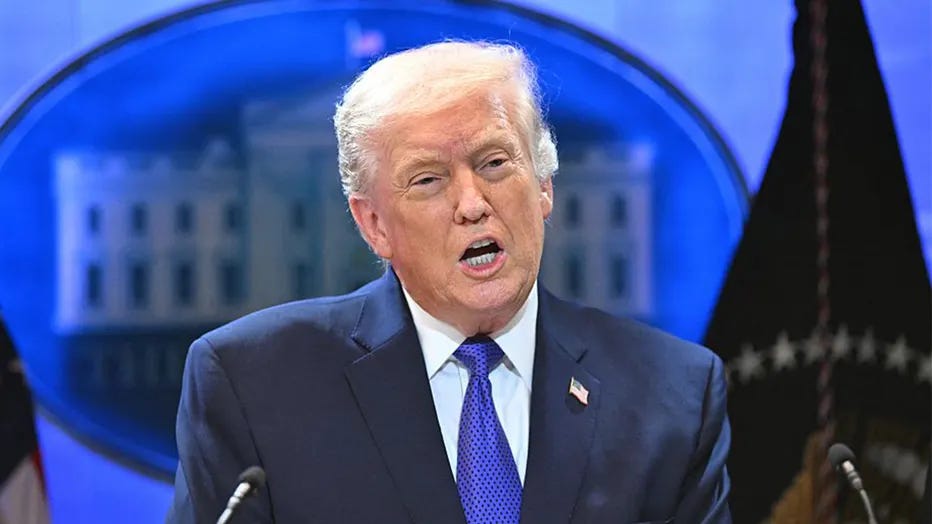
President Trump was furious.
His news conference swung from attacks on the Court to accusations, insults, complaints, bragging, and threats. But he didn’t stop at words.
Within hours, he signed a new executive order imposing a 10 percent across-the-board global tariff. This time, he cited a different statute: Section 122 of the Trade Act of 1974.
That law allows temporary tariffs to address a “balance of payments” problem — when the U.S. imports far more than it exports.
There’s one important limit: Section 122 tariffs last only 150 days. After that, Congress must approve an extension.
What the Court Did — and Didn’t — Say
The Supreme Court did not say a president can’t impose tariffs. It said Trump used the wrong law to do it quickly and broadly. But he still has tools.
Here’s what’s left in the toolbox:
1. Section 232 — National Security
Under the 1962 Trade Expansion Act, a president can impose tariffs on specific products if they threaten national security.
Steel and aluminum tariffs were imposed this way during Trump’s first term. Many remain in effect because they weren’t part of this case.
2. Section 301 — “Unfair Trade”
This allows the U.S. Trade Representative to investigate specific countries for unfair trade practices.
It requires formal investigations and hearings. It takes time. But it’s solid law and was used extensively against China.
3. Section 338 — The 1930 Option
This is an old statute from the Smoot-Hawley era. It allows tariffs of up to 50 percent on countries that discriminate against U.S. goods. It’s rarely used, but it’s still on the books.
4. Congress
The most straightforward solution would be legislation giving the president explicit, permanent tariff authority.
It’s also the hardest path. It requires votes.
The Next Legal Fight: Refunds
Billions of dollars were already collected under the struck-down tariffs. The Court did not decide whether businesses must be refunded.
That’s almost certainly the next battle.
If courts order repayment, the financial consequences could be enormous — not just economically, but politically.
The Larger Meaning
Congress writes tax law. The president executes it.
The Court just reminded the White House of that boundary.
The real question now isn’t whether tariffs will continue. They will.
The question is how far the president can push — and whether Congress is willing to reassert its authority.
Let me know what you think — leave a comment below. And check out the Disciples of Democracy podcast.
I'm actually hopeful Congress won't just follow Trump's orders with regard to tariffs at this point. Some have already been vocal about their approval of this decision.
Thank you Rob.