

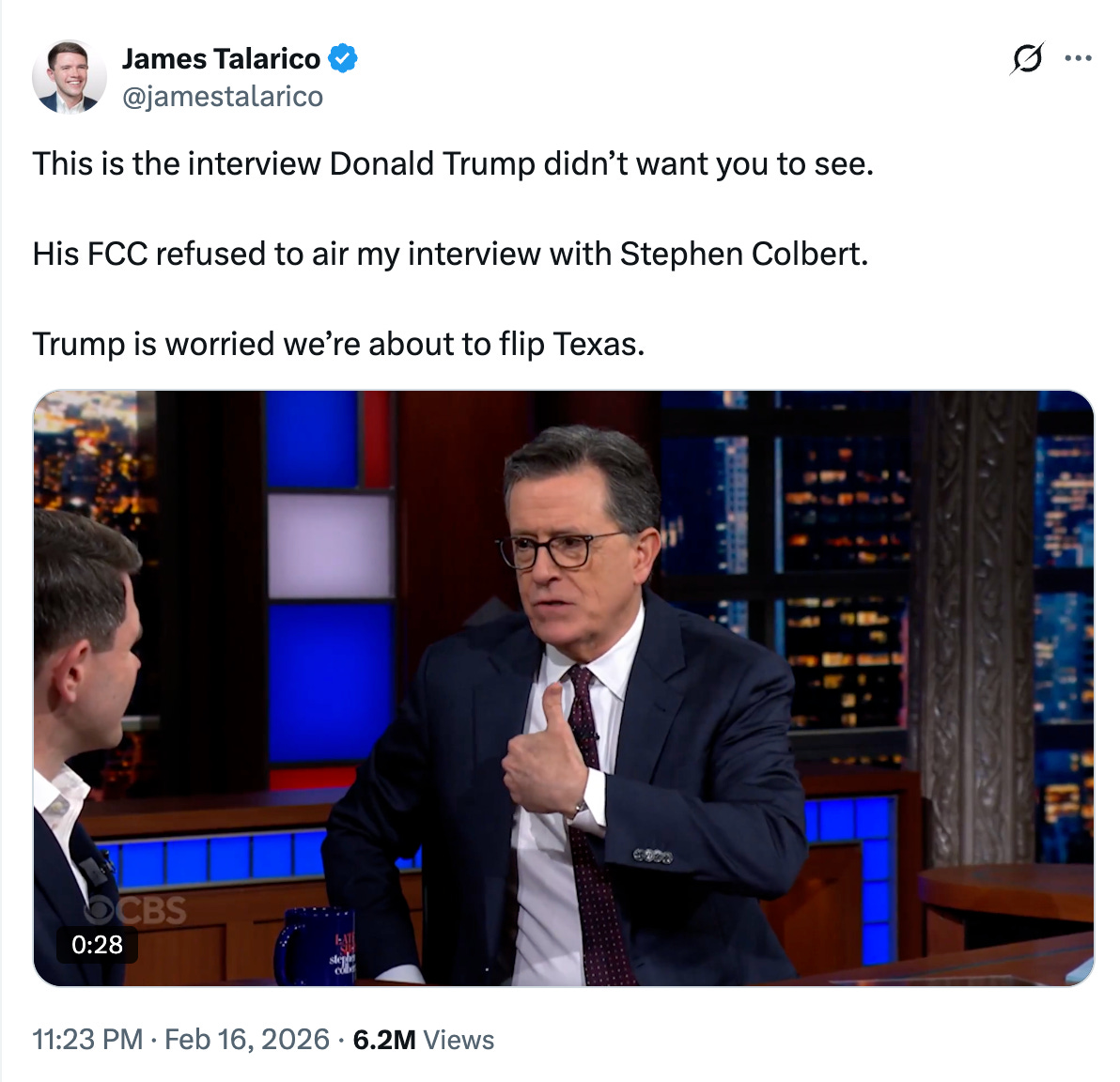
Stephen Colbert taped an interview with Texas Democrat James Talarico, who’s running for the U.S. Senate. It was a standard political conversation — commentary, sharp questions, a few funny asides.
It would have been just another Colbert interview with a political figure. Hardly worth mentioning.
Until CBS lawyers wouldn’t let him air it.
Colbert told his audience the network blocked it over “equal time” concerns. He ran a clip explaining why it wasn’t on the show — even though he says CBS told him not to mention it at all. Then he posted the interview online instead.
Ironically, the Talarico segment will now get far more attention than it ever would have.
The trigger was the FCC. The agency has opened an investigation into The View after it aired its own interview with Talarico. The suggestion is that letting a legally qualified candidate appear on a talk show might trigger the “equal time” rule — the old broadcast requirement that if you give one candidate airtime, you must offer the same opportunity to an opponent.
That rule dates back to 1934. It was built for a world of scarce spectrum. Three networks. A handful of stations. Limited public airwaves. So the government regulated access.
That world no longer exists.
Candidates have unlimited platforms. Social media. Podcasts. Streaming. Direct video feeds. Fundraising emails. The idea that Colbert interviewing a Senate candidate somehow distorts democracy is absurd.
There are exemptions in the law for genuine news interviews. For decades, late-night shows have qualified. The FCC has said so repeatedly — under Republican and Democratic administrations.
Ironically, one of the reasons for making those exemptions was for Rush Limbaugh, so he wouldn’t be required to give equal time to Democrats.
But now the FCC is signaling something different. It’s treating talk shows as potential violators. It’s opening investigations. It’s raising the cost of taking the risk.
So CBS lawyers did what corporate lawyers do.
They eliminated the risk.
That’s how the eye closes.
Let’s be clear about the chain of responsibility. No one from the government ordered CBS to pull the segment. No one needed to. The pressure was enough. The investigation into The View sent the message. The lawyers reacted. The host was overruled. The interview disappeared from broadcast.
Colbert made it public. He pushed back on air. He mocked the logic. He put the video online anyway.
James Talarico responded plainly: this is an attempt to silence him — and to keep Democrats from gaining traction in Texas.
You can argue about his politics. That’s not the point.
The point is that a broadcast network decided it was safer not to air a lawful political interview.
And yes, you’re not wrong to notice that right-wing talk radio — where conservatives dominate — is conveniently untouched by this new interpretation.
None of this is happening in isolation.
CBS News has been in turmoil for months. Bari Weiss was installed as editor in chief after the Paramount–Skydance deal. The shift rattled the newsroom. A 60 Minutes segment was pulled at the last minute before eventually airing. Executive producer Bill Owens left. Anderson Cooper is walking away from 60 Minutes after nearly two decades. There’s industry chatter that more correspondents could follow.
The audience has rendered its verdict. The ratings have fallen. The CBS Evening News remains in third place. Tony Dokoupil hasn’t closed the gap with ABC or NBC. The reboot hasn’t sparked a surge. The network is vulnerable. Corporate leadership knows it.
And the FCC, under Brendan Carr, is defining trouble in ways that align neatly with the president’s grievances against media outlets he doesn’t like.
The equal time rule was never meant to be a partisan cudgel. It was meant to ensure access in a scarce broadcast environment. Today, it functions as a regulatory tripwire. It encourages pre-compliance. It encourages silence.
When a news organization stops defending its own editorial space — even in entertainment programming — that’s not a technical dispute. That’s a cultural shift.
Once networks accept that regulators can redefine what qualifies as “news” based on ideology, the space for independent journalism shrinks. Not all at once. Just a little at a time. Until the light stops coming in.
What do you think? Leave a comment below. And check out the Disciples of Democracy podcast.