

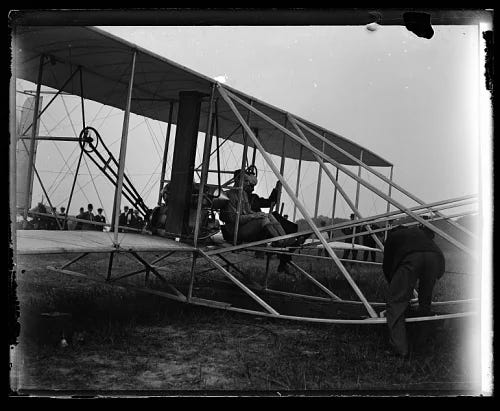
Five years after we figured out how to fly, somebody died doing it.
His name was Thomas Selfridge.
It happened on this date, September 17, 1908, at Fort Myer, Virginia, just outside Washington, D.C.
The Wright brothers had made their first powered flight at Kitty Hawk on December 17, 1903. Orville Wright stayed in the air for 12 seconds and traveled 120 feet. About the distance from home plate to second base.
Five years later, the United States Army was already interested, always on the lookout for cool military gear, and neat stuff that can be used in warfare.
The Army Signal Corps wanted a two-seat aircraft that could carry a pilot and a passenger, stay in the air for at least an hour, and fly at least 40 miles an hour.
Just flash forward a bit from there and think about what the Pentagon wants of its new fighters and drones.
So Orville Wright brought one of their airplanes to Fort Myer in September 1908 and started putting on demonstration flights.
And it was a pretty cool thing to demonstrate, because this was something most Americans had never seen before. And many of them believed that flying machines weren’t a workable idea.
But Orville was staying up longer and flying with passengers. On September 11, he remained in the air for more than an hour.
Less than a week later, Lieutenant Thomas Selfridge climbed aboard. He was just 26 years old.
He wasn’t just doing his military duty — he was utterly fascinated with flight.
He’d worked with Alexander Graham Bell’s Aerial Experiment Association, a group trying to build practical flying machines. He’d already gone up in experimental aircraft himself. Selfridge knew exactly what he was climbing into.
At 5:14 in the afternoon, Orville Wright took off with Selfridge beside him.
They circled the field. Once. Twice. Three times. Everything was fine.
On the fifth trip around, something went wrong. One of the wooden propeller blades split.
The airplane began shaking. Orville shut down the engine and tried to glide to the ground. For a moment, it looked like he might pull it off.
The airplane dropped from about 150 feet to around 75 feet. Then it plunged.
It hit the ground hard enough to smash the aircraft. Both men were badly hurt.
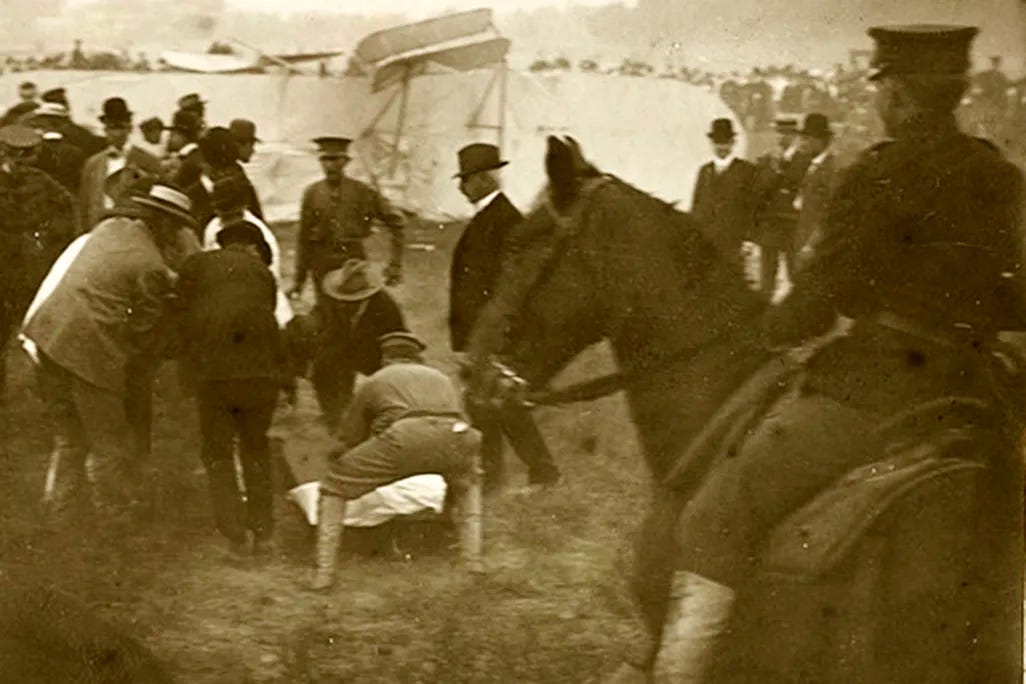
Orville Wright survived. He suffered serious injuries, including broken ribs and a broken leg or hip, depending on how the injury was described at the time. He spent weeks recovering.
But Selfridge never regained consciousness. He was taken to the post hospital and died during surgery.
Thomas Selfridge had become the first person in history to die in the crash of a powered airplane.
The story of human flight didn’t go from Kitty Hawk to Lindbergh to Pan Am to Apollo without a cost.
Considering what those early airplanes looked like, it’s almost surprising it took five years for the first recorded fatality. Those early airplanes were nothing but wood, wire, fabric, an engine, and a couple of propellers.
Nowadays, they’re so much more advanced. They come with amazing technology that’s always improving. Passenger jets can easily fly themselves for great lengths of time. We’ve got fighter aircraft that can travel at multiples of the speed of sound and maneuver like they’re toys.
And yet, people still die in crashes just like on that day in 1908.
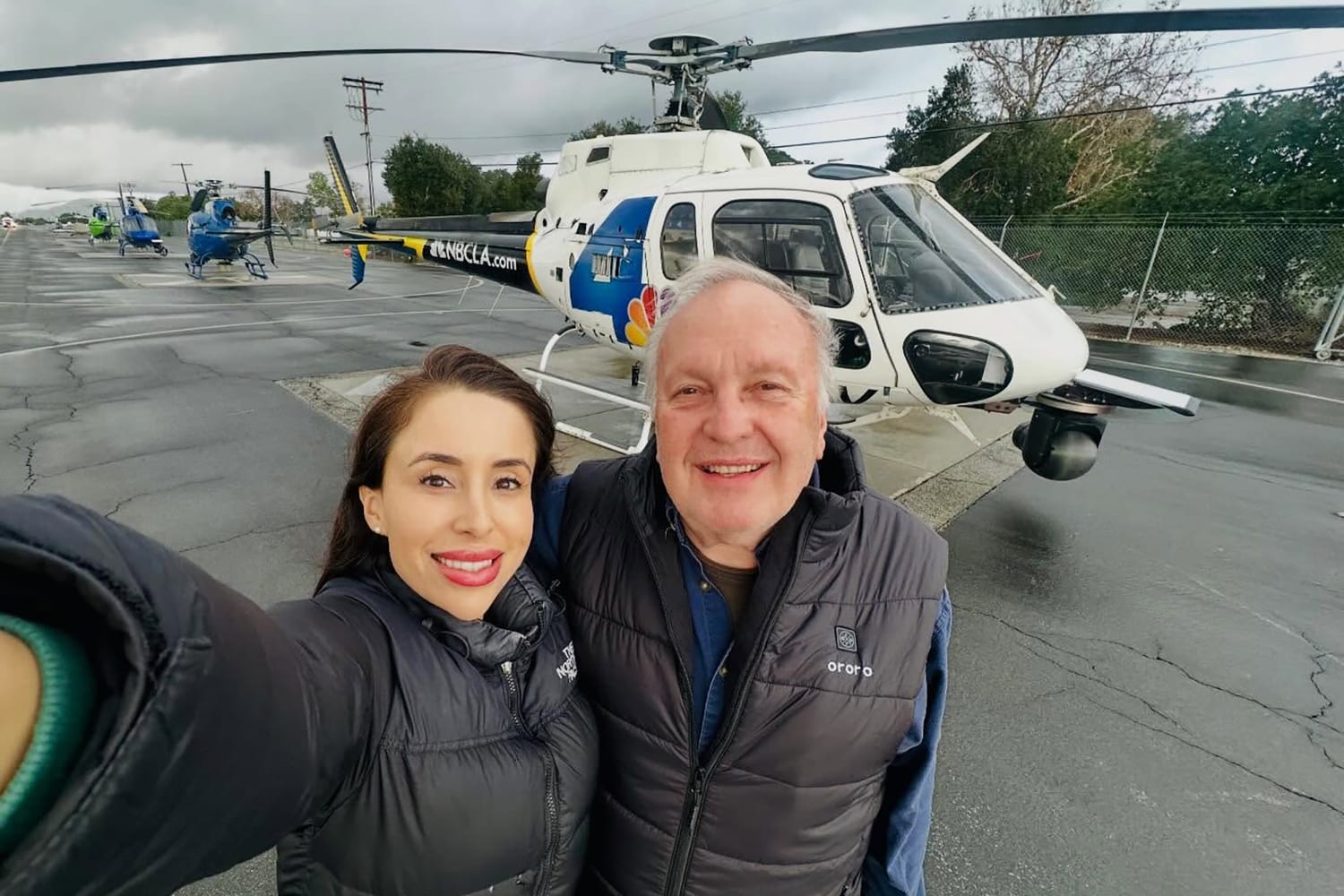
And just Tuesday night, word came of a terrifying crash that took the lives of a TV journalist, a pilot, and a man on the ground.
The NewsChopper4 helicopter that went down in Los Angeles while covering a bus crash came as a sickening shock. Aerial photojournalist Eliana Moreno and pilot George Marciniw were killed, along with Edy Gutierrez Mejia, who was on the ground.
The video feed from inside the chopper is scarier than anything a Hollywood disaster film might cook up. It almost seemed routine, nothing major, just a warning sound, the engine taking on a different tone.
But then the view begins to change and you know the helicopter is going down.
My heart aches for all involved. I didn’t personally know Moreno or Marciniw, but they were my colleagues in the news business in L.A.
But just like crashes now, the crash then didn’t end the science of building airplanes, or stop the progress of the technology. It certainly didn’t end the Army’s interest in planes.
The Wright Brothers came back the next year with another machine. In 1909, the Army bought it.
Six years after Selfridge died, airplanes were being used in World War I.
Eleven years after his death, Alcock and Brown flew nonstop across the Atlantic.
Twenty years after his death, regularly scheduled passenger aviation was taking shape.
Thirty-nine years later, Chuck Yeager broke the sound barrier.
Sixty-one years after Thomas Selfridge climbed into that primitive Wright airplane at Fort Myer, Neil Armstrong and Buzz Aldrin landed on the Moon.
That’s not even a full human lifetime.
Really interesting. I like the way you present all of this. Thank you, Rob.
With this tragedy, we realize the risks journalists take on a daily basis, both abroad and locally, to bring us the news and educate us. We are heartbroken when their lives are sacrificed, and grateful to those who continue. Long live the free press and God bless the folks who support and provide it!