

In the time I grew up there was someone in the box.
A local TV news anchor sat behind a desk with a team around him and told us what happened today. There were other people who told us the weather, the sports, and so on.
But it looks like TV is evolving beyond that.
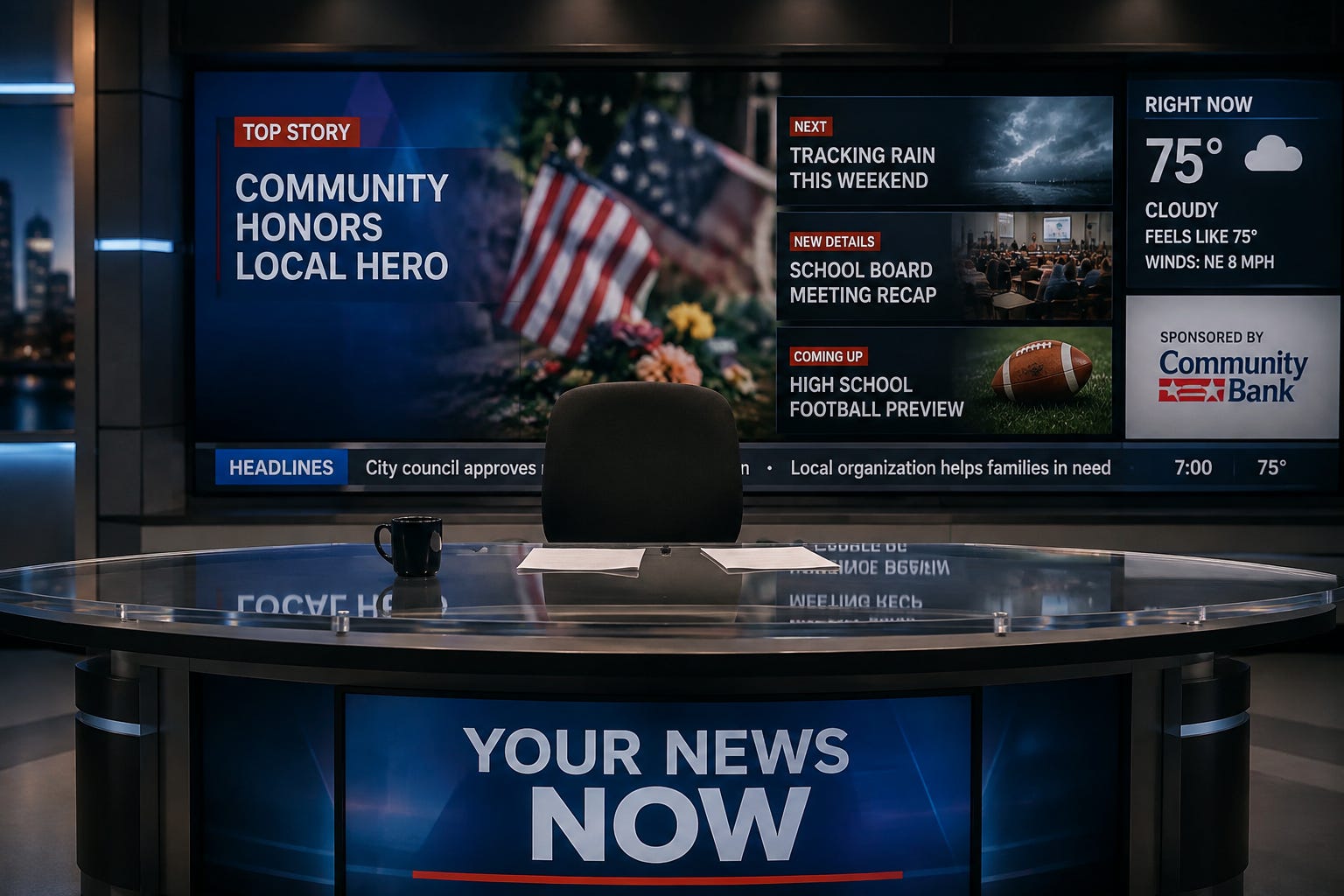
The E.W. Scripps Company, one of the largest owners of local television stations in the country, is rolling out a new model of local news that, in some time periods and markets, eliminates the anchor altogether. The anchor desk, too.
Instead, viewers get a continuous stream of prerecorded reports, weather, national material, and graphics connecting one story to the next.
The local newscast is becoming faceless. And Scripps says this is part of its plan for the future.
The company announced in August that it was eliminating 268 jobs as part of what president and CEO Adam Symson has called a “refounding” of Scripps.
The restructuring goes well beyond layoffs. Scripps is moving toward a digital-first operation built around streaming, automation, centralized functions, and artificial intelligence.
“We’re in the midst of transforming Scripps through fundamental changes in how we operate,” Symson said in announcing the company’s second-quarter results. He said those changes would use “today’s most advanced technology, AI and automation” to improve the company’s financial performance and better serve its audiences.
Among the changes: 24/7 local news streams.
Scripps says it’s rolling out in about a dozen smaller markets and intends to expand the concept across its local television stations, with the precise format determined by individual markets.
One place where viewers can already see what it looks like is Baltimore.
WMAR-TV, the Scripps-owned ABC affiliate there, began airing some evening newscasts without live anchors in August.
The Baltimore Banner described a 7 p.m. broadcast that opened with weather, followed by prerecorded local and national reports. Graphics replaced the anchor transitions between stories. There was reportedly dead air leading into commercial breaks at times.
Other WMAR newscasts still use anchors, and Scripps says its approach won’t be the same at every station.
But for some of the people who used to appear on WMAR, the change has already meant goodbye.
Morning anchors Megan Knight and Randall Newsome gave viewers an emotional farewell. Longtime evening anchor Kelly Swoope joined them in another goodbye message.
She told viewers, “We’ve all been a part of your families.”
Similar departures have been playing out at Scripps stations elsewhere.
In Corpus Christi, Texas, layoffs hit KRIS-TV as the station prepared for the company’s new streaming model. Reporter Bobby Poitevint thanked viewers for trusting his reporting and allowing him into their homes.
The reaction from some current and former journalists has been blunt.
Former WMAR reporter Megan Pringle wrote on Facebook that the consequences extend well beyond the people viewers see on television.
She wrote, “People will lose their jobs, not just the anchors, but the producers, photographers, editors, directors who make local journalism possible.”
Pringle argued that the new format eliminates part of the connection between a station and its community.
All this raises a very important question: What happens when a local disaster or major news story breaks?
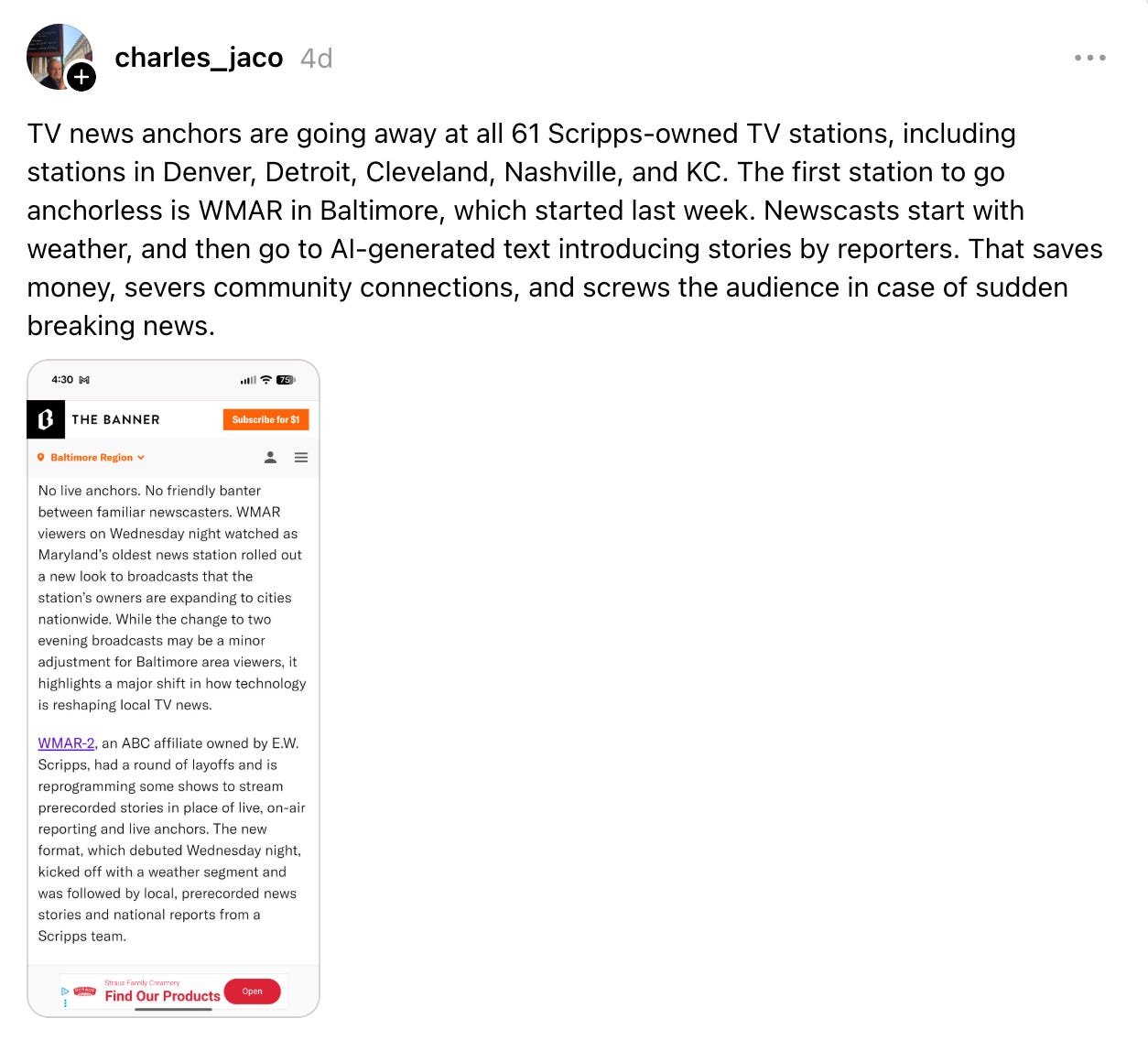
Veteran television journalist Charles Jaco said the approach could leave audiences poorly served during sudden breaking news.
Luke Russert raised a similar concern, pointing to the approaching anniversary of the September 11 attacks and asking what happens when viewers urgently need evacuation orders or other potentially life-saving information. How long will it take an anchorless station to get someone on the air?
Traditional local TV news is built around scheduled broadcasts. But those newsrooms are also expected to abandon the schedule when circumstances demand it. Tornadoes don’t always wait for the next scheduled newscast.
Neither does a mass shooting, an earthquake, a chemical spill, a wildfire, or any of the other events that can turn a routine afternoon into hours of continuous local coverage.
Scripps defends the move, saying its new model is intended to strengthen local reporting, not eliminate it.
Symson says the company wants more reporters in communities gathering stories throughout the day instead of concentrating its resources around traditional broadcast windows.
He wrote in a message to employees, “At a time when many communities are losing local coverage, the depth we are bringing is our competitive advantage.”
Scripps says anchors will remain an important part of its operation in many mid-sized and large markets, and that the company isn’t planning to make the change at all of its stations.
Artificial intelligence is another part of the transformation.
Scripps has been explicit about its intention to rely more on AI, automation, and other technologies as it tries to cut costs and remake the way newsrooms operate.
But the company’s published AI guidelines draw some lines around how the technology can be used.
Scripps says journalists are responsible for the accuracy of their reporting and that a human must always be accountable for the finished product.
Approved AI tools can be used for research and story or headline ideas, but journalists are required to verify the results.
The guidelines say AI is “generally prohibited” for scriptwriting, article composition, and photorealistic image generation unless other uses have been reviewed and approved.
Scripps has already been using AI for some newsroom work.
The company says it’s used it to convert TV scripts into digital stories, scan long government documents, reformat material for different platforms, and perform additional checks on journalistic content. Scripps says editors and news managers review material before publication and that human journalists are always responsible for editorial decisions.
It’s part of a broader shift in televised media.
AI and automation can perform tasks that once required people. At the same time, Scripps is reconsidering whether some of the people who have traditionally been central to a television newscast need to be there at all.
The economics behind the experiment are difficult to ignore.
Local TV is competing for audiences that get news from phones, social media, websites, YouTube, and streaming services rather than turning on a television at 5, 6, or 11 p.m.
Scripps says it expects these changes to produce substantial savings and revenue improvements over the next several years. That’s a common refrain these days, but the company describes them as necessary to make local journalism sustainable.
For the journalists losing their jobs, the transformation looks very different.
After layoffs hit KRIS in Corpus Christi, multimedia journalist Andrew Bishop posted a message telling viewers that he had survived the cuts.
Then he made a point of explaining how he works.
“A.I. plays ZERO role in my reporting,” Bishop wrote.
He said he writes his own scripts and social media posts, and personally conducts the interviews used in his stories.
“I don’t put those responsibilities in the hands of automation.”
For most of television’s history, the people delivering the news have been among the most visible parts of the product.
Scripps’ new model is built around a different assumption: that viewers care more about having local information available whenever they want it than about having that information presented by a familiar person at a specific time of day.
Like many other forms of traditional media, the numbers show a decline. Is the path forward for local TV news to act more like a streaming service than a television station?
The viewers will make the final call.
@Rob Archer You are right to focus on the anchor because that’s the most obvious part of this change, but just as significant for those of us who know how the work is done is the loss of the SHOW that surrounds the anchor. A whole sub-industry has been built over decades around the role of the show producer and it has become the primary path to newsroom management. But the show is no longer holding viewers in their seats. Instead, we get…the stream. I’m not sure it will work either for a generation used to everything on demand but the idea they will wait for a linear presentation (and its commercials) is either dying or dead. Long live EYEWITNESS NEWS ! Film at 11.
Perhaps Scripps means what it says. But I can’t help but think that the bottom line in all of these changes is… the bottom line. Many of us who have been in the television industry have been saying for a while that the traditional over-the-air, network-affiliate business model for local stations may only have a decade left. I’ve read or heard nothing lately that makes me think otherwise.