
The Most Dangerous Word in American Politics
The Founders narrowly defined “treason” for a reason. Trump keeps using it against journalists.

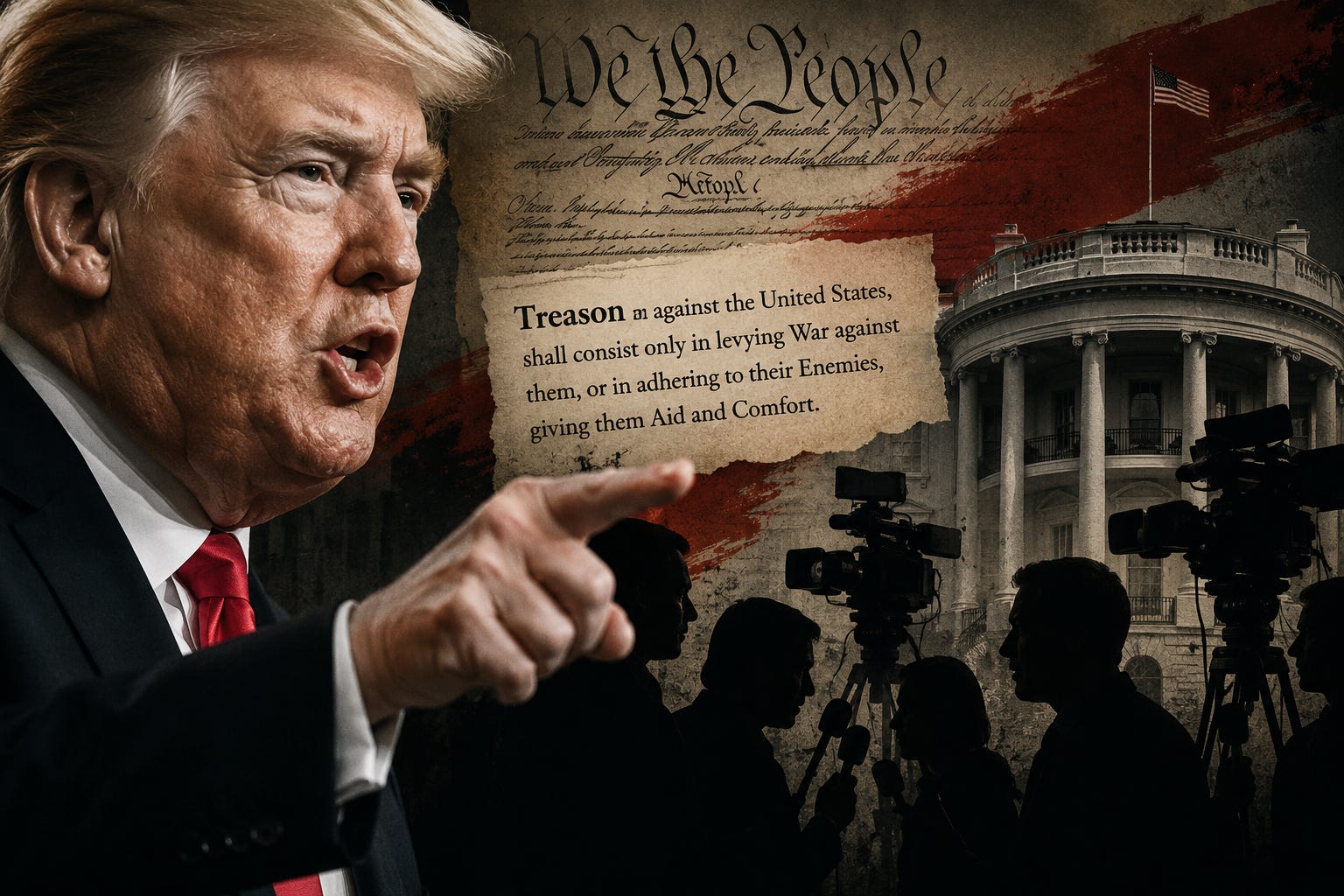
Once again, the President of the United States is accusing journalists of “treason.”
This time it happened aboard Air Force One, where Trump lashed out at New York Times reporter David Sanger over reporting on the war in Iran.
“I actually think it’s kind of treasonous what you write,” Trump said. Then, moments later, he doubled down. “I actually think it’s treason.”
Here’s the whole exchange.
The Founding Fathers considered treason so dangerous as a political weapon that they did something extraordinary: they narrowly defined it — and no other crime — directly in the Constitution itself.
The Constitution says treason against the United States consists only of “levying war” against the country or “adhering to their enemies, giving them aid and comfort.”
The founders knew exactly what governments and kings had done with accusations of treason throughout history. They had watched monarchs use it to destroy political enemies, silence critics, imprison dissidents, and intimidate the press.
In England, criticizing the crown could become an act of disloyalty. At some points in history, merely suggesting the King might someday die was considered treasonous speech.
Under authoritarian governments throughout history, the pattern repeats over and over again. First, the press is accused of bias. Then corruption. And down the list — sabotage, betrayal, and then treason.
A free press in a democracy is supposed to challenge power. It’s supposed to be free to ask questions, to hold leaders accountable to the people they’re supposed to be representing. But in authoritarian systems, especially when they’re built around cults of personality, criticism of the leader gradually becomes criticism of the state itself. And criticism of the state becomes betrayal.
History shows that language like this changes the atmosphere around journalism.
The public starts seeing journalism itself as suspicious, dangerous, and un-American.
And once that happens, pressure on the press becomes easier to justify.
The pressure takes many forms: Regulatory threats and lawsuits. License revocations. Journalists kicked out of the White House and the Pentagon. Harassment campaigns and reporters being arrested.
Public threats.
Sometimes governments don’t even need to formally censor the press. Fear does the work for them. The most effective authoritarian systems leave newspapers technically alive while making independent reporting increasingly dangerous, exhausting, expensive, or socially toxic.
Russia still has journalists. So does Hungary. So does Turkey. But ask reporters in those countries how free they really are.
They won’t be allowed to tell you.
John Adams signed the Sedition Act in 1798, making criticism of the federal government punishable by law. But the backlash to that became so intense that the law helped fuel Adams’ defeat.
During World War I, Woodrow Wilson’s administration used the Espionage and Sedition Acts to prosecute dissenters and anti-war activists.
Richard Nixon constantly portrayed the press as enemies undermining the country.
Authoritarian regimes throughout the twentieth century routinely described independent journalism as treasonous or traitorous. Stalin did it. Hitler did it.
Because controlling the narrative always requires discrediting the people who challenge it.
And here’s the uncomfortable part. Americans are becoming numb to this language. “Enemy of the people.” “Traitors.” “Anti-American.” “Treasonous.”
The words have become the background noise of political entertainment — another viral clip, outrage, a fire burning hot for a few hours or a day and then moves on to the next viral clip. The next attack.
That’s how democratic erosion usually works. And eventually, people stop reacting at all.
A president accusing reporters of treason for unfavorable coverage should still sound alarming in the United States of America.
Journalism cannot function in a free society if reporting information the government doesn’t like is treated as a betrayal of the country itself.
If I were trying to be above all this, I wouldn’t point out that Trump himself spent years attacking Obama and Biden with far harsher language than anything David Sanger wrote about him. He amplified conspiracy theories. He promoted dubious reporting constantly when it benefited him politically.
But now that he’s in office, don’t you dare say anything about him like what he said about Obama, Biden, or Hillary Clinton.
That would be “treason.”
So well written. Thank you Rob.
Thank you Rob. We constantly need to be reminded of these dangers, so that we do not become inured to the discouragement of free discourse.