The Real Reason for ICE Surges
Why Minnesota was targeted while Texas and Florida were not - and what this might mean on election day
Here’s a quick reality check: Texas and Florida each have millions more undocumented immigrants than Minnesota. Minnesota has roughly 130,000 people living in the country without authorization — a fraction of the numbers in Texas and Florida. Yet somehow, Minnesota became the focus of one of the largest federal immigration crackdowns in years.
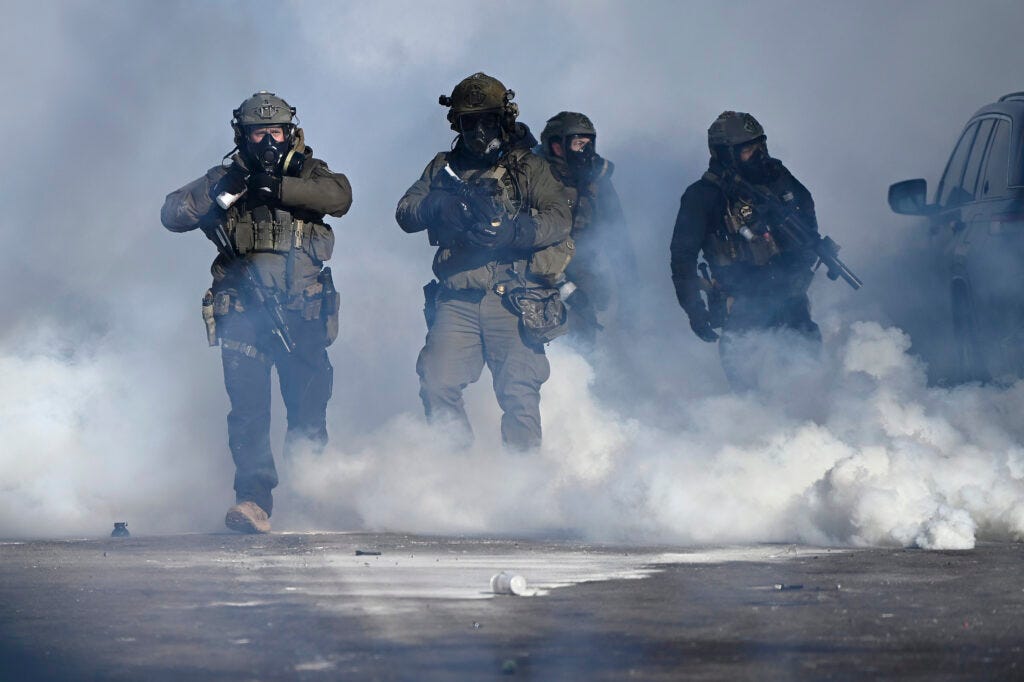
In late 2025, the federal government launched Operation Metro Surge — sending thousands of ICE, CBP, and Border Patrol agents into the Minneapolis–Saint Paul area. Officially, the goal was to arrest undocumented immigrants. In reality, the raids disrupted daily life, left two Americans dead, more injured, prompted lawsuits from state and city officials, and set off protests from Minneapolis to San Francisco and New York.
This isn’t about enforcement metrics. It’s about message-making.
If immigration enforcement were driven by population data, Minnesota wouldn’t be ground zero. Texas and Florida, with far larger undocumented populations, would be. Minnesota officials say the real motive is political — punishment for sanctuary policies and for refusing to cooperate with federal immigration priorities. That’s the central claim in a lawsuit filed by the state attorney general and the mayors of Minneapolis and St. Paul.
Minnesota leans deep blue. Its leaders have pushed back hard against federal immigration efforts. Texas and Florida — red states with far more undocumented residents — haven’t faced anything like this. Compare the enforcement maps to the election maps, and a pattern appears: the tougher the resistance, the heavier the response.
Operation Metro Surge has led to thousands of arrests, the deaths of Renee Good and Alex Pretti, countless videos of lawless and aggressive behavior from federal agents, and nationwide protests.
Minnesota asked a federal judge to halt the operation. The judge refused — not because the operation was deemed lawful, but because of procedural limits on court intervention. Still, the claim at the heart of the case remains: the surge is unconstitutional retaliation. That’s not fringe talk. It’s coming from the state’s top lawyers.
Yes, there are ICE and CBP agents carrying out roundups in red states, but their usual brutal tactics and aggressiveness toward bystanders aren’t as prevalent. They’re not acting like an invading army, like they are in blue states.
Immigration debates are one thing. Using law enforcement to punish political opposition is another. When federal power targets states that resist its agenda — regardless of actual numbers — that’s not policy. It’s intimidation.
We have to ask whether we’ll see ICE surges in blue areas and near polling places on midterm election day.
Steve Bannon says so. On his War Room podcast today, he said, “We're going to have ICE surround the polls come November... We're not going to sit here and allow you to steal the country again. And you can whine and cry and throw your toys out of the pram all you want, but we will never again allow an election to be stolen.”
Of course, that’s highly illegal. And Bannon is not an official member of the Trump administration. But should Trump endorse the idea, he hasn’t seemed to worry about illegality.
Once that door is open, any administration can use federal agencies to go after its opponents. That’s the real danger. Because in a democracy, the rule of law can’t depend on who holds power. And it should worry everyone that the Trump administration doesn’t appear troubled by this, as if it never expects to be out of power.
Bottom Line
Minnesota does not have a large undocumented population.
Yet it’s been hit with one of the biggest immigration enforcement surges in years.
State officials say this is political retaliation, not neutral law enforcement.
That’s not just an immigration story. It’s a story about power — and how it’s being used.
What do you think? Let me know in the comments. And check out Disciples of Democracy for lots more.


(Wisconsin) Thank you, Rob.
You are correct. Here in the Midwest we just don't see many immigrants without documentation. I worked in management at small business and did HR, payroll, etc. I did not encounter immigrants here illegally but ONE time. When I did it really surprised me. Texas and Florida have more issues just due to their location. It's common sense. So if the goal is not to enforce immigration it is clearly something else. Common sense. Also doesn't take a rocket scientist to narrow the options.