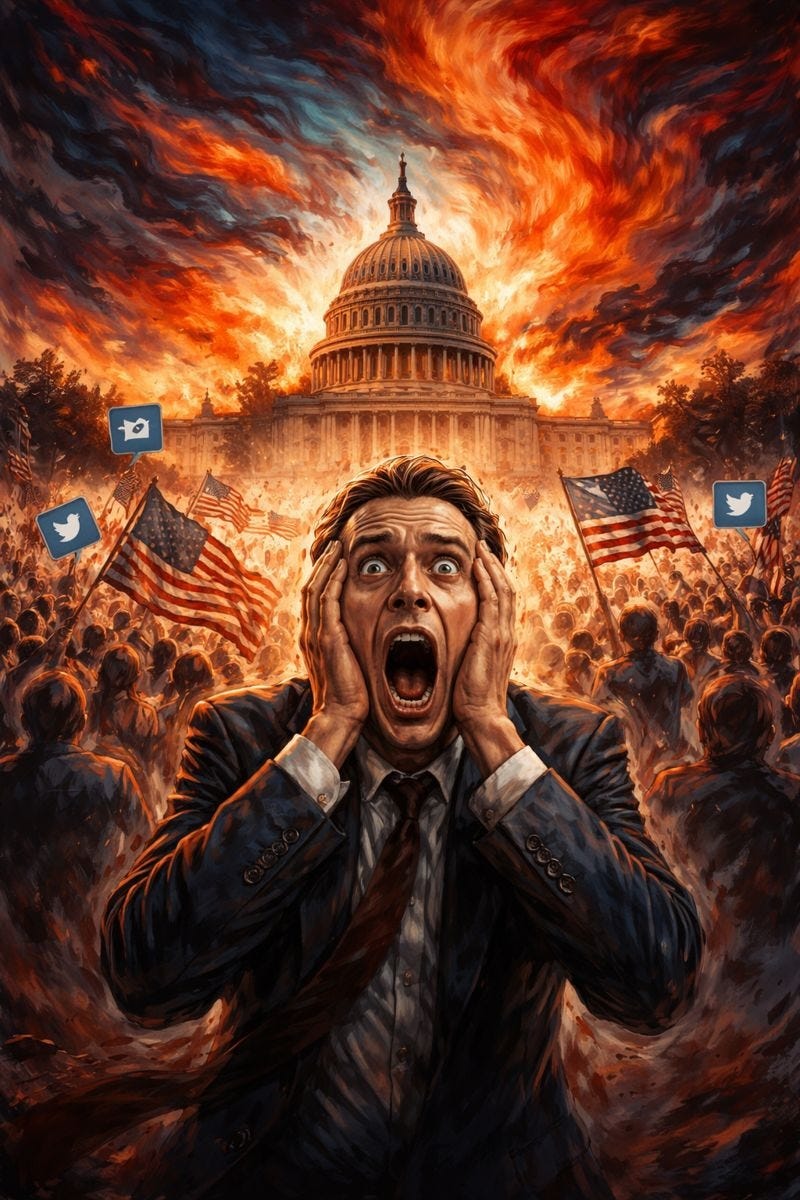
The Trump Era and the American Mind
How a decade of political stress, division, and outrage has affected mental health in America
We’ve talked a lot about Donald Trump’s mental state. But it’s worth stopping to look at ours.
Something has gone wrong with our mental health.
Not overnight. Not because of one bad year. But steadily, over about a decade. And when you line up the data, the research, and what people say they feel every day, one thing stands out:
The Trump era has not been mentally healthy for a lot of Americans.
That doesn’t mean every problem started with el Presidente. It doesn’t mean politics is the only cause. It does mean something changed around 2015–2016 — and we’re still living with it. And not just because of the Covid pandemic, though that clearly made things worse.
Look at the numbers.
According to federal data from the Substance Abuse and Mental Health Services Administration, around 2009 about 18 percent of American adults reported having a mental illness in a given year. By 2022, that number had climbed to about 23 percent — nearly 60 million people.
Depression has risen even faster. Data from the Centers for Disease Control and Prevention show that over the last decade, reported depression among adolescents and adults jumped by about 60 percent. Gallup polling adds another stark data point: nearly 3 in 10 American adults now say they’ve been diagnosed with depression at some point in their lives.
At the same time, more people are seeking help. CDC surveys show that from 2019 to 2023 alone, the share of adults getting some form of mental health treatment rose from about 19 percent to nearly 24 percent.
Some of that is good news. There’s less stigma. People are more willing to say they’re struggling. That matters.
But it doesn’t explain everything.
If this were only about better awareness, we wouldn’t also be seeing rising anxiety, rising loneliness, rising anger, and rising exhaustion — especially among young adults and women.
And it can’t all be laid at the feet of the pandemic.
Something else is going on.
One big change is that politics stopped being background noise and became a constant presence.
For most of American history, politics came in waves. Elections. Crises. Big moments. Then it faded back into the distance of daily life.
That’s no longer true.
Politics now lives in our pockets. In our feeds. In our group texts. At family dinners. At work. In bed, at midnight, glowing on our phones. We’re more divided than ever — so much so that it creeps into literally everything, even things that were never political before.
The American Psychological Association has been tracking this shift for years. In its most recent “Stress in America” reports, more than 3 out of 4 adults say “the future of our nation” is a major source of stress. Nearly 7 in 10 say elections themselves are a major stressor — a sharp jump compared to surveys taken before Trump entered office.
This isn’t abstract worry. It’s physical.
People report trouble sleeping. Trouble concentrating. Shorter tempers. Constant vigilance. A sense that something bad is always about to happen.
Politics has become a chronic stressor — not a debate, but a threat.
The Trump era accelerated this shift.
Trump didn’t invent division. But he normalized it. He turned conflict into performance. He rewarded outrage. He blurred the line between politics and identity. Almost every day since his second term began, he’s done something that invades and shatters what was once considered normal.
Under Trump, politics stopped being about policy disagreements and became more personal and more corrosive. Who you voted for became a proxy for who you are. And who you are determines whether you’re seen as a threat.
And feeling threatened by the vast power of the federal government is a huge factor.
That kind of environment isn’t healthy for the nervous system.
Surveys cited by psychologists show many Americans now say political tension makes them less likely to connect with others. Families avoid certain topics. Friendships quietly fade. People withdraw rather than risk another argument.
This is what some psychologists now call a “crisis of connection.”
And connection matters more than we like to admit.
Loneliness isn’t just sad. It’s dangerous. Research cited by the Surgeon General links social isolation to higher risks of anxiety, depression, and even physical illness. Humans are social animals. When we pull apart, we suffer.
Add social media to the mix and things get worse.
Social platforms are optimized for engagement, not well-being. Outrage keeps people scrolling. Fear keeps them hooked. And politics — especially in the Trump era — has been a perfect fuel source.
Social media makes its money this way. That means it’s not going to stop, and it’s not going to get better.
Multiple national surveys show many Americans say their anxiety about politics comes directly from what they see on social media. Not from reading full articles or watching long speeches, but from endless clips, headlines, and arguments stripped of context and delivered at maximum emotional volume.
This constant exposure has a name now: doomscrolling.
And it works exactly as advertised. It keeps you scrolling while slowly wrecking your mood.
None of this means earlier times were perfect.
The years before 2015 had their own stressors. Wars. Terrorism. Economic collapse. But there was still a sense — however fragile — that reality itself was shared.
That sense has weakened.
The Trump era didn’t just bring a different political style. It brought a different emotional climate. One where trust eroded, norms collapsed, and the volume never came down. The daily battering of outrage never stops. Embracing authoritarian enemies. Breaking relationships with allies. Normalizing racism and hate. Sending barely trained, heavily armed, masked thugs into American streets to target Americans. Instilling fear as government policy.
Even people who support Trump report higher stress levels tied to politics. Living in a constant state of conflict takes a toll, no matter which side you’re on.
And here’s the important point:
You don’t have to follow politics closely for it to affect you anymore. Politics follows you.
That’s new.
It helps explain why mental health has declined even as awareness and treatment options have improved. We’re asking more of our minds than they were built to handle.
Permanent alert. Permanent outrage. Permanent uncertainty. And no off switch.
This doesn’t mean we should ignore what’s happening in the country. It does mean we need to be honest about the cost of living this way.
The Trump era has reshaped not just our politics, but our inner lives. And pretending otherwise doesn’t make it less true.
In a future piece, I’ll write about ways people are trying to cope — what helps, what doesn’t, and how to protect your mental health without sticking your head in the sand. If you haven’t already, please subscribe so you won’t miss it.
Whether you love Trump, hate him, or are just exhausted by all of it, one thing is clear:
This era has been hard on the American mind.
I’d like to hear from you. Leave a comment below about how political stress is showing up in your life, and what you do — if anything — to cope with it.


