

Donald Trump has spent years calling the free press “the enemy of the people.” It’s the same framing used by authoritarian leaders everywhere to justify control, intimidation, and the eventual capture of media institutions.
What’s happening with Nexstar–Tegna fits the pattern.
The Nexstar Media Group–Tegna deal would merge two major local TV owners, allowing Nexstar to absorb Tegna’s stations and reduce the number of independent station owners across U.S. markets.
Trump opposed media consolidation when he believed it might benefit outlets that criticized him. In November, he echoed Newsmax’s objections and warned that any deal allowing “Radical Left Networks to enlarge” would make him “not be happy.” Then, the merger was bad — not because consolidation harms competition or local journalism, but because it might strengthen voices he dislikes.
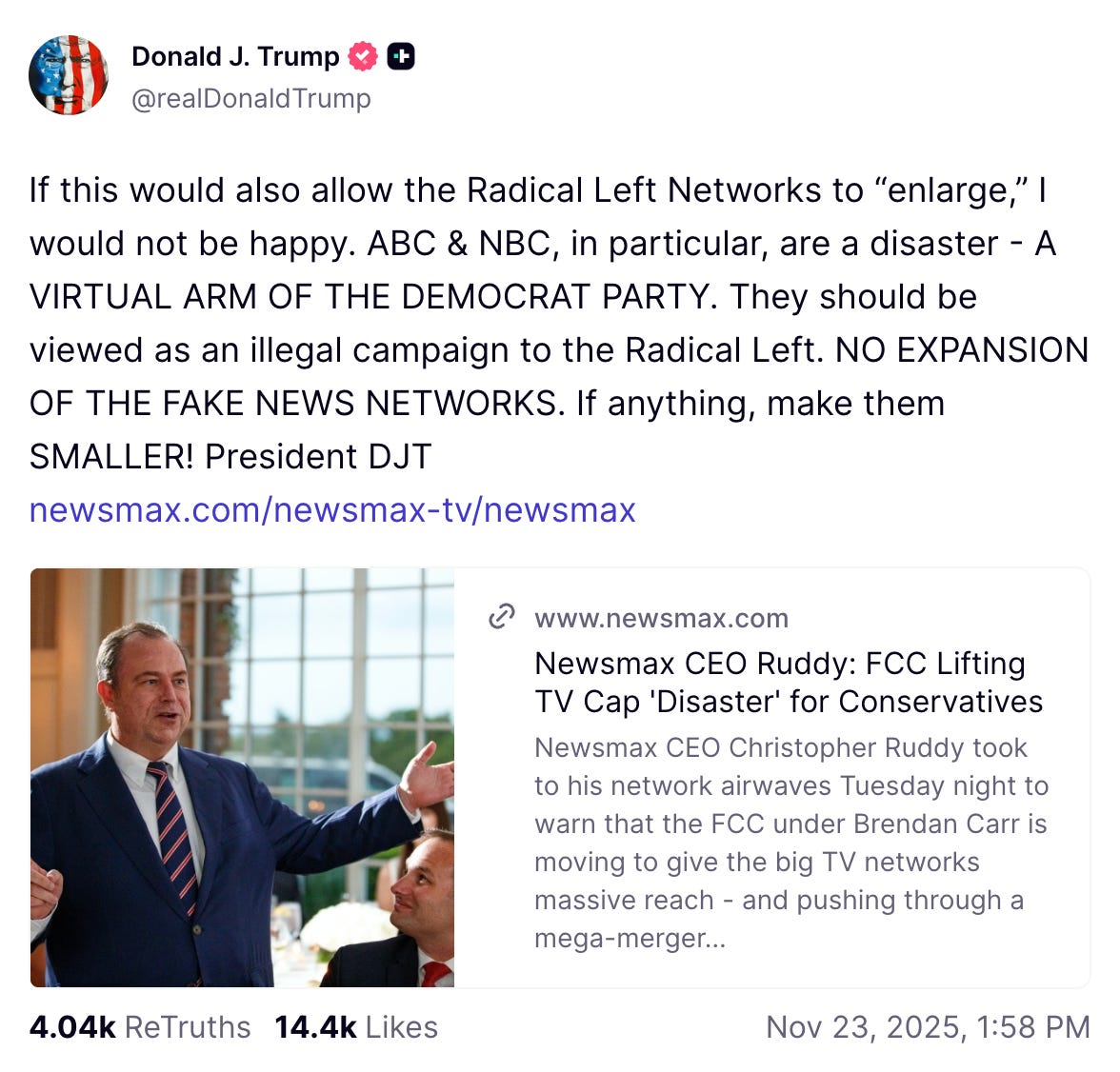
Now the calculation has changed. Nexstar courted him aggressively, branded itself “anti-fake news,” praised his policies on Fox Business, and shifted NewsNation’s programming in a more MAGA-friendly direction. Trump changed his mind. Suddenly, consolidation is good. Suddenly, mergers are “competition.” Suddenly, regulatory caps need to be loosened — as long as the beneficiaries are friendly.
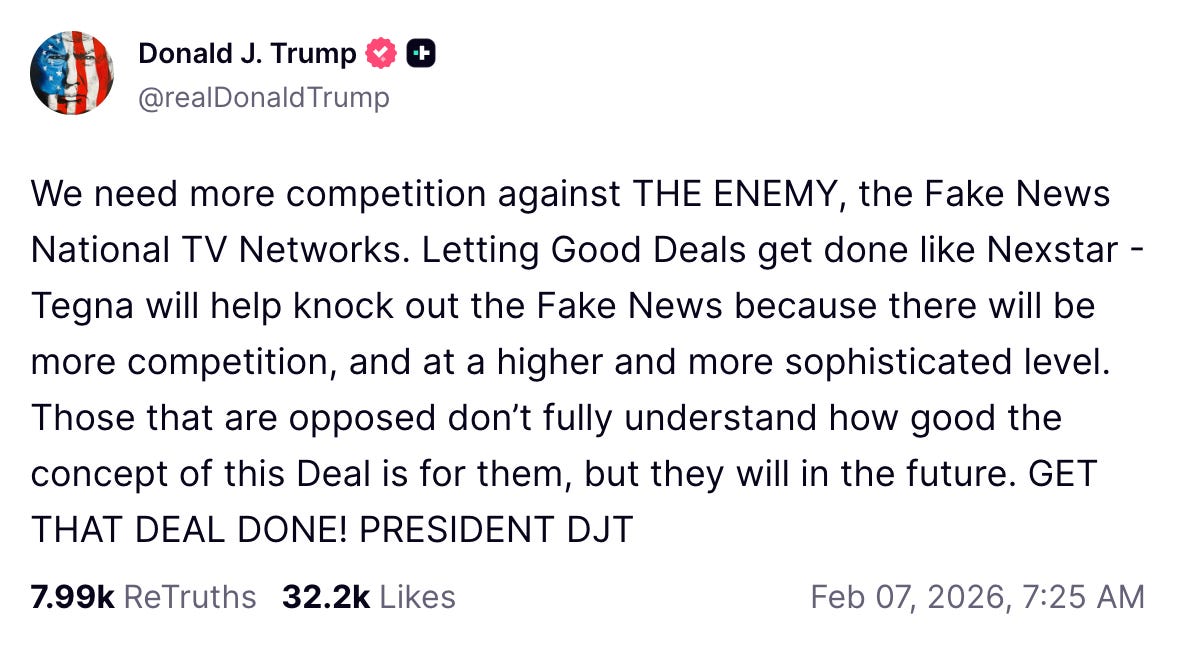
When Trump calls the press “THE ENEMY” while blessing a merger that shrinks the number of independent owners, he’s not promoting competition. He’s promoting alignment. Ownership concentration becomes acceptable — even desirable — if it produces compliant media ecosystems and weakens adversarial journalism.
We’ve seen this movie before.
In Hungary, Viktor Orbán encouraged friendly oligarchs to buy up newspapers, radio stations, and TV outlets, then merged them into a single pro-government media foundation. Independent voices weren’t banned outright — they were economically starved and politically isolated.
In Turkey, Recep Tayyip Erdoğan used regulatory pressure, tax penalties, and state-aligned buyers to force critical media into friendly hands. Journalists were marginalized, fired, and replaced.
In Hong Kong, Beijing didn’t immediately shut down the press. It targeted owners, advertisers, licenses, and legal exposure until once-independent outlets collapsed or self-censored themselves into irrelevance. Monday morning, Jimmy Lai — the city’s most prominent and defiant China critic — was sentenced to twenty years in prison under the national security law, the largest such case since Beijing crushed the city’s press freedom. Critics say it amounts to a death sentence for the 78-year-old publisher.
The pattern is always the same:
Label critical media as enemies.
Reward friendly owners.
Use regulators as enforcers.
Call consolidation “reform.”
Call intimidation “oversight.”
When the FCC cheers presidentially approved deals while simultaneously launching probes into shows like The View, it stops looking like neutral regulation and starts looking like selective pressure. The lone Democratic commissioner, Anna Gomez, calls it intimidation — and she’s right. Just the threat of FCC action, even if unwarranted or baseless, is enough to change media behavior. What happened to Jimmy Kimmel is the prime example.
And Trump’s claim that this will somehow create “more competition” is nonsense. Fewer owners mean fewer decision-makers, fewer editorial standards, and fewer places for journalists to land when they’re pushed out. Markets like Denver, Seattle, and Dallas won’t get more voices — they’ll get fewer, filtered through corporate and political incentives.
A president who calls journalists the enemy, changes regulatory rules based on loyalty, and personally blesses media mergers is not defending free speech. He’s shaping the press to serve him.
What do you think? Let me know in the comments below. Please share the article and consider becoming a paid subscriber to help support my work. And check out the Disciples of Democracy podcast.
You're right. It's entirely clear what his motives are and his goals seem equally obvious. I have become increasingly watchful of where I get news and always check sources but it makes me weary and worried.