

The other day, we did a wellness check on the First Amendment. But democracy in America itself needs a wellness check. We can see movement inside the house, but no one’s opening the door.
This week, a group of political scientists in Sweden who have spent more than a decade building the world’s most comprehensive democracy database put a number on what a lot of us have been feeling but couldn’t quite put into words. The Varieties of Democracy Institute — V-Dem, out of the University of Gothenburg — released its annual report, and the section on the United States reads less like an academic assessment and more like a chart from a patient who came in looking fine and left with a serious diagnosis.
The title of this year’s report is “25 Years of Autocratization — Democracy Trumped?” The question mark in the subtitle is doing a lot of work.
What the Numbers Say
For the first time in more than twenty years, there are more autocracies than democracies on the planet. We have crossed a threshold.
The level of democracy for the average world citizen is back to 1985. Two and a half decades of democratic progress, erased.
The United States got special attention in the report — and not the good kind. V-Dem identified the country as undergoing the fastest democratic backsliding in American history. In one year, the U.S. Liberal Democracy Index score fell 24 percent. Our world ranking dropped from 20th to 51st. The level of democracy is now back to where it was in 1965 — the year most analysts consider the real beginning of American democracy as we understand it.
Sixty years of progress, gone in a year.
The hardest hit category: legislative constraints on the executive branch, which lost a third of its value and hit its lowest point in over a century.
Staffan Lindberg, the institute’s founder, said the quiet part out loud after the report dropped. He told reporters that, at the current pace, the United States will stop qualifying as a democracy before summer. Not a liberal democracy — a democracy, period. He goes on to say, “It would mean that the rule of law, the constraints of the executive — that they would be gone to such an extent that we can no longer talk about even a constitutional republic.”
It’s Not Just V-Dem
Here’s the thing about dismissing one organization’s findings: you can’t dismiss all of them.
The Century Foundation’s new Democracy Meter gave the U.S. a 79 out of 100 for 2024, then dropped it to 57 for 2025. In one year. Their authors say U.S. democracy is now at greater risk than at any time since Watergate, possibly approaching its pre-Civil Rights era low. That’s nearly a 28 percent drop, well into what they categorize as authoritarianism.
Freedom House, which has tracked global freedom since 1941, says the U.S. has fallen 11 points over 13 years on its index, and now sits behind 53 other countries on freedom. Global freedom declined for the 19th consecutive year.
Three organizations. Three methodologies. Same diagnosis.
(All the links are below.)
The First Domino
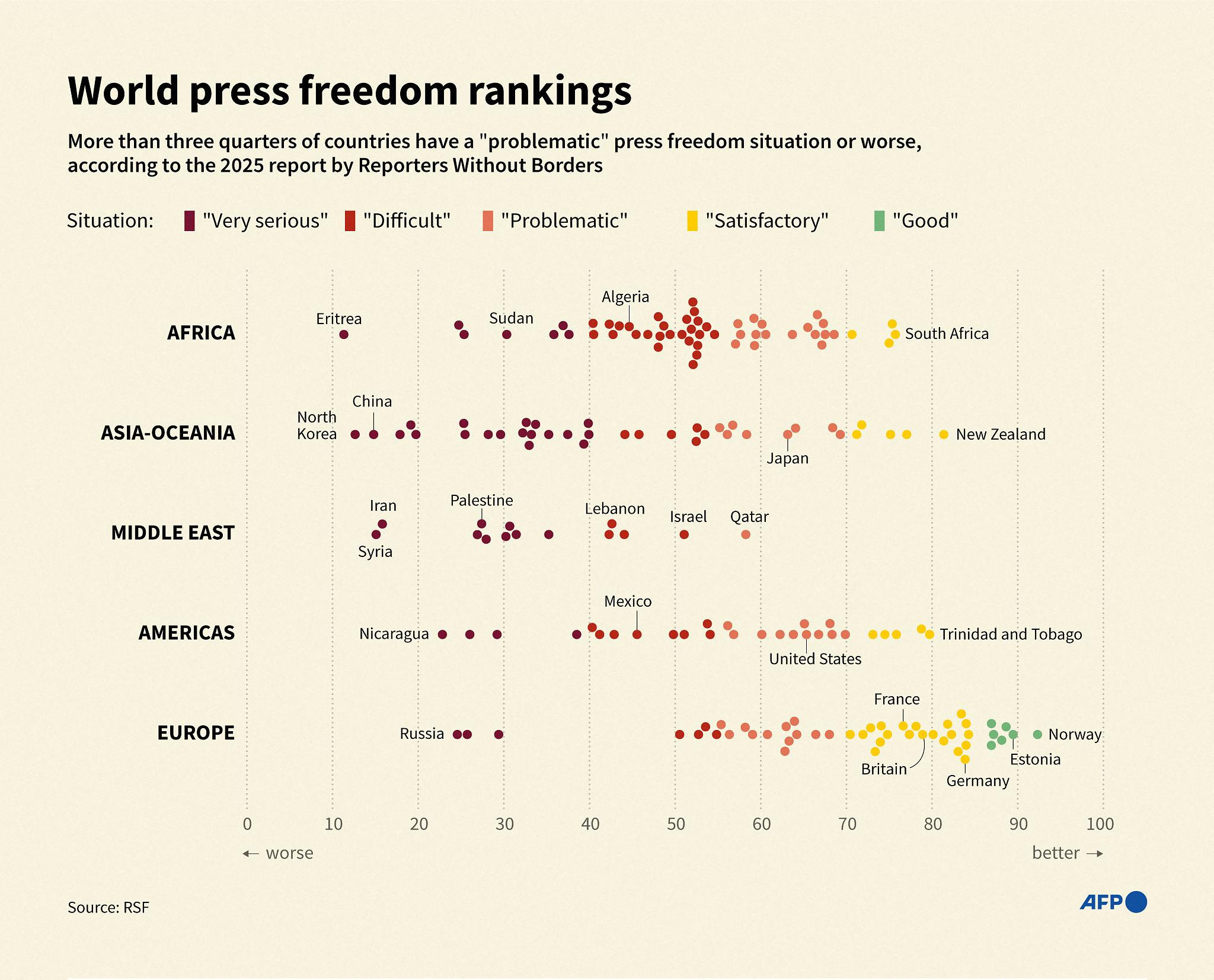
V-Dem has documented what happens to free expression during democratic backsliding across dozens of countries, and the pattern is consistent. Media suppression is the first move. Always. Lindberg calls government censorship of the press “the preferred weapon of choice” for leaders steering countries away from democracy. Half of all autocratizing countries are also ramping up state disinformation at the same time.
V-Dem’s researchers say the logic of the Trump administration’s early actions follows what they call “the script” — tightening executive control over independent agencies, weakening congressional and judicial oversight, and going after civil society and the press.
A Parallel Worth Sitting With

The Weimar Republic, Germany’s democracy after World War I, had one of the most progressive constitutions in the world when it was founded in 1919. Free press. Free speech. Universal suffrage. Equal rights. On paper, it was a model.
It didn’t collapse overnight. Conservative forces hostile to democracy were embedded in the power structure from day one. The parties that believed in the republic tolerated them in the name of stability. That tolerance proved catastrophic. The Nazi Party never even won a majority, just over 30 percent in the republic’s last free election. But the mainstream kept making concessions, each one seeming reasonable on its own, each one corrosive taken all together. The people who thought they could manage Hitler, contain him, use him — they were all wrong.
I want to be clear here: The United States in 2026 is not Weimar Germany. American institutions are older and more deeply rooted. The parallel is not about destination. It’s about the mechanics — the way erosion moves quietly and then quickly, the way concessions that feel pragmatic in the moment eventually become irreversible.
The Weimar Republic didn’t fall because of one dramatic moment. It fell because enough people, for long enough, decided not to make it their problem.
What the Data Also Shows
Here’s what gets lost when the alarm takes over: democratic backsliding can be reversed. V-Dem documents ten countries where it’s happening right now. Brazil went further toward the edge than the United States has gone — and pulled back. Poland reversed years of erosion after an election. In most countries where democratization took hold, the first thing that improved was press freedom. The domino that falls first also rises first.
U.S. elections, for now, remain free. The decentralized structure of our elections — run by states, not Washington — has so far shielded them from the worst. But the administration is already laying the groundwork to change that, using false claims of voter fraud to argue for federal control. The 2026 midterms are the next critical test.
The Spinning You Feel Is Real
If your head has been spinning — if the pace of this moment feels designed to overwhelm — the data backs you up. Countries typically take a decade to decline as much as the United States has in a year.
V-Dem’s data goes back to 1789. Lindberg has studied all of it. What he told The Guardian is worth reading slowly: “What we’re seeing now is the most severe magnitude of democratic backsliding ever in the country.”
Ever. In 237 years.
The wellness check shows vital signs — but they’re falling, and falling fast. We can see movement inside the house. The door is still closed. And the people whose job it is to measure these things are telling us, clearly and on the record, that the longer it stays closed, the harder it becomes to recognize what’s on the other side.
I want to know what you think. Is all hope lost, or can we turn it around? Leave your comments below. Also, check out the Disciples of Democracy podcast with my friend, Jack Messenger. A new episode is coming soon.
Here are the sources used:
V-Dem Democracy Report 2025 — v-dem.net
V-Dem Press Release: Restrictions to freedom of expression as democracy loses ground — v-dem.net
V-Dem peer-reviewed article in Democratization journal — tandfonline.com
University of Gothenburg: Democratic backsliding reaches western democracies — gu.se
Democracy Without Borders: Autocracies outnumber democracies for first time in 20 years — democracywithoutborders.org
Bette Dangerous: Autocratization in the USA — bettedangerous.com
The Century Foundation: Democracy Meter — tcf.org
Freedom House: Democracy in the United States — freedomhouse.org
Foreign Affairs: Warnings From Weimar — foreignaffairs.com
Hope is not lost. While I am deeply concerned by the erosion I see I also notice lines in the sand. Until I fall to see them anymore I am clinging to hope and planting my stubbornness deeply in rich earth.
Thank you Rob, always.
I've already gotten the expected slams on social media: "We're a republic, not a democracy!" That's like saying, "It's a Mustang not a Ford." A republic is a form of democracy.