Why Humans Lie: A Brief History of Dishonesty
From Adam and Eve to modern relationships — why deception may be built into us
Dishonesty didn’t begin with politics, advertising, or cable news. It didn’t even begin with organized religion. But religion gave it one of its earliest and most durable stories — and, like many origin stories, it tells us more than it intends to.
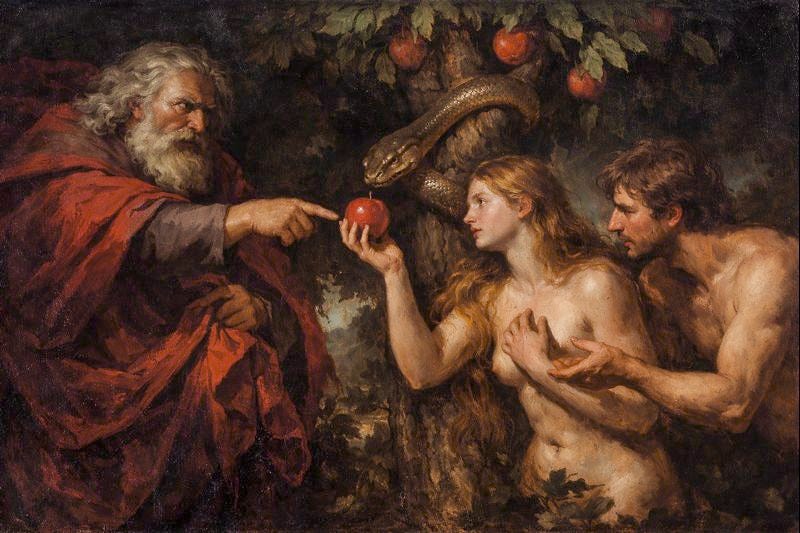
In the Western tradition, dishonesty enters the world within the first couple of weeks. God tells Adam, “You must not eat from the tree of the knowledge of good and evil, for when you eat from it you will certainly die.” The serpent tells Eve she won’t die. Eve eats. Adam eats. Nobody drops dead on the spot. Someone was lying, or at least omitting a few important footnotes, and the consequences echo outward from that moment.
Apologists ever since have had to spend a lot of time explaining how God didn’t exactly mean what he said — that he was talking about “spiritual death” or something like that. But that explanation is itself just fruit from the original dishonest tree.
Adam, Eve, and the apple isn’t simply a morality tale about an orgy of lies. It’s a layered one. God withholds context. The snake reframes the risk. Eve decides to test the claim. Adam promptly distances himself from the decision.
I’ve always seen it as a story about how lawyers were invented.
Strip away theology and myth, though, and the larger question remains: where did dishonesty actually come from?
Sociologists and evolutionary psychologists generally agree on one point, even if they argue about the details. Deception is old. Very old. It almost certainly predates writing, formal religion, and probably agriculture. What remains unsettled is how it emerged — and why it turned out to be such a reliable companion to human progress.
One theory holds that lying arrived alongside language. The moment humans learned to use sounds and symbols to stand in for reality, they also discovered those symbols could be rearranged. Once you can say, “there’s food over there,” you can also say it when there’s not. Language didn’t invent dishonesty, but it made it efficient, portable, and convenient.
Another view pushes the origin back even further, before language in any recognizable form. Animals deceive all the time. Some feign injury to protect their young. Others bluff, posture, or hide resources. In that sense, dishonesty may not have begun as speech at all, but as strategy — a tool for survival refined long before anyone was telling stories around a fire about talking snakes.
Every cat owner knows this. Cats lie constantly. “I haven’t been fed in ages,” they seem to be saying, when we know perfectly well we fed the little predators just a few minutes ago.
Then there’s warfare. Coordinated violence depends on misdirection — feints, ambushes, false retreats, inflated numbers. To fight as a group is to learn that what your opponent believes can matter more than what’s true. Once learned, that lesson tends to travel. It doesn’t stay politely on the battlefield.
All of this helps explain why dishonesty exists. It doesn’t explain why it hurts so much.
We tolerate dishonesty in the abstract. We joke about it. A television doctor once built an entire philosophy around the idea that everybody lies, and in a narrow sense, House was right. We lie constantly — to smooth social interactions, to avoid unnecessary conflict, to protect feelings, to protect ourselves. These are the white lies, the small social adjustments that allow people to coexist without screaming at one another in grocery stores.
In politics, there are lies we tolerate and lies we don’t. But humans are remarkably adaptable, and the line of what’s considered acceptable has a habit of drifting. Sometimes slowly. Sometimes very quickly. Especially over the last decade.
Still, most people know — without needing it spelled out — that there is a line somewhere.
It’s one thing to tell a friend they look fine when they don’t, or to soften a truth that would otherwise land like a brick. It’s something else to conceal a betrayal. And betrayal is not limited to sex.
In long-term relationships, dishonesty is often dressed up in nicer clothes. It can mean developing romantic feelings for someone else and saying nothing. It can mean minimizing interactions, deleting messages, not quite telling the whole story, or quietly convincing yourself that as long as nothing physical happens, everything is still basically fine. To the partner on the other side of that silence, it’s not much of a distinction. The discovery that important parts of the story were edited out can be as damaging as physical infidelity — often more so.
What breaks is not simply trust in the facts. What breaks is the shared understanding of reality. The realization that two people were living inside different versions of the same relationship is often the deepest wound.
That may be why dishonesty from strangers barely registers, while dishonesty from someone we trust can feel like a kind of internal fracture. It’s not just that we were misled. It’s that we believed we were being seen clearly — and learned we were not.
Which raises a question humans like to ask and then quietly back away from: what would a world without dishonesty actually look like?
Science fiction has taken a few runs at it. In Pluribus, the Joined share everything. Knowledge is collective. Secrets are impossible. Privacy dissolves.
At first glance, this sounds morally tidy. No deception. No betrayal. No manipulation. But it comes with a cost. Complete honesty would require stripping away all ego, desire, and unfinished thought — or at least the ability to explore those things privately. Every impulse would be exposed before it could be understood. Every doubt would be broadcast before it could be resolved.
Truth, delivered constantly and without mercy, is not especially kind.
Which brings us back to the beginning. Perhaps dishonesty didn’t arise because humans are inherently corrupt, but because they are intensely social creatures trying to survive one another. Cooperation requires tact. Intimacy requires timing. Some truths need framing, and some need silence — at least for a while. Raw honesty, delivered without judgment or care, can do damage that looks an awful lot like lying.
Dishonesty may be a flaw. Or it may be a compromise we stumbled into and never quite escaped.
The real question isn’t whether we lie. We do. The question is when dishonesty helps people navigate a complicated world — and when it becomes a weapon. And whether a world without it would be more humane, or simply uninhabitable for creatures like us.


Wow, Rob. So well written and very well thought out. I find this subject rather intensely complicated. I'm not certain whether we'll ever understand it very well. So much is bound up in the intentions of whomever is shading the truth--and nobody else can claim to really know what they are. Thank you. Good piece.