

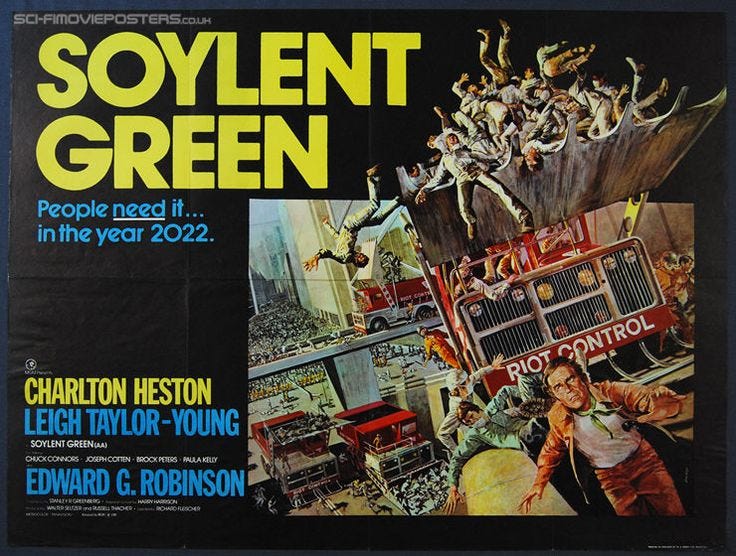
I’ve been thinking about the movie Soylent Green a lot lately.
Because I’m making my grocery list.
Actually, because it factored into my last Archer’s Line piece. And a macabre thought occurred to me: Maybe their world’s solution of turning people into crackers was the best idea for a very bad situation.
Or was it?
I first saw the movie in theaters as a child. I vaguely understood the plot, but the images stuck with me. I saw it again when I was older, with a better understanding, and the sad dystopia of it all was crushing. There’s no way out for that world.
But let’s look at the numbers, accepting the world that Soylent Green presents to us.
The food supply is running out. Or has run out. There’s nowhere near enough to feed everyone. Yet people keep having babies, which leads to the question: When does mass starvation begin to reduce the population?
Maybe the authorities shouldn’t have come up with the human crackers idea at all. Just let mass starvation take care of the population problem. A horrifying proposition.
And even if the population crashed, could the survivors rebuild? Would there be enough food, clean water, and healthy soil left? Or had humanity pushed the planet beyond repair?
Let’s bring in Dr. Math.
In the movie, New York City has 40 million people crammed into it. That’s almost five times the real population when the film’s fictional future finally showed up in 2022. We got expensive eggs and a bad mood. They got Charlton Heston, inflation like you wouldn’t believe, and more human sweat than any other movie ever made.
In 2017, archaeologist James Cole did the grim arithmetic on the human body. His estimate: about 125,000 calories, if you use everything. I'll assume the Soylent Corporation wastes nothing.
Now say 400,000 New Yorkers die in a year. That’s one percent of the city.
Grind them up, press them into crackers, and you can feed 40 million people for about fifteen hours.
Fifteen hours. A year’s worth of dearly departed, gone in less than a day.
The Soylent Corporation has a lousy business model. It does have one edge over every other company I can think of: the customers eventually become the inventory.
Kind of like Facebook.
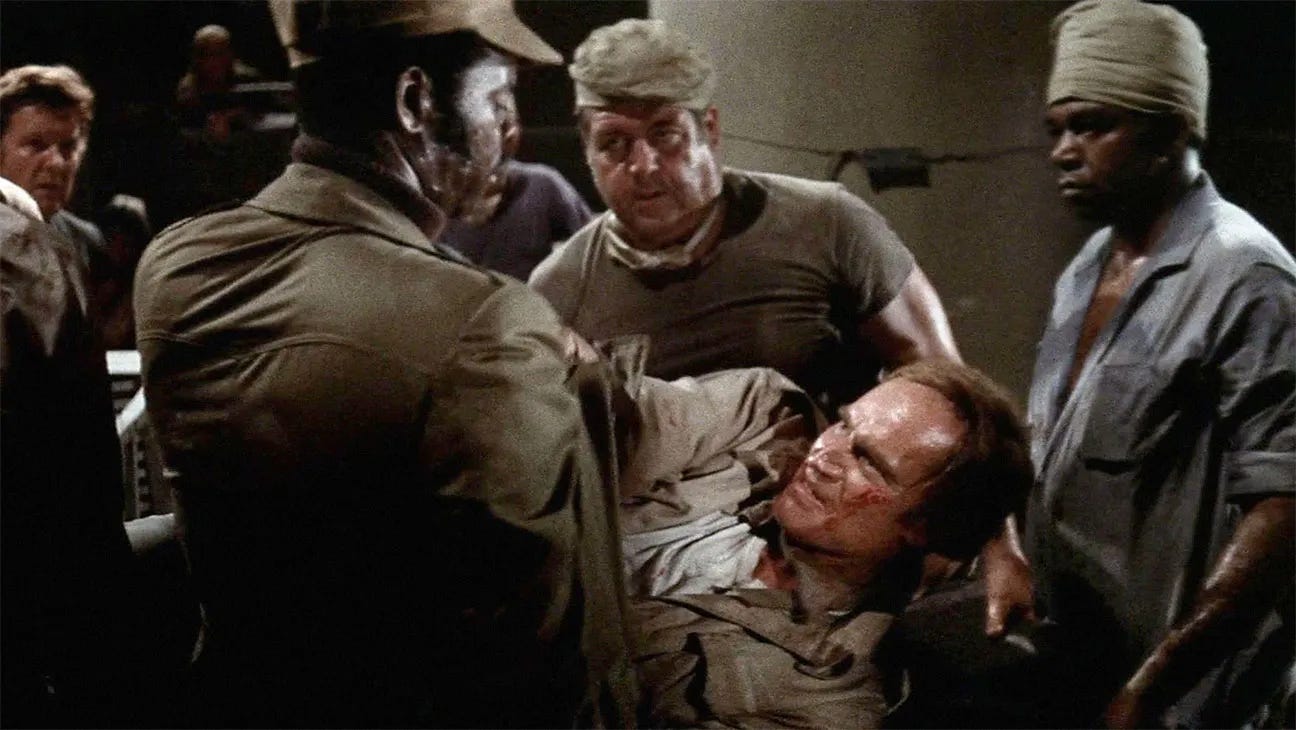
I imagine the planners in the movie worked out the same math, which is why the city runs a place called Home. The tired and the old go there to lie down, watch footage of a green world that no longer exists, and check out. A full-service suicide parlor that promises a happy ending. Edward G. Robinson’s character does exactly that, in what turned out to be his last film role. It’s the saddest scene in the picture. It’s also the supply chain.
Raise the death rate and you get more crackers. You also get fewer people to sell them to. Keep going and you run out of both.
Or maybe the people that make money from Soylent Green are trying to grab all the wealth they can out of a dying system, believing they’ll somehow survive the fall. Not that that would ever ever ever happen in real life.
So try the other road. Forget the crackers and let hunger do the work. Billions die. The survivors thin out to a number the land and sea can still feed, and the world finds its footing again.
That’s the theory. Nature balances the books. But she’s got a terrible bedside manner.
The trouble is, the food supply doesn’t stand still while the population shrinks. Farming takes water, decent soil, tractors, fuel, and people who know how seed works. A modern food system needs power plants, trucks, and a government that answers the phone. Lose enough people and you lose the people who ran all that.
And in Soylent Green, the oceans are dying. That’s the secret hiding under the famous twist. The company swore its green wafers came from plankton. There wasn’t enough plankton left.
So a billion survivors on a planet that can feed half a billion don’t get to rebuild. They keep falling, chasing a food supply that shrinks faster than they do.
Still, I’m not ready to write off the whole species.
Chernobyl is the best argument I know. Forty years ago the reactor blew and everyone ran. Now forests have swallowed the towns. The absence of people has done wonders for wildlife, despite the lingering radiation.
Radiation is less annoying than humans.
So maybe a sequel to Soylent Green ends with a few stubborn pockets of people in places where the dirt still grows something and the water won’t kill you. They plant. They build. They have kids. I’d hope somebody keeps an eye on the birth rate this time. Though, more than likely, the attrition rate would still be high. Diseases once controlled by modern medicine would kill them, and many children wouldn't survive to adulthood.
Some things don’t come back. Extinct species stay extinct. A cooked climate doesn’t cool off just because fewer people live in it. And when a society forgets how it fed billions of people, nobody hands the survivors the manual. They may not even remember how to read the manual.
That’s what still gets me about the movie, more than fifty years on. The people running things know the game is lost. Their whole plan is to keep the clock running, one batch of crackers at a time, until they run short of people, or factories, or reasons to keep the line moving. That’s dark. That’s one of the reasons the movie is a classic.
Maybe the planet heals anyway. Trees push up through Fifth Avenue. Fish find their way home. The survivors start the whole messy business of civilization from scratch.
Assuming enough of them know how to farm.
And assuming nobody asks what happened to Uncle Fred.
Happy Halloween.
You had me at :
"The Soylent Corporation has a lousy business model. It does have one edge over every other company I can think of: the customers eventually become the inventory.
Kind of like Facebook."
Brilliant!