

Global press freedom has hit its lowest point in the 25 years that Reporters Without Borders has tracked it.
Far from being a dip, it’s a trend. And there are no signs of it bouncing back.
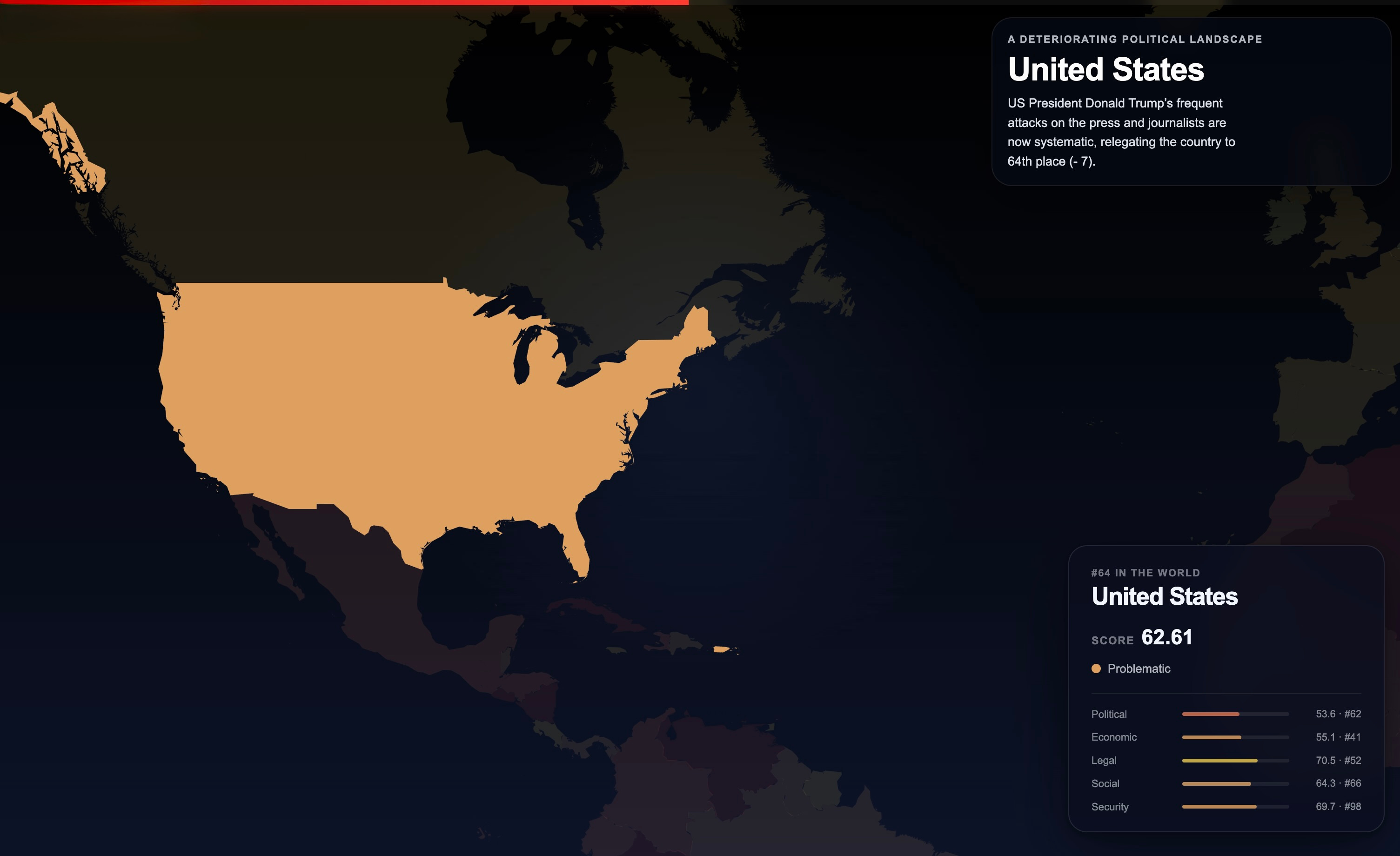
In its 2026 World Press Freedom Index, the group says more than half of all countries now fall into what it calls “difficult” or “very serious” conditions for journalists. And it’s not just the old threats — arrests, prison, violence — though those haven’t gone anywhere. What’s changing is how the pressure works. It’s more systemic, more bureaucratic, and in some ways more effective.
The report says journalism is being squeezed from every direction: hostile political rhetoric, a weakening business model, and laws increasingly used as weapons to silence or minimize coverage governments don’t like.
That last part matters. Of all the indicators in the index, the legal environment saw the steepest drop over the past year. Translation: it’s getting easier to punish journalists just for doing the job.
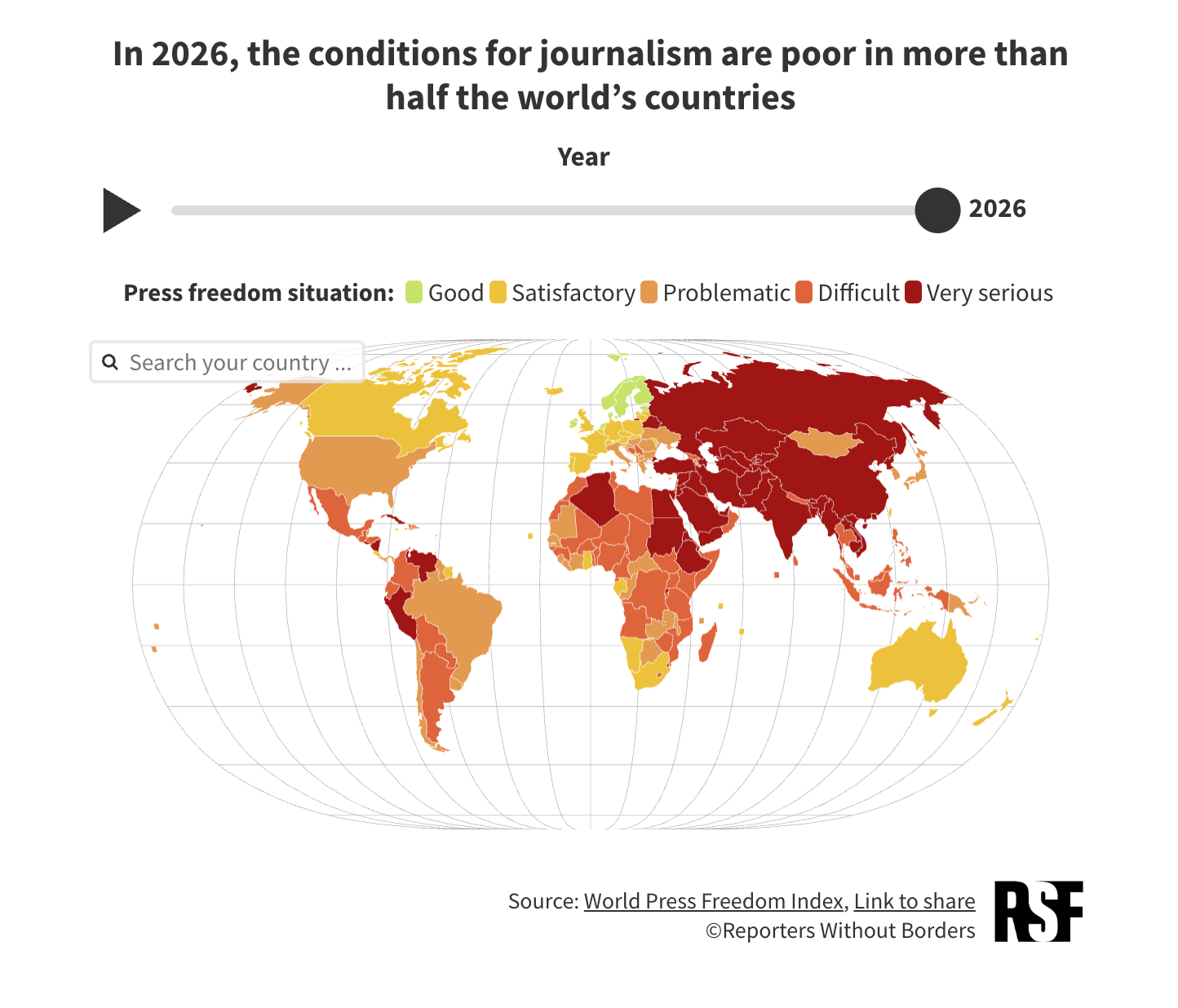
The United States ranks in the middle — 64th this year, down seven spots. Still ahead of plenty of countries, but behind a lot more than it used to be. The report points directly at President Trump’s repeated attacks on the press, describing them as something that’s hardened into policy in his second term.
And it doesn’t stay here. The report says leaders in other countries are taking notes — places like Argentina and El Salvador, where the tone toward the press is getting sharper and more openly hostile. If a country that brands itself as a beacon of press freedom starts tightening the screws, others don’t need much encouragement.
At the top, Norway is still number one for the 10th straight year. Germany, Canada, Australia, the United Kingdom — all well ahead of the U.S.
There is movement in the other direction, at least in one case. Syria — post-Assad — saw the biggest jump in the rankings, climbing 36 places. That tells you something, too: conditions can change. Just not always the way you want.
At the same time, there’s a second problem running parallel to all of this — the audience.
A new study from the Media Insight Project shows Americans aren’t abandoning the news. They’re rationing it. Managing it. Avoiding it when it gets to be too much.
Most people say they can still find reliable information. They just don’t always want to. It’s exhausting.
The numbers tell the story. 62 percent say they avoid news about Trump. 57 percent avoid national politics. And 71 percent avoid celebrity coverage — which may be the least surprising statistic in the entire report.
That fatigue has consequences. When people tune out, the vacuum doesn’t stay empty. It gets filled — usually by the loudest voices, the least accountable sources, and, increasingly, outright garbage.
Disinformation. Misinformation. State-backed propaganda — Russia still at the center of a lot of it, including efforts to quietly amplify sympathetic voices in the U.S.
And then there’s the flood of AI-generated junk. Fake images, fake moments, fake outrage — shared just as eagerly by people who should know better. Left, right, doesn’t matter. When those fakes get exposed, they don’t just disappear. They erode trust across the board. Everything starts to look suspect.
That’s the real damage.
You see another effect in how people react to actual events. After the shooting outside the White House Correspondents’ Dinner, the story barely had time to land before it started to fade. The fact that, fortunately, no one was killed or injured helped. But the bigger signal was how quickly it all felt… routine.
Mass shootings are already routine. Often, they barely make the headlines.
One last note from the study: the old political lines don’t fully apply anymore. Democrats are still more likely than Republicans to trust local news — especially on the radio. That part holds.
But when it comes to influencers, both sides are on the same page. Same level of trust. Same level of reach.
In a country built on the idea that a free press is an essential check on power, you can’t lose that foundation without losing something bigger.
And once it goes, getting it back isn’t easy.
If you care about where this is heading — and how fast it’s moving — stay with me.
Subscribe to Archer’s Line for more reporting and analysis like this.
And for deeper conversations, listen to the Disciples of Democracy podcast — hosted by me and Jack Messenger — where we break down the forces shaping politics, media, and the country in real time.
I was dumbstruck the first time I heard that people actually got 'news' from social media. I don't tend to like the news these days but the best way for me to process all of it is to look to the sources I've learned I can trust. I also check for new sources that might be reliable. I have to verify my chosen sources at various times. But when a story breaks --wherever--about whatever, I know where to find the details because I have already done the work. At least that way I only need to deal with the breaking news and not the process of trying to figure out what to read/believe/trust.
Thank you Rob, as always.