

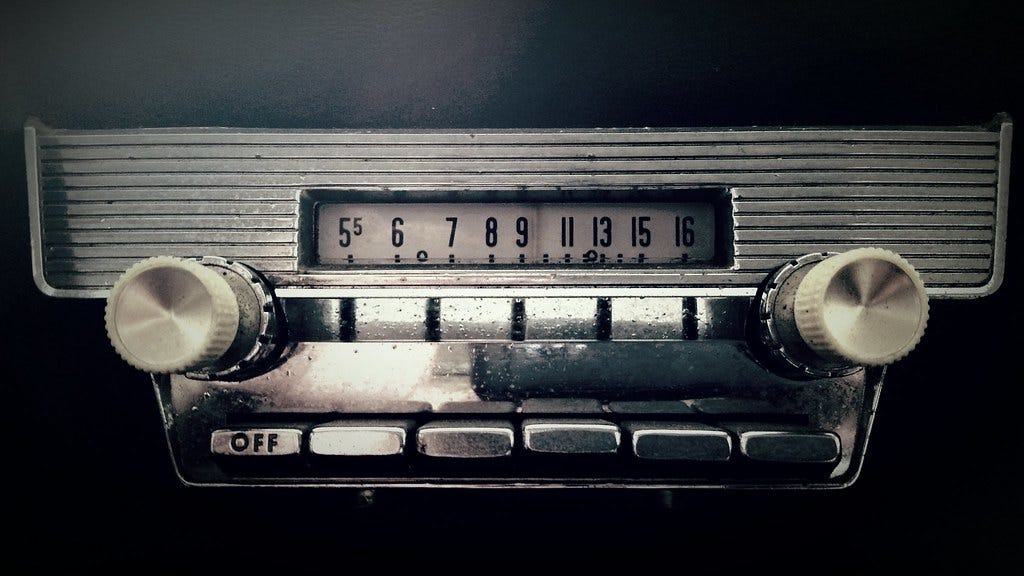
There’s a huge push right now to protect AM radio in cars. It’s a fight worth having because, in many places, an AM signal could be the last source of emergency information.
But keeping a radio receiver in the car isn’t enough if drivers can’t find it.
It’s not just AM fighting for space on the dashboard. It’s FM, too.
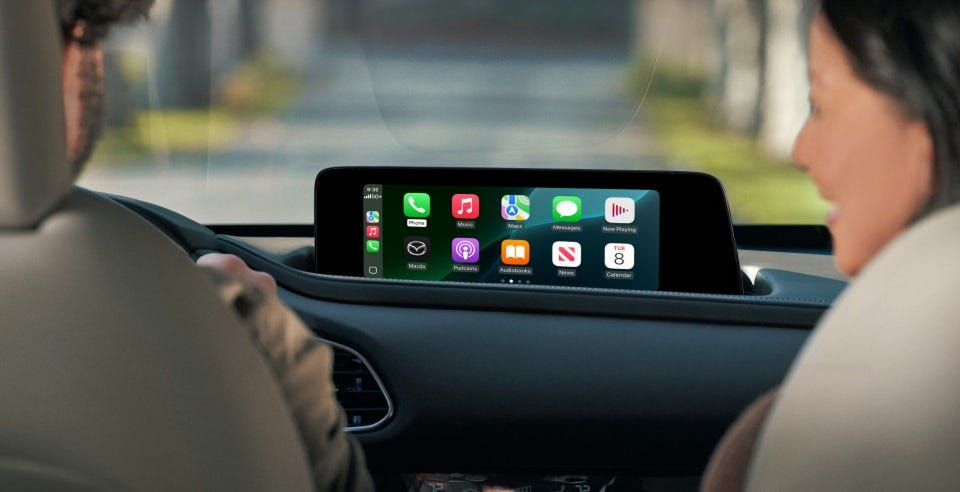
If I want to listen to the radio in my car—say, tune in to KNX to hear how they’re doing without the dulcet tones and magnificent talent of yours truly—I have to drill down on my CarPlay screen, find the relevant app, navigate to the KNX icon and select it.
It’s even worse if I want to hear the actual over-the-air broadcast. I have to exit CarPlay, navigate to Ford’s audio system, select the AM band and then find KNX.
That’s a lot of work for a lazy person. It may be impossible while driving unless you’re an old hand at using voice controls.
How many licks does it take to get to the center of a Tootsie Pop?
When broadcasters say this is one reason radio listening is declining, they have a point. There are other reasons, but I’ll save those complaints for another article.
The point is that two—and sometimes three—layers of technology now stand between me and my radio.
The fight over AM presents another hurdle.
Congress is considering the AM Radio for Every Vehicle Act. It would require new passenger vehicles to include equipment capable of receiving over-the-air AM broadcasts.
Electric vehicles make that more difficult.
AM carries sound by changing the strength—or amplitude—of the radio signal. Electrical noise can affect that amplitude, which makes AM vulnerable to interference. High-voltage electrical equipment inside an EV can create noise that produces static, buzzing or a weak signal.
That’s death for AM reception. But it isn’t an unsolvable problem.
A Congressional Research Service report found that automakers disagree about how serious the problem is. BMW and several other companies said electrical interference was one reason they removed AM from some EVs. On the other hand, Kia told Congress it wasn’t aware of AM interference problems in its electric vehicles. Ford initially moved away from AM and then changed its mind.
Possible solutions include better shielding, putting the receiver farther from the motor, and improving receiver technology.
But there’s an interesting line in the House version of the AM radio bill. It says AM must be provided in a way that is “easily accessible to drivers.”
There’s the rub.
Because you and I both know that if our cars are less than 10 years old, there ain’t much about the radio that’s “easily accessible” from the dashboard anymore.
Australia is beginning to deal with that problem. It started with television.
Connected television devices manufactured and supplied in Australia on or after January 10, 2026, must put local free-to-air television apps on the primary screen. Those apps must be visible without scrolling or clicking and displayed in a size and location comparable to other streaming apps.
They can’t be buried inside another menu.
A live television icon must also be visible on devices capable of receiving broadcast television. The manufacturer remains responsible even when another company supplies the operating system. Those rules are now in effect.
Australia has also considered a similar system for radio on smart speakers.
An Australian government paper warns that smart speakers aren’t passive receivers. They can steer listeners toward services that make more money for the platform. A voice assistant can decide which app or streaming company fulfills a request.
When my wife asks our Google device to play a podcast, it grabs the program from iHeart—not Spotify or Apple. Google’s system made the choice for her.
Australia’s proposal would require local stations to be found accurately, carried without a “prominence fee” and played without unauthorized advertising or other material being inserted into the stream. The government’s proposals paper says there is a reasonable case for regulating radio access on smart speakers.
Cars are the harder part.
Australia hasn’t adopted a dashboard rule. Its government says connected-car systems are more complicated and will take longer to figure out. During a February 2026 parliamentary hearing, an Australian official said car prominence might be considered later.
“Later” in the amorphous sense. No timetable was offered.
But let’s say we could work through those issues in the United States. What would a radio-prominence rule for American cars look like?
A clearly marked radio control would always be visible on the main audio screen.
Local AM and FM radio would be reachable with one action. One lick to get to the center of the Tootsie Pop.
The system would accurately carry out voice commands asking for a particular radio station.
Broadcasters wouldn’t have to pay for basic placement.
The system wouldn’t replace an available over-the-air signal with a data-dependent stream unless the listener chose it.
That would make radio a genuinely accessible choice again instead of burying it behind other apps like some stepchild the family is embarrassed by.
This isn’t only about ratings or protecting the radio business.
I’ve personally heard stories from people who made last-minute escapes from the Los Angeles fires in 2025. Some were getting KNX evacuation information through the station’s streaming app. But a stream could be as much as two minutes behind the live, over-the-air broadcast.
They couldn’t remember how to reach the actual radio. They hunted for it on the CarPlay screen, forgetting that the broadcast receiver wasn’t inside CarPlay in the first place.
Meanwhile, they were desperate for immediate evacuation information.
When seconds count, and the glow of the flames is in your rearview mirror, the last thing you should have to do is hunt through a dashboard menu to find the radio.
Let’s save radio in cars by cutting out the middlemen.
My car is so old I didn't entirely understand the barriers you describe. Maybe I don't need a newer one after all. Thank you Rob, always.
In 2009, I joined the NAB board and asked who was fighting for radio in the dashboard with auto manufacturers. I was told, “Don’t worry, Ibiquity is dealing with that.” My response was, “Their interests and those of the industry are not aligned at all. They are begging for chipsets, and we need to be demanding primary placement.” I was sidelined quickly because I did not conform. Ben Downs from Texas managed to make some progress and was more diplomatic than me. Subsequently, the votes were arranged to bring in Bob Profitt from Alpha after me. I like Bob, and Bob wasn’t in a position to piss anyone off. John David gave a life of service to the industry but he was poorly advised and missed the curve at the end of his career at NAB. It frustrates me to no end that much damage could have been prevented, but the path to resurrection requires blood and may be too much for the industry I love to endure.